
 German (DE)
  English (US)
  Spanish (ES)
  French (FR)
  Hindi (IN)
  Italian (IT)
  Russian (RU)
  3 weeks ago
Jenny O’Connell-Nowain was put under house arrest, and her husband, Benjamin, lost his job after they protested at board of supervisors meetings
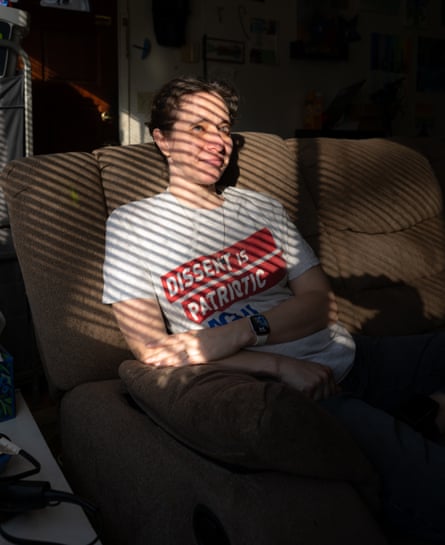
Jenny O’Connell-Nowain was ready to go to jail.
She had been prepared to spend six months in the custody of the Shasta county sheriff’s office. One of the top prosecutors in this part of far northern California had presented the evidence against her in a weeklong trial, and a jury had delivered a guilty verdict. A judge offered probation, but O’Connell-Nowain did not agree to the terms.
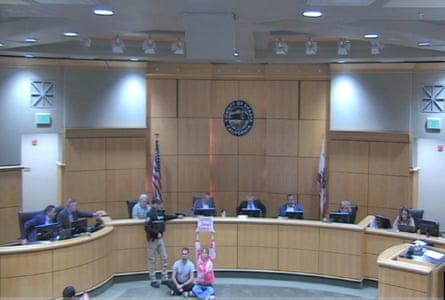
Her crime? Sitting on the floor in front of the dais of the board of supervisors with a sign, silently protesting an official who had criticized the county elections office.
The case of a former preschool teacher with no criminal history tried and convicted for a peaceful demonstration was shocking even for Shasta county, which has drawn international attention for its rowdy and radical brand of conservative politics.
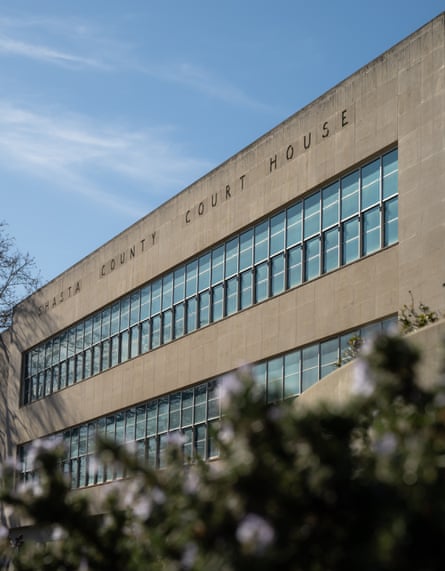
But what happened to O’Connell-Nowain is not just the story of one county’s crackdown on free speech and the forces that have sown division in the community; it is emblematic of the political turmoil that has become commonplace in this part of California and the US more broadly.
“Despite the fact that [this] is not a particularly important part of the country, it really has been the testing grounds,” O’Connell-Nowain said. “Anything that happens here, happens elsewhere. It happens on a bigger scale.”
Shasta county has for decades been one of California’s most enduring conservative strongholds, with Republicans almost wholly dominating local offices. While it long had a radical streak, like so much of the US its politics intensified during the pandemic as frustrations mounted over shutdowns.
Residents in the community of 180,000 people directed their ire locally at their county board of supervisors. People openly threatened the public health officer and elected officials. The anger here helped unite diverse swaths of the county, including militia members, anti-vaxxers, secessionists and, eventually, those who believed US elections were being manipulated. And they were eager to reshape local government.
A Connecticut magnate with a longstanding grudge against the county was sympathetic to their cause, and donated large sums into the growing anti-establishment movement, helping to fund the successful recall of a county supervisor and changing the balance of power.
While public life in the US seemed to slowly return to normal after the pandemic and Joe Biden’s election, the political upheaval in Shasta county was only just beginning. Since an ultra-conservative majority gained power, it has battled the state over Covid and second amendment policies and attempted to do away with voting machines and replace them with a system based on hand-counting paper ballots. Officials here have promoted misinformation about vaccines and elections, hired an election skeptic to serve as the county’s top voting official and appointed a local hydroponics store owner, who was also a conservative activist, to a county board overseeing mosquito control, rather than an epidemiologist and former public health director.
As the county politicized, so did O’Connell-Nowain and her husband, Benjamin Nowain. They started attending board of supervisor meetings, regularly speaking out in an effort to fight back against what they viewed as the extremism that had taken root in politics, and joined a growing movement of residents frustrated by the direction the county was taking.
O’Connell-Nowain would frequently appear in strawberry-themed clothes, a lingering habit from her days teaching preschoolers that sometimes drew derisive comments from some in the audience, and would often start her remarks with: “Good morning, beautiful supervisors.”
She made a point to speak warmly, even while frustrated, to show that even people who disagreed could be kind to one another. O’Connell-Nowain grew up in a left-leaning family in a deeply conservative community in the mountains of Shasta county.
“I had to learn to be really polite and really respectful and really kind to people who did not agree with me, or I’d be very lonely,” she said. “That’s probably how I ended up at the board giving the speeches I give.”
She usually appeared along with her husband, who was often directly critical of county leaders and documented political developments in video newscasts. They were struck by how often public meetings were rife with disruptions. On one occasion, a conservative activist shouted with a bullhorn, while another time, residents made “baa” noises, like sheep, as O’Connell-Nowain and others spoke in support of vaccines. People of all political persuasions frequently yelled from the audience in the meetings.
“People are usurping whole meetings to talk about irrelevant things,” Benjamin Nowain said. “We have actual public health crises … We have measles right now floating around in our community.”
The couple realized that the changes in the county were driven by a small group of people, and that motivated them to speak out. “This entire thing is cruxing on a handful of people willing to speak up and do things. And I was like, well, me and Jen can do that,” he said.
Nowain was so horrified by what was unfolding that in 2021 he began using his massive backlog of vacation hours to take time off from the county job he’d held for more than a decade to attend meetings. The first time he spoke, co-workers reached out to tell him he was brave, he said.
In October 2024, Nowain lost his job. The county accused him of “maliciously” spreading inappropriate rumors about a senior employee at his agency during a conversation with a colleague. Nowain said he had been seeking to file a whistleblower complaint and had been retaliated against for doing so. He began the lengthy process of fighting his firing.
It was a troubling development for the family. The couple have been married for 12 years – they tied the knot under the maple tree where they met at a local community college – and have two sons. O’Connell-Nowain is epileptic and worsening seizures forced her to quit her job teaching preschool.
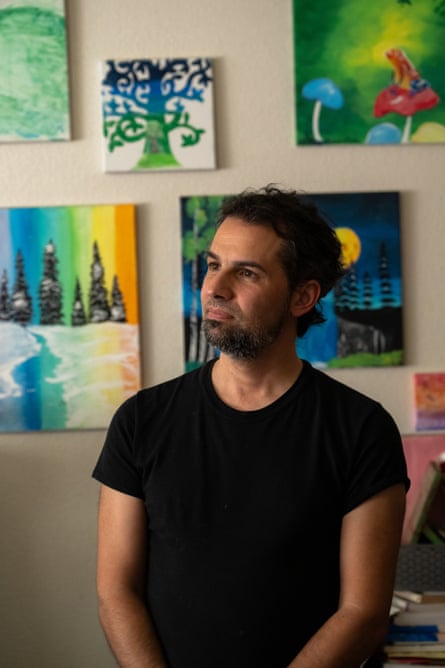
Donations from community members helped, and Nowain cashed out his entire retirement and took out loans from friends and family. A local church dropped off groceries at their house.
“It’s been incredibly rough. There were moments where I was not sure how we were going to get to the next,” Nowain said.
A month after her husband’s firing, O’Connell-Nowain staged her demonstration. Earlier that year, she had been cited and carried out of the board chambers after refusing to leave, but she was particularly frustrated that November evening.
She had grown outraged hearing a county supervisor who had recently been voted out by a large margin criticize staff and the elections office, where workers were still processing ballots from the recent election.
“I don’t think that harassing citizens or county employees is the business of the board. And that’s what was happening that day,” she said. “I walked up and I went: ‘I’m not going to listen to this any more.’”
She sat down with a sign urging the official to resign, while her husband briefly sat alongside her.
The then board chair, Kevin Crye, put a stop to the meeting and ordered the audience to leave the chambers. O’Connell-Nowain refused. Officials also ordered members of the press to exit the room.
The lights in the room were shut off and O’Connell-Nowain was handcuffed in the dark.
Over the last year, husband and wife have battled the county on two fronts. O’Connell-Nowain’s case went to trial, where her lawyer argued she was being punished for her speech.
The Shasta county district attorney’s office said in a statement that its mission “is to seek the truth through fair, honest, and ethical prosecution”. When police believe a crime has been committed, they submit it for review by the office, where an attorney determines whether that is the case, if charges can be proven beyond a reasonable doubt, and whether it would be appropriate to file charges, the office said.
“Our office evaluates each individual case based on the facts and the law,” the office said.
The jury deadlocked on a charge that O’Connell-Nowain had delayed a police officer, but convicted her of disrupting a public meeting. She was offered probation, but said she would not be able to comply with the terms that she not disrupt another meeting; if she were to violate probation, she could face a felony.
Time in jail seemed unavoidable. She embarked on a goodbye tour of sorts, speaking about her experience at community events and protests. O’Connell-Nowain thought if there were a silver lining, it would perhaps be that she could see the conditions inside the county’s troubled jail herself, and share that information.
Around the same time, Nowain got into legal trouble of his own at a county meeting. He was arrested after refusing to leave the board chambers. Nowain had spoken out of turn in response to criticism leveled at one of the board’s few moderate officials. The board chair, Chris Kelstrom, gave a warning and, when Nowain spoke again, ordered his removal. Kelstrom did not respond to a request for comment.
Nowain stayed – he believed his comments were within the confines of the law and that the chair’s order was at odds with state regulations about public meetings. His arrest cost him a job at a local TV station he had only recently started. But staying seemed important as he had come to believe it wasn’t enough to speak out while following rules he felt were designed to limit dissent.
“It is easier to get up and walk away. It’s super easy. In fact, everybody does it,” Nowain said.
“But I’m pushing them to make a decision because if their decision is to quell free speech, I want our community to know that’s what they’re doing. They wouldn’t know if I just got up and walked away.”
The board has not applied rules evenly, the couple has argued. A year before Nowain’s arrest, and just two months after his wife’s arrest, another woman staged a similar protest, sitting in front of the room for more than an hour. The county lawyer said at the time she was not impeding the meeting, Shasta Scout reported, and deputies were not called to the scene. The county lawyer did not respond to a request from the Guardian on the matter.
Meanwhile, Nowain’s employment case had gone to arbitration. The county made its case for firing him for spreading a “baseless and ugly” rumor, arguing that he had a “lengthy history of poor performance”, as well as previous pay reductions, and said it had conducted a “full and fair investigation” before terminating him from his role with the health and human services agency (HHSA).
But the former director of the HHSA, who is no longer employed by the county, testified that Kevin Crye, the elected official, and the county’s chief executive, David Rickert, had pressured her to fire Nowain. She filed a claim against Crye after leaving her role with the county, the arbitrator noted.
The arbitrator did not agree with Nowain’s assertion that his conversation with a co-worker was a “protected whistleblower activity”, but ruled in his favor, finding that he had been wrongfully fired. He ordered the county to restore his employment, with a one-week suspension, and make him “whole for his [losses]”.
“It is true that Mr Nowain is not a perfect employee and was on a [performance improvement plan] at the time of this incident … His record does not indicate the kind of poor performance where one additional disciplinary infraction should result in termination,” the arbitrator wrote, adding that Nowain’s performance had improved prior to the incident that led to his firing.
Rickert told the Guardian that he was “prohibited by California law from releasing information from the employee file” and that he “respectfully [declined]” to comment. Crye said he was not able to discuss the matter unless Nowain’s personnel file was made public.
The couple says their battle against county leadership has taken on new importance amid what’s happening elsewhere in the country, including the violence the US government has inflicted on people protesting against ICE and the killing of two American citizens by federal officers in Minneapolis. O’Connell-Nowain touched on that point at a demonstration organized in response to Alex Pretti’s killing the night before she was set to go to jail.
“There’s consequences to standing up but – if you don’t see from what’s happening nationally – you kind of have to,” she said. “Because every time you let them take ground, they don’t give it back.”
In late January, Nowain drove his wife to court and said goodbye. She was carrying $200 cash – a bailiff who took a liking to her had advised her to bring in money for the commissary. He planned to make a schedule of the friends and community members who wanted to visit. Nowain felt proud of his wife and what she was willing to do to stand up for her beliefs. He always admired her sense of self, and ability to get along with anyone.
“You can’t tell her how to act, behave or think about a subject. And it’s the thing I love the most about her,” he said. After he dropped her off, he headed home to watch a movie with their son and make a video about the development.
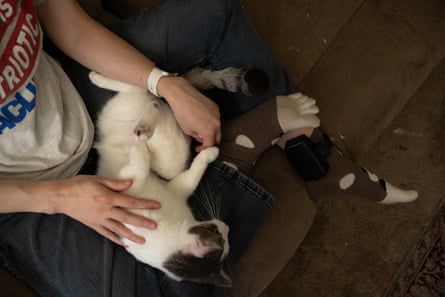
O’Connell-Nowain never saw the inside of a jail cell. She spent a few hours in custody, where officers had to bring her child-size handcuffs after full-size restraints kept slipping off her wrists. O’Connell-Nowain’s booking was disrupted and police transported her to an alternative custody program, where she was informed she was being released for good behavior and would be on house arrest for 45 days, minus two days for time served.
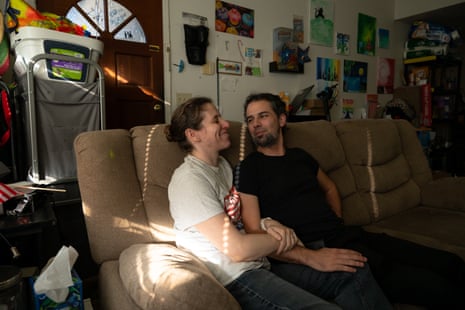
Nowain suspects his wife’s health issues – she has both epilepsy and asthma – and her desire to report from the detention center might have been behind the sudden change.
Instead of investigating the jail, O’Connell-Nowain’s time has been spent at home, writing about what she’s experienced and, of course, sending emails to the county board of supervisors. She plans to appeal her conviction.
Meanwhile, Nowain is still negotiating his back pay with the county before he can return to employment, and working for a local congressional campaign.
The couple wants to see the board return to the practices of the past, handling county budgets without applying ideology, and respecting employees. They say they frequently field calls from county workers who feel they were fired unfairly – even more so since Nowain won his arbitration.
But they hope too that their ordeal might be of use far beyond the small community where they live. Shasta county is a bellwether, Nowain argued, and if residents here can push back against extremist politics, perhaps that can provide a blueprint for the rest of the country.
“Any way that we fight it here, any way that we’re successful here, is a way to successfully fight the erosion of our rights,” O’Connell-Nowain said.






















Comments