
 German (DE)
  English (US)
  Spanish (ES)
  French (FR)
  Hindi (IN)
  Italian (IT)
  Russian (RU)
  3 weeks ago
Theodore Roosevelt, the 26th president, characterized his approach to international relations as “speak softly and carry a big stick”. It was an approach that won him a Nobel peace prize in 1906, for his role in ending the Russo-Japanese war.
In recent days, Donald Trump’s own take on diplomacy has come into focus, one that might be characterized thusly: speak hysterically and threaten to use (and sometimes actually use) a big stick. This idiosyncratic approach to statecraft has yet to win Trump a Nobel peace prize, although that is something that the president has said – many, many times – does not bother him at all.
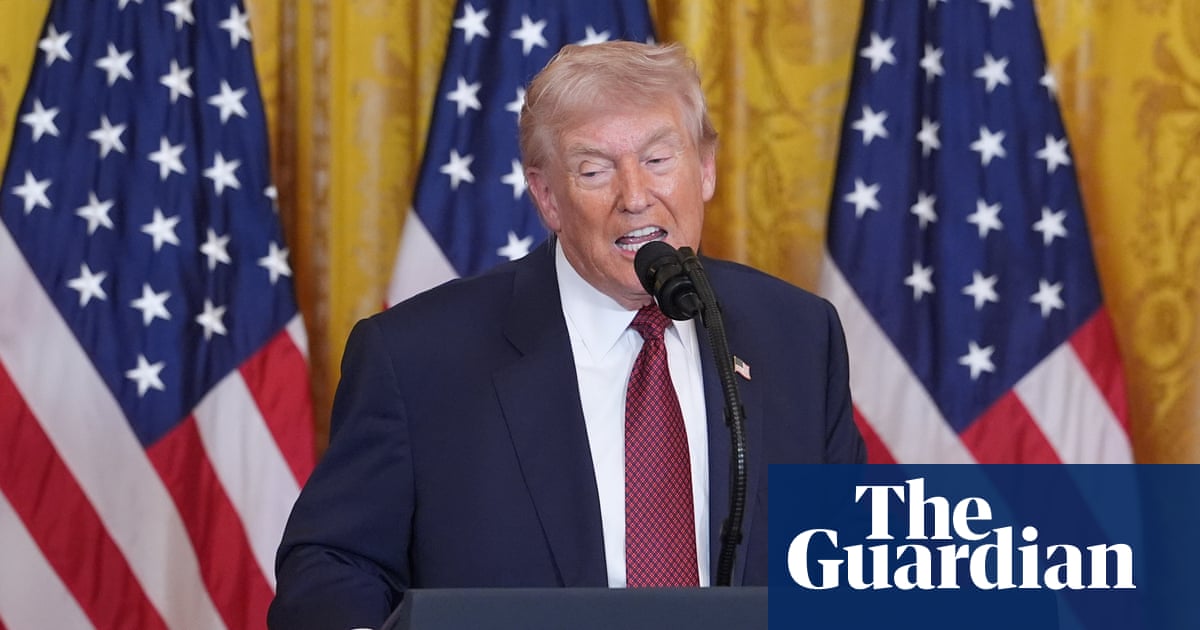
Yes, instead of winning him awards (made-up soccer prizes notwithstanding), Trump’s statecraft is rattling key US allies, through his increasingly pugnacious effort to conquer Greenland. It’s a topic that dominated the buildup to his speech at the World Economic Forum, in Davos on Wednesday, as Trump launched a specious argument as to why the US should be able to have Greenland, which is part of the Danish kingdom.
Trump claimed that the US is owed Greenland because it helped to defend the Arctic territory during the second world war, and then, in his words, “gave it back” to Denmark. As my colleague Shrai Popat reported, this is not true, but facts have rarely bothered Trump.
The president, who at points during his speech referred to Greenland as Iceland, also argued that the US should get Greenland because the US has contributed to Nato and, in Trump’s telling, “gotten absolutely nothing in return”.
Trump added: “It’s a very small ask compared to what we have given them for many, many decades. But the problem with Nato is that we’ll be there for them 100% but I’m not sure that they’d be there for us. If we gave them the call, ‘Gentlemen, we are being attacked. We’re under attack by such and such a nation,’ I know them all very well. I’m not sure that they’d be there.”
Trump’s speech suggested that the US president knows little about US-Nato history: Nato’s Article 5, which triggers an obligation for each member state to come to the assistance of another, has been triggered just once: in 2001, after 9/11, when Nato countries came to the US’s aid. It was an outrageous claim for a US president to make, one which summarily dismissed the hundreds of thousands of European military members who served after the terrorist attacks on the US.
Yet there was some relief to come from the speech, with Trump saying “I won’t use force” in his bid to seize Greenland, contradicting previous White House statements.
There had been legitimate cause for concern, given Trump’s emotional approach to foreign policy. Trump repeatedly and loudly threatened Nicolás Maduro, then the Venezuelan president, including warning him that he shouldn’t “fuck around”, before then invading the country and capturing Maduro: surely the opposite of speaking softly and carrying a big stick. He followed a similar playbook before attacking Iran, potentially in violation of international law.
On Greenland, the unhinged threat of Trump’s diplomacy has continued, with the president saying before Davos that there is “no going back” on seizing the island. He shared comments claiming the UN and Nato are a bigger threat to the US than China or Russia.
But the big stick hasn’t been used in Europe yet. Instead, Trump has threatened to punish the EU economically, with the alcohol industry finding itself helplessly dragged into the feud when Trump threatened to place a 200% tariff on wine and champagne – Trump doesn’t drink alcohol himself, but he lives at his nouveau riche private members-only club where people seem to be necking the stuff.
In return, the EU has said it would retaliate by placing tariffs on American whiskey, much of which is made in Republican states, which could upset Europeans forced to pay more for their bourbon. The EU previously tariffed American beer, but given much of it is not good, people in Europe were probably less bothered.
In his first term, much of Trump’s bluster came to nothing. But in his second act it has become impossible to ignore such a hot-blooded president, given he has proved to have a taste for foreign interference. Just how far Trump will go in harassing America’s main allies remains to be seen.











Comments