
 German (DE)
  English (US)
  Spanish (ES)
  French (FR)
  Hindi (IN)
  Italian (IT)
  Russian (RU)
  2 weeks ago
Over breakfast in one of the swankiest hotels in Caracas, you can hear them mulling Venezuela’s past, present and future in sporadically hushed tones. As diners tuck in to plates of fried eggs, black beans and arepas, snatched fragments of conversation speak of election roadmaps, political fragmentation and oil-fuelled economic growth.
But the murmured discussions are not being conducted in Caribbean Spanish by Venezuelan officials pondering their country’s direction after the abduction of President Nicolás Maduro. The accents are North American and belong to the US officials, diplomats and spies now calling many of the shots here after Donald Trump’s controversial military intervention on 3 January. Neighbouring tables are occupied by huddles of musclebound US marines, tattoos covering their bulging calves, baseball caps covering their heads, and walkie-talkies strapped to their hips.
“How long will you be staying, sir?” a receptionist asks one of countless US government guests as they check in downstairs in the lobby.
“Oh, 26 or 27 days,” the man replies in thickly accented Spanish.
Since Trump’s decision to snatch Maduro in January and reboot relations with his successors, the five-star hotel has become the nerve centre of Washington’s efforts to steer a country some now call a US protectorate – and which Trump has even said he hopes to turn into the 51st state.
“It’s [effectively] the US embassy. I don’t think anybody’s going to work at the actual embassy,” said Phil Gunson, a Caracas-based political analyst for Crisis Group.
Having been closed for seven years since the collapse of diplomatic relations in 2019, “the embassy building is full of rats and cockroaches, and it’s being fumigated,” Gunson explained.
The conversations that can be overheard in the JW Marriott’s restaurant offer a fascinating insight into Venezuela’s plight as it emerges from nearly 13 years of economic mayhem and authoritarian rule under Maduro.
One sunny afternoon a North American energy specialist sat on the veranda, holding a conference call with colleagues back home about the dire state of Venezuela’s electrical grid – the cause of frequent blackouts, even here in the capital.
“The distribution is a mess – that’s the biggest issue right now … the wiring, the transformers – and the software is a mess,” he said, before grumbling: “The Chinese came in and did their little Chinese thing, which did not work.”
Another morning, diplomats debated the likelihood of fresh elections, which opposition leaders hope will soon be called but which Maduro’s heir and former vice-president, the interim president, Delcy Rodríguez, seems in no rush to hold.
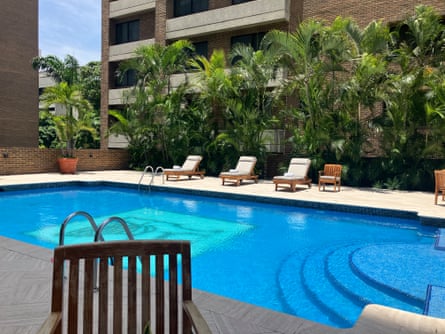
Throughout the day, English-speaking officials and fortune hunters can be seen roaming the 17-floor redbrick building, which has nearly 300 rooms, a gym and a palm-flanked pool. Bullet-proof SUVs wait outside to ferry guests, who include Trump’s top diplomat to Venezuela, John Barrett, around town. Two buildings down the street, not far from the stock exchange, a large propaganda poster of a smiling Maduro still hangs from a government office.
In the hotel’s restaurant, corridors and meeting rooms, patrons and visitors plot what some locals call “the corporate takeover” of Venezuela to the sound of Brazilian bossa nova. One particular favourite on the hotel playlist is Tom Jobim’s Triste, the Portuguese lyrics of which offer a poetic word of caution to any gringos hoping to decide the South American country’s future. “It’s sad to know that nobody can live off fantasies, that will never come to pass, that will never happen. The dreamer must wake up,” the song warns.
Across the street sits the Juan Sebastian Bar, a jazz and salsa nightclub named after Johann Sebastian Bach, where foreign visitors can let off steam.
If the $250-300-a-night JW Marriott – or “the spooks hotel” as some journalists call it – is the HQ of the US presence in Venezuela, it is at another luxury hotel a few miles away where many of the big-money deals are being done.
Since Maduro’s downfall, foreign tycoons have been flocking to the Cayena, where rooms cost about $600 a night, wagering that even if Rodríguez stays in power and there is no transition to democracy, Venezuela’s economic future looks bright.
One deal-maker who has spent time there recalled encountering at least four foreign billionaires they could identify – but believed there were others whose names they did not know. “They never give you a card. They don’t give you their last names … and what is very interesting to me is that they are all asking about the same things: mining and privatizations,” they said.
The Trumpian takeover has generated widespread discomfort, even among patriotic members of Venezuela’s elites who were glad to see the back of Maduro but privately bristle at the suggestion that their country is being turned into a US colony. After giving Rodríguez his blessing in January, Trump warned she would face an even worse fate than Maduro if she failed to toe the US line.
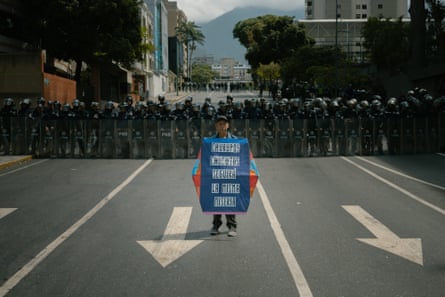
On the streets there is anger too. During a Workers’ Day rally on 1 May, a socialist economist called Oswaldo Pacheco marched towards a line of riot police wielding a white banner denouncing the government’s “neocolonial collaboration” with Trump. “It’s a complete capitulation,” complained Pacheco, 53, accusing Venezuela’s new rulers of following US orders “to the letter”. “Clearly these [US] demands are not about bringing us democracy but about plundering our resources and increasing worker exploitation,” he said.
Among Caracas-bound capitalists the mood is buoyant, even if huge doubts remain over Venezuela’s future and, above all, its democracy.
At a third luxury hotel, the Renaissance, a Venezuelan oil man waxed lyrical about his country’s post-Maduro prospects. “This is going to be the best country in the world,” he predicted, declaring: “I’m more than optimistic.”









Comments