
 German (DE)
  English (US)
  Spanish (ES)
  French (FR)
  Hindi (IN)
  Italian (IT)
  Russian (RU)
  3 weeks ago
With housing costs for working-class families steadily climbing across the US while billionaire fortunes soar to all-time highs, renters’ rights are becoming a defining policy in the upcoming midterm elections, tenant rights organizers say.
In Massachusetts – where Boston consistently lands in the top five US cities for priciest rents – a proposed ballot question this November could overturn the state’s three-decade ban on rent control and cap annual increases at 5%, thanks to a coalition of three dozen housing, faith and labor groups.
The coalition, Homes for All Massachusetts, joined forces last year, recruited an army of volunteers, and within two months, gathered more than 124,000 signatures for the measure – far exceeding the minimum support required to place the issue before voters.
“We’re proud to be part of the national movement for rent control and tenant protections,” said Carolyn Chou, the executive director of Homes for All Massachusetts. “Those kinds of wins symbolize what resonates with everyday people across the country.”
Tenants’ rights organizers say renters’ policies previously considered too extreme have become the centerpiece of insurgent political campaigns in the midterm elections. “Renter” has even become an identity for candidates to run on. Taking a cue from renter politicians in major cities – like New York City’s mayor, Zohran Mamdani, who turned “freeze the rent” into a rallying cry, and Seattle mayor Katie Wilson, who championed social housing – renter candidates across the country are running for city council, mayor and Congress this year.
“Working-class families are at an inflection point,” said Chris Otten, a tenant organizer in Washington DC. “There’s a lot of momentum for these types of policies that can materially benefit people’s lives.”
Putting housing affordability on the ballot
Nearly half of American renters spend roughly a third of their income on rent, according to a 2024 report from Harvard University. The growing support for rent control initiatives and renter politicians indicates that housing is becoming a “more acute problem” for a broader segment of the electorate, particularly middle-class voters, said Michael Lens, a professor of urban planning and public policy at UCLA. In recent years, cities like New York, San Francisco and Portland have enacted laws to protect tenants from high rent increases.
“More cities are starting to look like LA and New York, and that’s motivating people to vote on the issue of housing affordability than ever before,” he said.
In Providence, the median rent has soared by 40% since 2020, earning the Rhode Island capital the unfortunate distinction as the least affordable city in America for renters. Last fall, a coalition of tenant advocacy groups launched a campaign with a two-pronged plan: push city councilors to consider a rent stabilization proposal and mobilize the community to support it. The coalition rallied hundreds of renters, homeowners and even some landlords to testify at public hearings, where they “spoke from the heart” about how the policy could alleviate their financial hardships, said Siraj Sindhu, executive director of Reclaim RI, one of the groups leading the rent stabilization charge.
“That made a huge impact, demonstrating to everybody that there’s massive support for rent stabilization,” Sindhu said.
In early April, after half a year of sustained grassroots organizing, the Providence city council approved an ordinance to limit annual rent increases to 4% in most apartment buildings. However, it was immediately vetoed by Mayor Brett Smiley, who argued that rent stabilization would depress housing construction and property values.
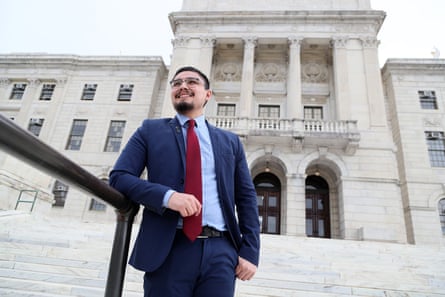
Despite the expected setback, Sindhu said Reclaim RI will continue to mobilize residents to put pressure on council members to override the veto. Meanwhile, the organization has endorsed David Morales, a lifelong renter and state assembly member, in his challenge against Smiley in the September mayoral primary.
“We see tenant organizing as an indispensable pathway to correcting the really pronounced and egregious power imbalance between renters and landlords in a deregulated marketplace,” Sindhu said.
Morales, who has made rent control a focal point of his campaign, said he would sign off on a rent stabilization ordinance without hesitation. As a child, he said he often couch-surfed with his mother because they could not afford rent – a struggle shared by many Providence families.
“The disturbing trend of constituents and long-time neighbors being priced out, not being able to call Providence home, is what motivated me to run for office,” Morales said.
Increasing renters’ representation in local government
Last October, the progressive political organization Run for Something launched a campaign aimed at increasing renters’ representation in local government. Of the 275 candidates the group endorsed for the midterms, more than one-third are renters, said co-founder and president Amanda Litman; comparatively, renters currently comprise just 2% to 7% of elected officials nationwide.
The over-representation of homeowners in office, organizers say, has fueled housing policies that enrich developers and corporate landlords at the expense of renters. “Generally speaking, we do not see housing policies directed through the lens of helping renters,” Litman said. “Buying a home for a young person just feels like a fantasy.”
Many DC tenant rights organizers have put their weight behind ward 1 council candidate Aparna Raj, a renter and tenant organizer backed by Democratic Socialists of America. Raj, who’s representing a constituency that’s two-thirds renters, wants to expand the district’s rent control law, which currently applies only to apartments built more than a half-century ago. She said she never considered running for office until she saw the “total dissonance” between the crises renters were experiencing – many having to forgo groceries or medication to make rent – and an unsympathetic, homeowner-led DC council that continued to prioritize the interest of corporate developers and landlords.

“I felt like we really needed someone on council who knows what renters are going through and what working people are going through and is willing to fight for that,” Raj said.
A ballot campaign in Washington DC, drafted by the tenant organizing group More Affordable DC, goes beyond simply capping rent: the measure would implement a two-year rent freeze, reset how public land is developed and limit affordable housing to renters making less than $60,000 a year, or 60% of the area median income.
Otten, an organizer with the group, said the district is “a tale of two cities becoming real”. As rents skyrocketed, the city’s Black population plummeted from 59% to 41% between 2000 and 2020, according to the US census.
“We’re up against the wall at this point,” Otten said. “Do we really want to take our public land and dedicate it to people making $80,000 a year?”
The group has already recruited more than 200 volunteers who will soon erect signs on lawns, streets and windows all over the district. While organizers won’t have enough time to collect the required 40,000 signatures to qualify for the 2026 ballot, Otten said they’re working to place a measure before voters in next year’s special election.
Just as DC organizers looked to New York and Massachusetts when drafting their ballot measure, Otten said he hopes the fight in the Capitol can serve as a blueprint for other cities planning to take up rent control.
“If it can happen in the nation’s capital,” he said, “it can happen everywhere.”









Comments