
 German (DE)
  English (US)
  Spanish (ES)
  French (FR)
  Hindi (IN)
  Italian (IT)
  Russian (RU)
  3 weeks ago
Hello and Happy New Year. We have started 2026 with a geopolitical shock as the Trump administration ousted Venezuelan president Nicolás Maduro and imprisoned him on US soil. As many western governments struggle to respond to this violation of international law, for Caribbean countries, this is not an awkward diplomatic spot but a real moment of political fear, uncertainty, and regional fracture.
One remarkable aspect of the Venezuela raid is how Trinidad and Tobago’s prime minister, Kamla Persad-Bissessar, has openly aligned with Donald Trump. Dr Jacqueline Laguardia Martinez, a senior lecturer at the Institute of International Relations at The University of the West Indies, told me that Trinidad and Tobago – one of the founding members of the Caribbean Community (Caricom), a regional grouping of 15 member countries – has “openly endorsed US actions under the pretext of combating transnational crime”. One way that has happened is through military cooperation. On 28 November, a radar appeared in a coastal neighbourhood of Tobago, described by the New York Times as “a state-of-the-art mobile long-range sensor known as G/ATOR, or Ground/Air Task-Oriented Radar, that is owned by the US Marines and is worth tens of millions of dollars.” Along with the sophisticated equipment, US military jets and troops arrived on the island, which is only 7 miles from Venezuela.
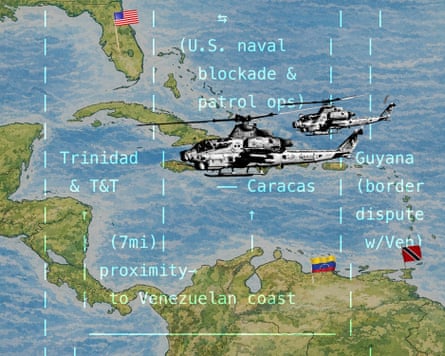
Since September, the US has launched at least 21 airstrikes on alleged drug smugglers in the Caribbean Sea and the Pacific Ocean, killing more than 80 people – reportedly including several Trinidadian citizens.Persad-Bissessar has long expressed support for strikes on Venezuelan vessels and for US military buildup in the Caribbean. In mid-November, Venezuela accused her of helping the US seize an oil tanker. Then, in December, Trinidad and Tobago allowed the US to transit its military aircraft through its airports. The claim on the part of Trinidad and Tobago’s foreign ministry was that such transits were for “logistics” purposes. Persad-Bissessar has long held she has “no sympathy for traffickers” at a time when the twin-island Caribbean country, which has a population of about 1.5 million, has been struggling with rising homicides and gang violence. Last year it recorded 624 homicides, making it one of the most violent countries in Latin America and the Caribbean. But the escalation in military cooperation can be seen, in light of recent events, as laying the groundwork for last week’s operation in Venezuela.
A divergent closeness with the United States
Trinidad’s attitude constitutes the adoption of “a divergent adversarial stance”, Laguardia Martinez said. “Caricom has historically distinguished itself through a relatively cohesive foreign policy voice in international forums anchored in the core principles of the post-second world war multilateral order, and the defence of Latin America and the Caribbean as a ‘Zone of Peace.’”
Trinidad is now an outlier. “One could say that their facilities have not been used to stage an attack,” said Peter Wickham, director of Caribbean Development Research Services, “but nonetheless there is cooperation at least in the provision of intelligence.” This is a choice, he told me. Grenada and Antigua were asked to install the radar, he says, and they refused.
“She and Trump have something in common, in that they both want resources from Venezuela. Trump wants oil, she wants gas. She has determined that the best way to get it is not to negotiate with the Maduro administration but to negotiate with Trump in the hope that Trump will give her Venezuela’s gas.” Trinidad and Tobago’s previous strategy involved long discussions with Venezuela, with the US’ permission, to develop Venezuela’s Dragon Field near Tobago waters, which holds roughly 4.2tn cubic feet of gas.
I ask Wickham about the wisdom of taking such a high-stakes position and betting on an unpredictable Trump. “I don’t think she is thinking about any of that,” he says. She speaks “loosely”, in a contradictory fashion, and “off the cuff”. “She has called Caricom an unreliable partner, this is her second largest trading partner. Frankly, I don’t think anybody in Trinidad and Tobago is convinced that this thing is going to work out long-term.” Trinidad and Tobago is “taking positions in respect of a matter that could very well end up in front of the ICC. There are clear extra-judicial actions. The US is not a part of the ICC, Trinidad and Tobago is.”
Strong associations with Venezuela that Trump could weaponise
Venezuela has several interests in the Caribbean, and several countries in the region are exposed to Venezuela through petro-trade. Petrocaribe, an oil procurement programme, was established in 2005 by former Venezuelan president Hugo Chávez, with the goal of achieving development in the region through favourable financial agreements. That was then extended through Alba, the Bolivarian Alliance for the Peoples of Our America, which had wider economic development aims and south-south cooperation. The West Indies oil company in Antigua is partly owned by Venezuela.
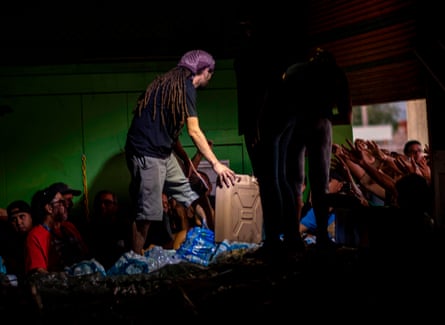
Beyond that, Venezuela has played a significant aid role in the Caribbean. During Hurricane Maria, which ravaged Dominica and Barbuda, it was Venezuela under Maduro that established the communications network after it was destroyed. “It was essentially the Venezuelan coastguard that was the first port of call,” Wickham said. There could be a claim on the part of Trump that all of this could be cast as “narco-related”. “There are several Caribbean leaders that were close to Maduro, and legitimately so, he was until a few days ago the head of state, and a head of state that was involved in initiatives that helped people in the Caribbean get oil at reduced prices, extended credit. Venezuela helped build the airport in Saint Vincent.”
Caribbean-wide wariness and an uncertain future
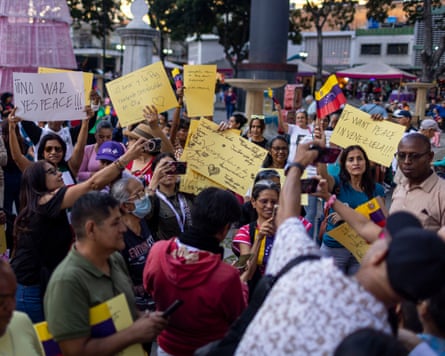
Caricom as a whole, Wickham said, is “taking the path of least resistance” by not releasing a joint statement condemning the US’s actions on their turf. “It’s unfortunate there hasn’t been a more strident condemnation, but I am entirely unsurprised.”
On the ground, he “gets a clear sense that people understand the bind that leaders are in and the fact that they are hesitant. When you see Keir Starmer and President Macron not condemning this action, if they are not willing, how can Mia Mottley or others? If London or Paris cannot speak frankly, how is Bridgetown or Kingston supposed to be able to speak out? These are small countries with tiny populations.”
There is also the matter of what the Trump administration has signalled. The US indictment of Maduro refers ominously and threateningly to other leaders that have facilitated and supported him. This essentially says “we’ll be coming for you next”, Wickham said. “There is this fear of speaking out and the consequences.” I asked Wickham how being in such close proximity to this powerful country to the north, with a history of intervention both in Latin America and the Caribbean, shapes politics and attitudes in the region. “This changes everything,” Wickham said. “We have elections coming up in three of the islands this year, where heads of state are possibly asking themselves, ‘Do I want to call an election when I can be on a US hitlist?’ People are concerned. You don’t know what tomorrow will hold and wonder, what’s next?”










Comments