
 German (DE)
  English (US)
  Spanish (ES)
  French (FR)
  Hindi (IN)
  Italian (IT)
  Russian (RU)
  3 weeks ago
When the White House fired Julia Curlee from her senior intelligence position in March 2025, her boss had an odd request: please still show up to work on Monday, but be “discreet”.
The longtime CIA analyst had served in Donald Trump’s first term, briefing Vice-President Mike Pence; worked for Joe Biden as a national security director; and stayed on for Trump’s return. She had known her days might be numbered as the incoming White House was ousting national security staffers en masse. Curlee is also transgender, which made her particularly vulnerable as the new administration made anti-trans policies a top priority. But she didn’t understand her boss’s message until she opened her phone and saw the X post:
“SCOOP: A transgender, Biden holdover who hates President Trump is still working in the [National Security Council] intel office,” wrote Laura Loomer, the far-right social media influencer known to have Trump’s ear. “If you are aware of this person and have their name, please send it to me and I will post their identity.”
Curlee was serving as a director for intelligence programs, leading Situation Room sessions, and her identity as a trans woman was well known. But now that she had been targeted online, the White House decided to remove her, though not before she returned to work and – quietly – finished vital tasks.
“It was absolutely not a problem for this administration to rely on and ask a trans woman who they knew was trans to continue serving them in a capacity of great sensitivity at the highest levels, including briefing this president, as long as it was secret,” she said in a recent interview.
Curlee came forward in an Atlantic essay last month and is now sounding the alarm about the national security consequences of Trump’s extraordinary purging of intelligence experts. In a wide-ranging conversation with the Guardian, Curlee recounted the turmoil inside Trump’s White House, arguing the administration’s obsession with diversity, equity and inclusion (DEI) and “the enemy within” had made the US government staggeringly incompetent – contributing to the debacle in Iran and causing damage that may take decades to repair.
“Sometimes you have to scream, ‘this is not normal. This is not acceptable,’” she said.
‘Everyone’s fired except you’
After serving in Iraq with the Defense Intelligence Agency, Curlee became a Central Intelligence Agency officer in 2007, fulfilling a childhood dream, as she recounted in her essay. She went on to complete multiple tours in the Middle East and South Asia, and in 2013 she fulfilled another longtime dream – coming out as trans.
Her transition caused little fanfare within the CIA, she wrote. In 2017, she penned an anonymous piece about being a trans intelligence officer, encouraging other trans people to apply. She soon after joined the first Trump administration, even as the president moved to ban trans people from the military. She briefed Trump on Air Force One and became Pence’s daily briefer, recalling a close, respectful working relationship with a man who had long opposed LGBTQ+ rights.
Curlee was serving as a director for intelligence programs on Biden’s National Security Council (NSC) when Trump was re-elected in 2024. Trump had aggressively mocked and demonized trans people during the campaign, and her superiors had advised her to step down, knowing how she could be personally targeted, she recalled.
But she stayed.
Maintaining a senior intelligence role as Trump took office, Curlee and other remaining NSC staff helped onboard people and bring officials up to speed on highly secretive programs: “It was our charge to make sure the new government has everything they need to take the reins.” She led Situation Room sessions, reminding incoming officials they should not bring cellphones into secure facilities where national secrets were discussed and that Signal was not an appropriate platform for sensitive discussions.
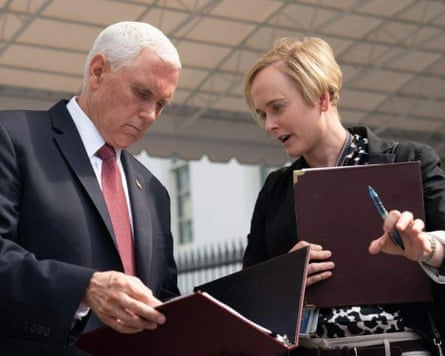
At the same time, she began leaving the White House to use a bathroom across the street, since she was banned from entering women’s restrooms under Trump’s day-one order.
On day three, chaos erupted. Curlee recalls leaving a briefing with a deputy national security adviser when her assistant intercepted her, telling her: “Everyone’s been fired except for you and me.”
The administration had sidelined 160 NSC staffers, telling them not to return to the White House. The staffers were career public servants who were considered non-partisan policy experts, on loan to the White House from the CIA, state department and other agencies.
“It was a dumpster fire – I think that’s the technical term,” she recalled, saying the administration had not considered extremely basic questions of how it would absorb the losses. People needing computer logins or access to secure rooms had no technical staff to help. Officials gave her assignments she struggled to fulfill without staff, she said. There was no process to determine which officials even had clearance to receive the presidential daily brief, the most senior-level intelligence product, she said. At times, she had to withhold information to ensure she wasn’t committing a felony by sharing it with an unauthorized person.
“People who are supposed to be running policy, overseeing critical national programs, are unable to get access to information,” she said. “It would not have been impossible to imagine that a foreign adversary of the United States would see that as a window of opportunity to do something. And they would have found a government crippled at the senior most level by its own decisions.”
It soon fell to Curlee to plead with some of the ousted NSC officers to return: “I’m saying, do it for me. We’re drowning here. And they all came back, all the people they humiliated, because we’re public servants. That’s what we do.”
Senior officials, she recalled, continued to tell her she was “indispensable”.
Until she wasn’t.
‘Shooting the messenger’
Curlee continued her White House work even as Trump’s anti-trans orders stripped her of insurance coverage for estrogen and revoked her passport with a “female” marker. In February 2025, more than 100 intelligence officers were fired over their participation in a group LGBTQ+ chat, including two officers who had previously told her they had joined the CIA because of her anonymous essay presenting the agency as trans-friendly.
Did she feel moral conflict about working for Trump?
“Every day was hard. I won’t lie. I thought about it a lot. But at the time, I still felt it was my duty to serve and try to prevent the worst from happening, and it was just our culture.”
Loomer, the far-right Trump ally, had no formal White House role and it was unclear to Curlee how she learned of her presence. But Loomer’s post about a “transgender, Biden holdover” left Curlee exposed. It was reported soon after that Loomer had met with the president and urged him to fire “disloyal” intelligence officials, and the National Security Agency head was subsequently removed. Loomer didn’t respond to an inquiry.
Curlee returned to the White House on the Monday after her firing and helped finish a budget and did her best to prepare others to take over her portfolio from the last two years.
While she was placed back at the CIA, Trump’s attacks on intelligence officials escalated – dramatically.
In May 2025, Tulsi Gabbard, then Trump’s national intelligence director, fired the two highest-ranking National Intelligence Council (NIC) officials after the council released an assessment on a Venezuelan gang that contradicted the president’s narratives. Then last August, Gabbard ousted one of the CIA’s senior Russia experts who had reportedly been involved in a decade-old assessment on Russian election interference.
“It’s an attack on the messengers,” said Curlee: “You had a purge of a currently serving officer who was one of our best, for simply having had the integrity to speak the truth a decade before … If that person can be purged, what hope do you have if you’re a junior officer?”
This politicization of intelligence went beyond a president cherrypicking assessments to match policy aims, she said: “This was direct retaliation against the officers.” The impact, she said, was experts leaving government or self-censoring: “Shooting the messenger results in the message not being delivered.”
‘Bolstering the president’s ego’
Back at the CIA, Curlee watched as the administration’s shunning of intelligence experts played out in Iran.
“Most of what has gone wrong was foreseeable and had been previously assessed as a likely consequence for any war with Iran,” she argued. Traditionally, the NSC would be providing regular briefings for senior officials with warnings about potential outcomes in a war. For Iran, “I know the analysis kept going. People tried to do their best. I know many of the officers who work these issues have great integrity, but there’s no sign that information ever reached the president.”

As a result, she said, the administration lacked an evacuation plan for the half a million Americans living in the Middle East when strikes began in February. It appears the US also hadn’t prepared for Iran to close the strait of Hormuz. And because the Trump administration had little consultation with allies before the war, when the US asked European nations for help reopening the strait, those nations refused.
“When you tell our allies and partners, we don’t care, we don’t need you and we insult them and their leaders, then we launch the war and it turns out we need their help, it’s the worst possible sequencing,” Curlee said.
It could get much worse, Curlee warned: “An administration seeking to salve the humiliation of losing a war with the Iranians, which we are doing, could try to find some new conflict they can engage in to bolster the president’s ego or his odd expansionist inclination. So I’d be very concerned with where they start a conflict next, in our hemisphere especially.”
‘I had to tell my story’
In May 2026, Curlee left the CIA.
The government would only issue her a “male” passport, making work overseas untenable, and the restrictions on her bathroom use had become intolerable, she said.
The administration’s war on “DEI” had pushed out women, people of color and LGBTQ+ people and was part of a broader “desire to purge from government service people who are the wrong kind of person”, she said. “The chilling effect includes cis people saying, ‘This isn’t the kind of place where I want to spend my life and risk so much, because this is a place that is persecuting some of my colleagues for who they are.’”
Curlee is now a public service fellow at Lawfare, a non-profit publication focused on national security.
Curlee said she felt an obligation to come forward to expose the administration’s national security failures. She also thought of the darkness of her former life before coming out and recognized the value of the public seeing what she, a trans person, had accomplished.
“Thinking back to myself as a kid, what a tremendous difference it would have made to know someone like me existed, who could have a big, amazing life with a family and brief presidents,” she said. The administration was attacking trans people as a “small enemy within” in an effort to distract from Trump’s failures, she added: “The only thing I can do to help fight this caricature … is to tell my story, which I think shows the lie of what they’re saying.”
The White House responded to Curlee’s claims with a brief statement, saying she was a “Biden-era appointee” whose end date was scheduled for mid-2025. “President Trump … can remove any executive branch official at his discretion,” wrote spokesperson Anna Kelly. “Anyone who writes a 3,000-word op-ed bragging about themselves while attacking the President clearly doesn’t belong in public service.”
But months after her departure, the administration continues to honor Curlee’s legacy. Inside the museum at CIA headquarters, a photo of Curlee still remains on the walls. It hangs above a bathroom that Curlee was banned from using.








Comments