
 German (DE)
  English (US)
  Spanish (ES)
  French (FR)
  Hindi (IN)
  Italian (IT)
  Russian (RU)
  3 weeks ago
A Los Angeles software engineer, Hunter Futo, recalled being “disaffected and apolitical” for years but experienced an about-face recently: now, she’s leading resident debates, helping guide local governance reforms and even pushing for more options for Angelenos to help create policy.
For Futo, the turnaround happened in January, when she and a few other LA residents were randomly selected to lay out a vision of local values for the first-ever preamble for the city charter.
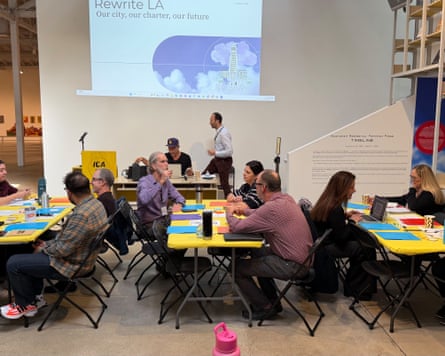
Weeks later, she helped moderate a much larger “civic assembly” – a group of a few dozen randomly selected residents, compensated for their time, who talk with experts and deliberate over a complicated local issue – to make recommendations for city charter reforms for the first time in two decades.
After meeting for nearly 30 hours, the group presented nine recommendations, including expanding the city council from 15 to 25 seats and instituting regular civic assemblies. The reform commission ended up adopting nearly all of the policy recommendations, and the proposed reforms now move to the city council and potentially to a public ballot in November.
“We rose to the occasion,” Futo said. “That’s what gave me faith in this process, that this is something that could work.”
Civic (or citizens) assemblies have been slow to catch on in the US, but they are suddenly spreading to address complicated local issues – often ones that have left the public and local officials at loggerheads.
An assembly in Lexington, Kentucky, for instance, recently recommended that the city council be more transparent about their attendance and job expectations; another in Raleigh, North Carolina, debated how the community could best use the land around the city’s mass transit. Connecticut is currently putting together the country’s first state-wide assembly to deliberate over the outsized role that property taxes play in paying for local services.
Elected officials say civic assemblies offer them a more robust understanding of where the public stands on a complex local issue, while participants say these processes give them a sense of direct participation in governance – and an appreciation of how their communities can work together.
“It always seems to happen when you sit down at a table and bring lived experiences and solve a problem together – it’s like magic. This is a table apart from yelling, from politics as usual – it’s its own environment,” said Wayne Liebman, co-founder of Public Democracy LA, a non-profit that helped spark the city’s recent assembly.
“People know they’re in a special place – they’re in the democracy place. They’re going to be listened to. When people are treated that way, they step up.”
Including residents in policymaking
Civic assemblies have been increasingly integrated into European countries over the past decade. Within the US, they have been slow to gain a foothold.
Since the first “official” US civic assembly was held in 2022 in Petaluma, California, to figure out what to do with a local fairgrounds, about a dozen more have taken place across the country.
The Foundation for Innovation in Democracy (FIDE) launched a North America chapter two years ago to advocate and train on civic assemblies. Marjan Ehsassi, executive director of the chapter, said the organization is seeing interest coming not just from community groups but also elected officials. This month, FIDE will bring high-level officials from five governors’ offices for a study trip to Brussels, where assemblies have become a regular part of governance.
Elected officials are “coming to us to say, ‘Help me reach more marginalized voices. I’m tired of hearing from the usual suspects,’” Ehsassi said.
For a typical assembly, a few dozen residents are chosen through postcards sent to random addresses. Final participants are then brought together over the course of several days to address a specific question or issue, with expert discussion and delegate deliberation taking place in specific, agreed formats, facilitated by trained moderators.
For instance, a 2024 assembly in Fort Collins, Colorado, brought together 20 residents to focus on the contentious question of what to do with an old sports stadium site. After two weekends of work, the group recommended a multi-use location including environmental restoration and recreation; the resulting recommendations were put on a public ballot, which passed in November.
Liebman, of Public Democracy LA, foresees future assemblies working on a range of larger local and national issues: budgeting and redistricting, police reform and gun safety, healthcare and immigration.
Other countries have shown it’s possible. Ireland memorably used the approach to legalize abortion and same-sex marriage, while Paris and Belgium have established permanent civic assemblies.
Deliberating vexing issues
One civic assembly garnering local and national attention is in Washington’s Snohomish county, where 40 residents began deliberating this month on how the local government should use AI tools.
To get educated on the issue, participants are taking part in a process akin to “expert speed dating”, moving around in small groups to informally chat with experts, said Jillian Youngblood, executive director of the National Civic League’s Civic Genius program, which is overseeing the process.
“Right now, if you don’t embrace AI, you’re made to feel like a Luddite – it’s framed as inevitable,” said Youngblood. “This feels like a tangible way that anyone can potentially have some agency on how it gets rolled into our lives.”
A Snohomish county councilmember, Nate Nehring, said he was hoping for recommendations on both AI use and potential guardrails. “It is rare to have an opportunity where a group of residents are working together to generate policy proposals on a topic which has yet to be deliberated upon by the legislative branch,” he said.
Residents in Akron, Ohio, last week wrapped up a 10-week civic assembly focused on another key national issue: housing concerns. Akron faces a host of challenges related to housing, the Akron planning director, Kyle Julien, said, pointing to affordability and growing homelessness, as well as absentee landlords not fulfilling their obligations to tenants and cash buyers dominating local housing markets. The assembly’s results are set to be presented to city officials on Thursday.
Akron business consultant Kevin J Smith, a housing assembly delegate, said that he knew nothing of the civic assembly concept before his selection but that he couldn’t turn down the opportunity to participate: “The issue is too important for me to have that opportunity and not engage.”
His experience had been fantastic, Smith said, lauding the opportunity to engage at a higher level with city officials and saying he expected the process would provide real solutions.
Akron housing assembly organizers, Unify America, which works nationally and is also planning an assembly in Dayton, Ohio, are looking at the efforts as a first of many in these two communities.
“These are really powerful events, but they’re typically thought of as events – one-time things,” said the non-profit’s Morgan Lasher. “So the way our model is trending is, how do we give local communities the tools to run these things over and over?”
Back in Los Angeles, Futo said the assembly process had helped her become not only politically engaged but also more aware of the problem-solving capacity of her neighbors. She recalls having repeatedly watched participants on opposing sides of an issue come to an agreement on a policy proposal.
“I was blown away – you don’t ever see that online,” she said. “I went from being apolitical to being an activist.”











Comments