
 German (DE)
 English (US)
 Spanish (ES)
 French (FR)
 Hindi (IN)
 Italian (IT)
 Russian (RU)
 56 minutes ago
In early September, the Trump White House announced a surprising new addition to its official website. Named simply Arcade, it is a collection of browser games based on classic titles such as Flappy Bird, Snake, and Tetris, but re-tuned as flagrant works of political propaganda. Designed to court reactionary gamers, they push the administration’s policies on immigration and other hot-button issues, while dehumanising their targets. There have recently been some new additions: a Temple Run clone named Red Scare about crossing the “ration market” and escaping the Democratic Socialists of America, and another simple item-matching game about the threat of socialism. In the midst of increasing fuel, utility and grocery prices thanks to the Iran war, these were naked attempts to distract voters by appealing to their video game nostalgia.
After an explosion of news coverage, Arcade caught the attention of the games industry. The Tetris Company warned on social media that it “took copyright infringement very seriously.” Days later, the game was removed from the White House site. However, aside from a March 2026 statement from the Pokémon Company condemning the White House for using its characters in Immigration and Customs Enforcement (ICE) propaganda, major video game companies have been relatively silent in the face of the administration’s widespread usage of their IP.
But now, video game creators and artists are pushing back, looking to regain ground the industry has ceded to reactionary ideologies over the last decade by turning the gamification of politics back on Trump. Anonymous art collective The Secret Handshake has been known for its political activism since installing a sculpture of Donald Trump and sex offender Jeffrey Epstein at the National Mall in downtown Washington, DC. This spring, the group developed a game entitled Operation Epic Furious: Strait to Hell and made it available online, as well as installing three free arcade cabinets on the National Mall.
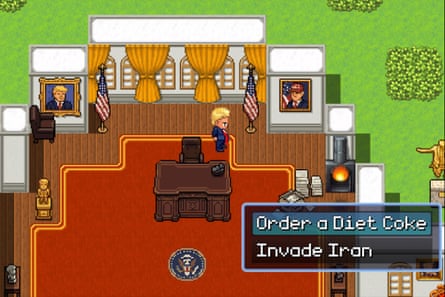
A satire on the Trump administration, the game allows players to control the president in a Pokémon-style challenge that starts with an important choice: order a Diet Coke, or invade Iran. As the game progresses, Trump heads to Iran to collect barrels of oil (called “lube” in the game) and encounters administration members such as vice-president JD Vance, secretary of state Marco Rubio, and “secretary of war”, Pete Hegseth. It’s unwinnable, which is the point, though you can get a “Game Over” screen by trying to hold Melania Trump’s hand.
The Secret Handshake had never made a video game until Operation Epic Furious: Strait to Hell. “The ‘form’ was really dictated by the Trump Administration,” a member of Secret Handshake says via email. “It’s not that we wanted to make a video game; it’s that the Pentagon began using video games to promote their war in Iran and make it seem ‘cool’. They actually introduced the idea of a video game, not us. We felt like, well, if they’re going to use video games to promote their war, let’s make a video game satirising that war.”
The collective followed similar logic when creating their second free game, Operation Epic Furious: Nuuk ’Em All which tasks players with speaking to Trump’s advisers, including a UFC fighter as “secretary of combat” and a no-bid contractor helping renovate The White House. The aim is to piece together enough “Big Brainpower” to figure out how to distract voters from the oil crisis. After Trump accidentally hits on his own daughter, Ivanka, and speaks to enough advisers to collect enough partial ideas to make one “big beautiful idea”, he decides to invade Greenland.
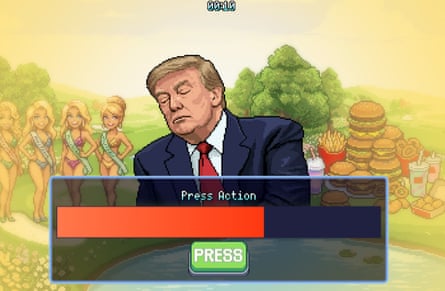
For The Secret Handshake, the video game as a medium helps people take in “the insanity” of what’s happening, which the collective believes may be hard to ascertain from just headlines. “When you are using a medium that’s very familiar, like a video game, and you’re going through these actions, it allows you to experience the headlines in a different way,” a spokesperson says. “This game is meant to be a caricature and satire, but it’s full of things in there that aren’t. The school in the Iran game and Trump calling a woman a maggot felt very intense to experience in the form of a game.”
The Secret Handshake had to learn how to build a game on the fly for Operation Epic Furious. “We had no idea what we were doing,” a spokesperson explains. “It was a lot of trial and error, and figuring it out as we went along. We did have someone helping that understood this world and could actually make it happen, but no one was a game designer.” They describe the games as, “held together with duct tape”.
Still, there are avid gamers in the group, and they pulled inspiration from Japanese role-playing adventures, particularly the early Final Fantasy titles, while the invidious, scatalogical tone is similar to South Park games such as The Stick of Truth and The Fractured But Whole. The aim was for the games to be funny and to properly satirise the absurdity of the current administration. So far, more than 350,000 people have played them online.
Space invading
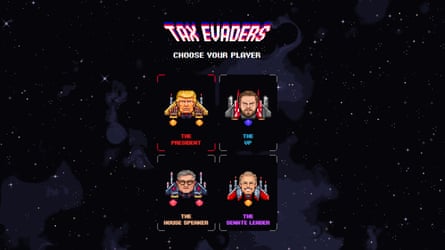
Two further anti-Trump games mimic the iconic arcade shooter Space Invaders, and they couldn’t have been made in more different ways. This summer, game developer Richie Branson partnered with nonprofit All for America to create Tax Evaders, in which you choose one of four playable pilots (President Trump, vice-president JD Vance, House speaker Mike Johnson, or Senate leader John Thune) before jumping into the first level, destroying healthcare and lining billionaire pockets.
“There’s something a bit unsettling about playing as the ‘villain’,” says Branson, who created Tax Evaders using the free and open-source game development engine, Godot. “The intent here is to drive home the point that these officials are destroying beneficial programmes with the same combination of enthusiasm and indifference as someone blowing up enemy space ships in an arcade game.”
The Trump administration’s aggressive push into online culture is working, according to Branson, who said the White House team is, “on a rampage” with its memelord and gaming culture posts. “It’s a very cunning way of spreading whatever message they’re trying to spread,” he says, before referring to the White House Arcade as “gamified propaganda”, and “garbage, [with] no love for the art”. Tax Evaders has had over 50,000 players and over 2m page impressions since July.
Alfie Souter and Carlota Real work in advertising together. They often chat about breaking news and trending topics, so when they saw the White House release its propaganda arcade, they decided to do something about it. “The craziest thing is the oversimplification of such a complex issue, like immigration,” says Real. “What they’re trying to do is boil this down to the minimum that people understand. A Tetris game; everyone on the planet has probably played it once, and they apply it to the shitshow that they’re doing.”
Angered by the administration’s trivialision of the issues and its demonisation of immigrants, the duo started brainstorming their own version of a simplified game with a political message. With no background in game design, they decided to build it in ChatGPT, which itself is perhaps a satirical message: many believe the Trump Arcade games are “vibe-coded”, or built using plain language to describe a game to a generative AI program, which then codes it.
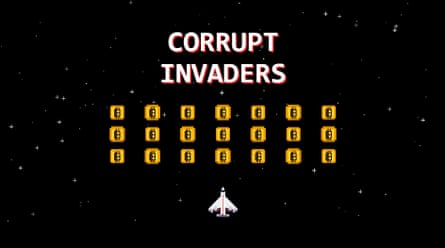
The result is Corrupt Invaders. Essentially a homage to Space Invaders with an anti-Trump filter, the game tasks you with moving Trump’s “$400m Qatari gift” (his aeroplane) to “collect another $1.4bn in crypto.” Your final score is subtracted from Trump’s reported cryptocurrency earnings. According to Souter the duo wanted the game to be focused on something that felt inarguable about the Trump regime and settled on corruption, using the $400m Boeing 747-8 luxury jet gifted by Qatar. Federal law says US officials can only accept gifts under $480, but the Trump White House insisted Trump accepting the aircraft was legal. “We thought about that jet, and also the $1.4bn earnings in crypto last year – those numbers are so ridiculous,” says Souter. “That’s why when you play the game, you subtract it from the score, because it’s such an unfathomable number”.
The two wanted to focus on the money that President Trump and his close allies have earned since his second presidency and juxtapose that against Americans’ consistent concerns with the cost of living crisis. The games are designed to makes the dichotomy crystal clear. Recently, the duo launched Diesel Kong, a parody of the classic Nintendo platformer Donkey Kong in the context of rising oil prices due to the continued war in Iran. “Prices are going up. Putin’s throwing useless barrels, can Trump be saved?” asks the starting screen. Trump stands in place of Princess Peach, while a nondescript Maga supporter wearing an American flag shirt and red hat tries to make his way up the ramps and ladders.
The developers and activists behind these games are pushing back against the Trump administration’s gamified propaganda while looking to subvert the gaming subcultures the president has co-opted. “Our current administration runs the country as if were a video game, with no real sense of sympathy for the people affected by the losses incurred by their policies,” said Branson. “Gas prices are crazy right now, people’s lives are being affected, but to our nation’s leadership, we’re just NPCs.”











Comments