
 German (DE)
  English (US)
  Spanish (ES)
  French (FR)
  Hindi (IN)
  Italian (IT)
  Russian (RU)
  2 weeks ago
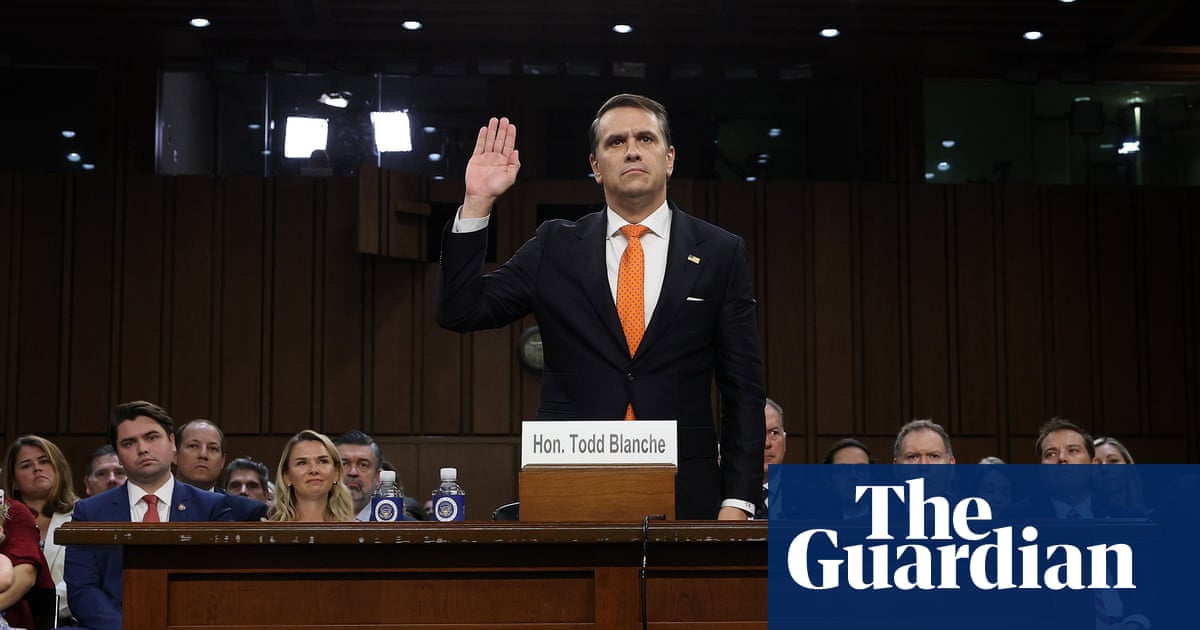
Todd Blanche will appear in front of the Senate judiciary committee on Wednesday, as one of Donald Trump’s most loyal and powerful enforcers in government aims to be confirmed as the nation’s top law enforcement officer.
Few officials have been more instrumental in Trump’s crusade to transform the federal government in his second term than Blanche. Trump tapped Blanche, his former personal attorney, to serve as the deputy attorney general, the justice department’s No 2 position, at the start of his term, where he steered the department’s day-to-day work as career employees were purged over their connection to Trump investigations and the president oriented the department towards punishing political rivals and investigating debunked conspiracy theories about the 2020 election.
After Trump fired Pam Bondi as attorney general in April, Blanche began serving as the acting attorney general, where he amped up Trump’s retribution agenda.
Among other topics, Blanche is likely to face pointed questions from Democrats over those actions, which include firing career prosecutors for their work on anti-abortion cases, indicting the Southern Poverty Law Center on specious charges and filing criminal charges against former FBI director James Comey over a seashell display that said “86 47” – shorthand for “get rid of Trump” – on the beach.
Blanche has overseen a department in which prosecutors and other government lawyers have been reprimanded for misrepresentations before judges. Government lawyers have long enjoyed a “presumption of regularity” – an assumption that officials are acting ethically and honestly before the court – but that seems to have evaporated.
For Blanche, his nomination as attorney general represents the pinnacle of a decision less than five years ago to bet everything on Trump. A former federal prosecutor, Blanche left a partnership at the law firm Cadwalader in 2023 to represent Trump in the criminal cases against him. Blanche, who was a registered Democrat until fairly recently, was rewarded for his loyalty with a top post in the justice department.
Blanche is also likely to face hard questions about the department’s decision to vacate some of the most serious convictions from January 6 as well as an arrangement the government reached with the president to end a $10bn lawsuit over the leak of his tax returns. The agreement, approved by Blanche, called for the creation of a $1.8bn slush fund to compensate the victims of alleged government weaponization and gave the president, his family and related business entities unprecedented immunity from tax audits up until the agreement was reached.
Facing bipartisan backlash, Blanche scrapped the fund. And a federal judge on Monday excoriated Blanche and the president’s other lawyers for the agreement, saying the original lawsuit was collusive and had been filed to engineer the president’s preferred outcome.
Senators are also expected to robustly press Blanche on his handling of the release of millions of files related to Jeffrey Epstein. Beginning last year, the department released a trove of documents, but many contained sloppy and haphazard redactions that publicly identified the names of Epstein victims and kept private the names of other figures associated with Epstein.
In May, Bondi admitted during testimony in front of lawmakers on the House oversight and reform committee that “there were redaction errors” in the Epstein files but said that “since day one of this process, this department has been committed to accountability and transparency”.
During that same testimony, Bondi said that it was Blanche who was “in charge” of the DoJ’s release of the files.
Before Blanche’s hearing this week, several Epstein survivors released a video and put up billboards urging senators not to confirm him.
Blanche also made headlines last year when he met with longtime Epstein companion Ghislaine Maxwell, who is currently serving a 20-year prison sentence on sex-trafficking charges, in prison to interview her about the Epstein case.
Not long after the meeting, Maxwell was transferred from a low-security federal prison in Florida to a minimum-security prison camp in Texas. The move sparked backlash, with experts calling it “unprecedented” and Democratic lawmakers noting that convicted sex offenders are not typically placed in minimum-security facilities.
Blanche has defended the transfer, arguing that it was necessary for Maxwell’s safety.
No other people affiliated with Epstein have been charged.
In May, during an exchange at a Senate hearing, Blanche was asked whether he could commit to not recommending a pardon for Maxwell. “Yes, I can commit to that, of course,” he responded.
More than 1,200 former justice department employees signed a letter earlier this month opposing Blanche’s confirmation.
“Since his confirmation as deputy attorney general, Todd Blanche has shown time and again that his guiding star is fealty to the president, not the constitution,” said Stacey Young, a former DoJ attorney who is now executive director and founder of Justice Connection, a group for justice department alumni that organized the letter.
“That fealty led to the purge of thousands of experienced career employees, a loss that will have a generational impact on the justice department’s ability to carry out its mission and maintain credibility with the courts and the American people.”



















Comments