
 German (DE)
  English (US)
  Spanish (ES)
  French (FR)
  Hindi (IN)
  Italian (IT)
  Russian (RU)
  3 hours ago
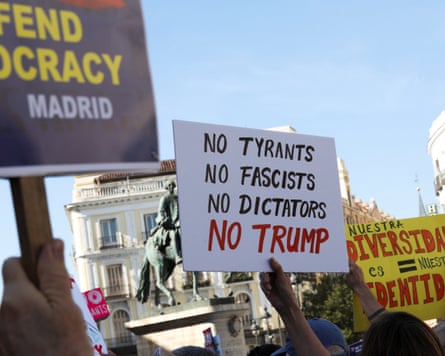
Almost half of EU citizens regard Donald Trump as an enemy of Europe, a new survey across nine countries revealed last week. The poll, conducted for the French debate platform Le Grand Continent, found that across Europe, Trumpism is considered “a hostile force”.
The new US foreign policy doctrine published by the White House on Friday will have heightened these respondents’ worst fears. The 30-page National Security Strategy landed like a bombshell in Europe. And citizens may have been out in front of their political leaders in figuring out what Trump’s worldview could mean for Europeans.
The strategy outlines a radical shift away from the ethos underpinning the Atlantic alliance, the doctrine that has bound the US to Europe since the second world war. The US, now frames the EU – the continent’s core political community – as a legitimate target for ideological warfare.
Its most astonishing pivot is a threat to meddle directly to “cultivate resistance” in Europe and restore the supposedly lost national sovereignties of the EU’s ailing individual nations.
This is not just the familiar threat to withdraw troops or demand that Europe shells out more money for its own defence. It suggests that the Trump administration wants to help “patriotic” far-right parties to power, while legitimising racist conspiracy theories. It makes the extraordinary claim that Europe faces the risk of “civilisational erasure” if “non-European” immigration is allowed to continue.
For the Dutch political scientist Cas Mudde, an expert in the far right, this strategy means Europe must count the US from now on as “a willing adversary”. Writing in the Guardian, Mudde said: “Perhaps now that it is published in an official document, European leaders will finally understand that ‘daddy’ is serious … The current US government believes that its national security is best served by the destruction of liberal democracy in Europe.”
Trump doubled down on Tuesday, using an interview with Politico to again lay into “decaying” European nations and their “politically correct” leaders whose immigration policies were “destroying” their countries. He complained about Paris and London in particular: the problem, as he viewed it was that the French and British capitals were becoming less white, or, wrote the Guardian’s Peter Beaumont, that they are “not racist enough”.
Coercive consequences
The US military and political alliance with Europe is clearly in crisis.
In an opinion piece on Monday, Georg Riekeles and Varg Folkman predicted that Washington will, as it draws back militarily, pull harder on other coercive levers to reshape Europe in the political direction the US wants. Not just on trade, either: as Mudde also noted, this could mean the US demanding protection for far-right free speech.
One of the biggest questions to be asked, according to Paul Taylor of the European Policy Centre, is why there is such an unequivocal embrace of Russia but no mention of it as a threat. Is there a longer game involving pulling in Vladimir Putin to isolate China? Are influential US interests eyeing juicy business deals? Either way, the document was warmly welcomed by the Kremlin.
Yet, European governments’ reaction (in public, at least) has been muted. Leaders have grovelled to Trump for so many months, desperate to keep him engaged in the defence of Ukraine – and to avoid any peace plan that won’t harm their security, too (or provoke another trade war) – that they seem immobilised from speaking up. Germany’s Friedrich Merz has gone the furthest, saying it underscored the need for a more independent European security policy.
The White House’s efforts to bully Ukraine into a bad “peace” deal could be entering another treacherous phase. But Washington’s priority is not – the strategy made clear – a European security architecture that shields Ukraine from future Russian invasion. It is an “expeditious cessation of hostilities” and the desire to “reestablish strategic stability with Russia”.
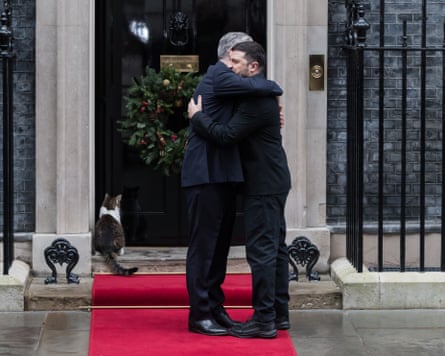
These words (coupled with the accusation that Europe is not interested in making peace with Putin) must have been the elephant in the room when Merz, Starmer and Emmanuel Macron hugged Ukrainian president Volodymyr Zelenskyy close at Downing Street on Monday.
In his interview the following day, Trump again threatened to cut Ukraine adrift if Zelenskyy does not “play ball” in the talks. Europe has been sidelined from direct involvement in the US-led negotiations, yet it has helped Ukraine to hold the line against a dangerous Trump-Putin carve-up. Kyiv is now running out of money however so Europe must urgently find billions to keep Ukraine in the fight, either by using frozen Russian assets or joint borrowing.
after newsletter promotion
Zelenskyy, meanwhile, desperate to avoid a transatlantic rift, has said he may be able to stage elections, in response to Trump’s accusation that he is using the war to cling to power.
How should Europe respond?
This latest doctrine could form the basis of US international policy for the remaining years of Trump’s term, and much longer if his vice-president, JD Vance, succeeds him.
Europe’s democracies, as a wide range of analysts told Jon Henley, need urgently to develop a counter-plan both to save Ukraine and future-proof their liberal democracies from Maga-inspired interference. Merely hoping that Trump’s embrace drives a wedge between Europe’s leading far rlght parties is a risky strategy. As Timothy Garton Ash implored of the continent’s leaders in this column: “How much more clarity do you need?”
Nathalie Tocci, director of the Italian Institute for International Affairs, believes that Europe has the means to stand on its own, even in the short-term, to defend Ukraine. “Europe can prevent Kyiv’s capitulation, if we jolt ourselves out of our learned helplessness and stop sucking up to Trump. It’ll be tough but we can do it.”
Being heard to stand up to Trump right now might even put Europe’s centrist leaders in good stead with their anxious voters. Le Grand Continent’s survey also showed that 51% of Europeans believed, even before Putin’s chilling statement last week about being “ready for war right now with Europe”, that they too are in Moscow’s crosshairs.
To receive the complete version of This Is Europe in your inbox every Wednesday, please subscribe here.






Comments