
 German (DE)
  English (US)
  Spanish (ES)
  French (FR)
  Hindi (IN)
  Italian (IT)
  Russian (RU)
  3 weeks ago
Donald Trump’s second term has been marked by a rollback of civil liberties.
He has terminated all federal diversity, equity, inclusion and accessibility offices and positions. He has declared that the government will only refer to individuals by their biological “sex” instead of their gender identity. He has also set a sweeping anti-immigration agenda, attempting to end birthright citizenship, pausing refugee admissions and increasing immigration enforcement operations around the country.
But many Americans have been using the courts to fight back.
More than a hundred lawsuits were filed against the Trump administration over the past year by people and organizations to restore some of these rights. Among them are Fernando Viera Reyes, who says he was denied proper medical care in immigration detention; Zaya Perysian, who was denied a passport with her correct gender identity; Mohsen Mahdawi, who was detained by immigration officials over exercising his first amendment right to protest over the war in Gaza; and Jon Carlson, a pastor whose place of worship has become a target for immigration enforcement seeking to detain undocumented people.
Reyes, Perysian, Mahdawi and Carson spoke to the Guardian about why it’s so important to fight back, not just to protect their own rights, but the rights of millions of others in the US.
Fernando Viera Reyes, 50, suing over allegations of inhumane conditions at an ICE facility
Fernando Viera Reyes fled to the US from El Salvador during the country’s civil war when he was 10. For the past two years, he has been held in ICE detention over a warrant in connection with his undocumented status. While at two California facilities, he says he has experienced symptoms consistent with prostate cancer – but doctors haven’t given him proper testing to confirm a diagnosis. In November, he joined a class-action suit against the Trump administration alleging inhumane conditions at the privately owned California city detention facility, with his lawyers filing a motion in a California federal court seeking to require ICE to provide him with immediate medical care. The administration has argued that the plaintiffs’ complaints constitute isolated and atypical experiences resulting from the facility’s inadequate opening during its first month. The administration claims that staffing, training and medical protocols for detainees have now improved.
“The most difficult thing for me is the neglect. Every test pointed out that I had something, most likely cancer. Time passed, [doctors] knew something was going on, and did nothing. I would go to the clinic, I would go to a neurologist, and every time I went, they didn’t have my medical records. I wasn’t able to use the restroom normally. I was peeing a lot, having burning sensations, and nothing was done. I didn’t get the biopsy that would screen for cancer; it was canceled. Every time I saw the doctor, I asked when I was going to get the biopsy. It never happened.
“When I got transferred to another facility, I noticed that there was blood in my stool twice. It took almost a month and a half to really get the medical staff’s attention. A month later, again, I was bleeding, and nothing was done. I was asking for pain medication, and they were taking forever. They always take forever. To this day, it feels like they didn’t put in the effort to do whatever they’re supposed to do to help me out. So we still do not know how bad it is, and if I have cancer.
“There needs to be a lot more training. It seems like [the medical staff] don’t have the ability to communicate on a human level. I would like officers to get more personal in the way they treat the detainees, because even though you feel sick and you go to them, some of them don’t know what to do. We are treated inhumanely. They just see a criminal and a prisoner, and we get treated that way.”
Mohsen Mahdawi, 35, suing over the right to protest
In 2014, Mohsen Mahdawi, then 24, moved from a refugee camp in the Israel-occupied West Bank to Windsor, Vermont. Now a US permanent resident, he is currently in Columbia University’s master’s program for international and public affairs. On campus, he has been active in advocating for equality, particularly for Palestinians during Israel’s siege of Gaza. During a routine naturalization interview last April, he was detained by immigration officials, with the administration arguing that his pro-Palestinian advocacy could undermine Middle East peace talks. He spent more than five months in a detention facility in Vermont before he was released on bail in September. In an appeal, the administration argued that the district court judge lacked jurisdiction in the matter and that, under the Immigration and Nationality Act, only federal immigration courts may intervene in deportation proceedings. On 13 February, an immigration judge blocked his deportation.
Mohsen Mahdawi. Photograph: Ryan Murphy/Reuters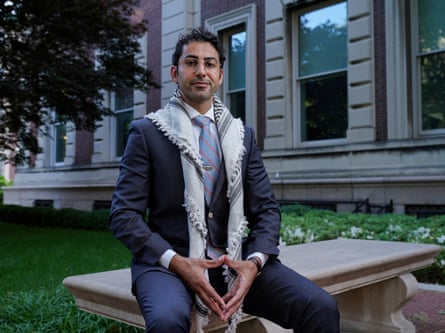
“My life is the life of a Palestinian refugee. As you might imagine, living in the refugee camp is a life of oppression, a life of horror, a life of loss. That’s what I experienced as a child, where I saw a number of my family members and my best friend getting murdered, killed in front of my eyes.
“The day I was arrested was a day of shock. I had lived in this country for 10 years. I respected the law and never committed a crime. I paid taxes. I worked. I have attended the best educational institutions in this country. I was looking forward to having my citizenship. It is the first country where I had the opportunity to feel a level of safety, and it’s the first country where I experienced freedom for the first time in my life. I was hoping to walk out with my citizenship, and instead, I was walked out handcuffed and thrown into prison.
“I hope that people can understand that this is not an individual case. It’s not about me. What is at stake is literally the most fundamental right in this country, a constitutional right, which is the first amendment to free speech. It’s very clear that the government is coming after me, and after other students as well, just for protesting a genocide, which is a legal activity in this country. If the government succeeds in punishing me by putting me in prison or deporting me for practicing this right, everybody else should worry about their own future and their rights in this country.
“When I walked out of the prison, I gave a speech. This was the message: yes, the government can harm me and intimidate me, but I will not be intimidated, and they will not be able to shut my voice down. This work I am doing is a work of love – love for humanity – and there is no power that can shake me. I say to President Trump and his cabinet, ‘I’m not afraid of you.’ And I want to share with the American people that this is the time to speak up, because things are getting worse. To speak up is to not surrender to fear and intimidation. If there is a time to save this beautiful country that I believe in, its values and principles, this is the time.”
Zaya Perysian, 22, suing for trans people to receive correct gender markers on passports
When content creator Zaya Perysian filed her passport application last January, she marked her gender as “female”. However, the passport she received in the mail eight days later identified her as male. Trump had just been re-elected president, and it was unclear whether the administration would uphold the Biden policy of issuing passports that reflect the gender identity of trans and non-binary people. Perysian sued the Trump administration to get her passport corrected – and won. Her lawyers have since filed a class-action lawsuit for all transgender people to receive the correct gender identification on their passports. The courts granted the class-action status until the Trump administration appealed in federal court. On 6 November 2025, the supreme court upheld the administration’s request to pause the class action until the US first circuit court of appeals resolves the case. The administration has argued that Trump’s policy requiring a person’s biological sex on their passport is fair, and the courts may not interfere with the president’s constitutional authority in matters involving foreign affairs.
Zaya Perysian. Photograph: Daniel Cole/Reuters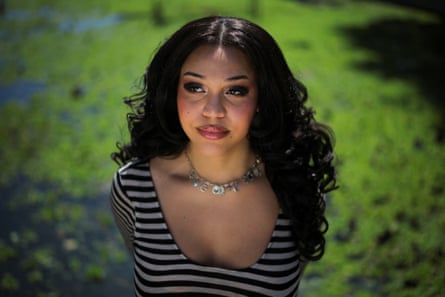
“It felt like the world went silent when I read ‘male’. It lit something in me, and I just knew I had to be an advocate and stand up for myself and my community.
“I’m a full-time content creator. I’ve been doing it for a decade now, and when the Trump administration first started pushing their anti-trans legislation, a lot of the brands that I work with started to back away because they were scared to work with trans people. Then, when I sued Trump, I became a political target. I’m a very vocal advocate, and that scares a lot of brands. It scares a lot of people.
“It’s definitely opened my eyes as to how cowardly people are willing to be when it comes to standing up for marginalized communities. There’s been a lot of pushback online from ultra-rightwing people, but there’s also been a lot of support, and I’ve found a really deep-rooted community because of it. So many people have reached out to me, thanking me and telling me how this is inspiring them and giving them hope.
“A lot of people think that we are pushing some ideology in their faces, and we’re trying to force people to conform, when really all we’re doing is trying to be free, as is our American right to be able to express ourselves and be who we are without governmental interference.”
Jon Carlson, 41, suing to protect immigrants in places of worship
When the Trump administration overturned the longstanding precedent banning immigration officials from making arrests at “sensitive locations”, including houses of worship, faith leaders like Jon Carlson were concerned. Carlson is the lead pastor of Forest Hills Mennonite church in Pennsylvania and the former moderator of Mennonite Church USA, an Anabaptist Christian denomination committed to peace and non-violence. Last February, the Mennonite church and other Christian and Jewish religious leaders sued the Department of Homeland Security in a DC federal court to protect immigrants who attend their places of worship against ICE officials. The administration has argued the churches lack standing to pursue the case because they cannot prove that there is an imminent threat to them.
Jon Carlson. Photograph: Courtesy of Kelly Lapp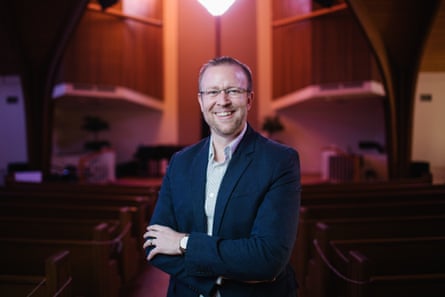
“We hold in common with many people of many faiths the importance of welcoming the stranger. Jesus identifies himself as a stranger and says, ‘When you welcome a stranger, you are welcoming me.’ The earliest Anabaptists were persecuted, in some cases imprisoned and even executed, by government authorities for trying to practice their faith. When we see governments saying that they intend to interfere in houses of worship, it becomes very concerning for us.
“Our hope is that churches will be seen as spaces of sanctuary and protected, absent a judicial warrant or exigent circumstances. That churches and other houses of worship will not be targeted by immigration and customs enforcement officers or border patrol officers. That the church will be a truly safe space where all people can gather to exercise their faith freely.”







Comments