
 German (DE)
  English (US)
  Spanish (ES)
  French (FR)
  Hindi (IN)
  Italian (IT)
  Russian (RU)
  3 weeks ago
The Trump administration may remove the temporary protected status (TPS) of Haitians and Syrians in the US, the US supreme court ruled in late June – a move that will worsen America’s growing caregiver shortage, experts say.
The US is now experiencing its fastest increase in the aging population in more than a hundred years, and more than 20% of the US population will be 65 or older by 2030. But the population of caregivers has not grown at the same pace, leading to staffing shortages.
Immigrants account for about one in six workers in the US – but they comprise about 30% of caregivers in longterm settings. The caregivers, often nurses and aides in hospitals, facilities, and homes, come from at least 163 countries, and Haitian immigrants are strongly represented at 7% of that workforce, according to a report from LeadingAge, the national association of non-profit and mission driven providers of aging services.
“Foreign-born staff are significant contributors to care and services our members provide, and that older adults and their families rely on,” said Lisa Sanders, vice-president of communications and media relations at LeadingAge. “Without staff, there is no care.”
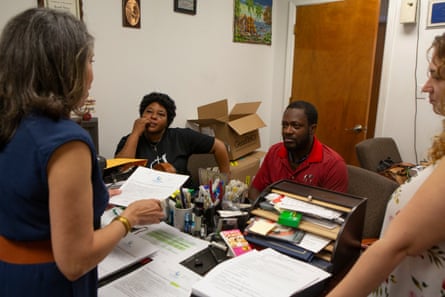
The US House passed a Haiti TPS extension in April, but the Senate has yet to take action on an extension.
Allowing the TPS status of Haitians to expire will further exacerbate the caregiving crisis, as Haitians on temporary status will be forced to stop working as soon as the status expires, said Nixon Pierre-Louis, a Haitian-American citizen who works two jobs as a licensed practical nurse in Delaware.
“That’s going to leave the institution or the facility where you work short, and that’s going to affect the resident or the client that you’re taking care of,” Pierre-Louis said. He works with patients who need assistance with daily living – feeding, toileting, bathing. “They depend on you… The clients and the residents are also going to suffer because there is no one to take care of them, and that can also lead to illness and infection.”
As Haitians on TPS status are forced to stop working, their duties will fall on already-stressed colleagues, Pierre-Louis said, noting: “It’s just a circle. Not only does it affect residents or clients, it also affects co-workers.”
It also puts pressure on longterm caregiving facilities and home health agencies, which may not be able to care for new patients amid staff shortages. Finding, training, and retaining new staff is a difficult, expensive process.
Care facilities – for instance, in south Florida and parts of Massachusetts and New York state – will face “significant” challenges, Sanders said.
“In aging services, a sector that has, for a number of reasons, long navigated workforce challenges, the loss of good workers is a significant blow. These are dependable, valued staff who are having to leave their employer because the government says they must go,” Sanders said.
While the number of immigrant workers has stayed relatively stable despite US immigration crackdowns, the composition of the workforce has changed, according to a recent report from the nonpartisan health policy non-profit KFF. Immigrant workers who aren’t citizens have left the caregiving workforce in greater numbers, while naturalized citizens have joined it.
As aging service employers are often reimbursed by Medicaid and Medicare Advantage, they are limited in what they can do when faced with financial difficulties like these, Sanders said.
“Unlike, say, a pizza restaurant, which raises the cost of a pie when ingredient prices rise, aging services providers cannot increase the reimbursements they get from Medicaid or MA plans,” she continued, adding that makes it harder to recruit nurses and aides. “Our members are also competing with restaurants, hospitality businesses, and retail for servers, housekeepers and maintenance workers.”
Retaining experienced workers is one of the biggest challenges in home care; some 70% to 80% of new employees leave after about three months.
The recent supreme court decision is “one of many blows to the sector that relies on foreign-born staff, whose ability to work in the US increasingly is limited, because of actions by the current administration”, Sanders said.
Many Haitians on TPS status have lived in the US for years or decades, and they’re worried about paying mortgages and car payments and providing for their families. They are “on edge and anxious and concerned”, Pierre-Louis said.
Most Americans agree that immigrants frequently do jobs Americans do not want, according to surveys by Pew Research.
“There are certain jobs that I’ve only seen foreigners do,” Pierre-Louis said. While white Americans sometimes work alongside him in caregiving jobs, it is often temporary until they can find other jobs that may demand less and pay more.
It can be difficult work, and sometimes patients, especially those who suffer from cognitive decline, may spit on or curse or hit their caregivers. “You have to assist them with dignity,” Pierre-Louis said. “You do it with all your heart, because they need the help. If you don’t do it, no one’s going to do it for them.”
Being a foreigner in the US now means being targeted, Pierre-Louis said. Even citizens worry about backlash from their neighbors or political leaders. “I just want people to know that we are here to contribute to society. We are here to help,” he said.
Donald Trump and JD Vance are both married to first- or second-generation immigrants, as are other top officials in the Trump administration, and many Americans descend from immigrants, Pierre-Louis pointed out. “Why is it an America for them only, and it cannot be the America for all?”

















Comments