
 German (DE)
  English (US)
  Spanish (ES)
  French (FR)
  Hindi (IN)
  Italian (IT)
  Russian (RU)
  3 weeks ago
Donald Trump’s decision to order airstrikes against Iran will hinge in part on the judgment of Trump’s special envoys, Steve Witkoff and Jared Kushner, about whether Tehran is stalling over a deal to relinquish its capacity to produce nuclear weapons, according to people familiar with the matter.
The president has not made a final determination on any strikes, as the administration prepares for Iran to send its latest proposal this week, ahead of what officials have described as a last-ditch round of negotiations scheduled for Thursday in Geneva.
Those talks will be led by Witkoff and Kushner, whose assessment on the likelihood of a deal will shape Trump’s calculus. If there is no deal, Trump has told advisers he is considering limited strikes to pressure Iran and, failing that, a far larger attack to force regime change.
An administration official said on Monday that Witkoff was part of the group advising Trump on his decision about how to proceed with Iran and had been involved in all meetings related to the matter.
Trump has received multiple briefings on military options, the people said, including most recently on Wednesday in the White House Situation Room. He has also solicited views from a broad range of officials in the West Wing in recent weeks on what he should do with Iran.
The other main advisers include the vice-president, JD Vance; the secretary of state, Marco Rubio; the CIA director, John Ratcliffe; the defense secretary, Pete Hegseth; Gen Dan Caine, the chair of the joint chiefs of staff; Susie Wiles, the White House chief of staff; and Tulsi Gabbard, the director of national intelligence.
Vance has presented both sides of the argument for airstrikes. But he has pressed Caine on the possible risks, not least because he has been far less confident about the likelihood of success with attacking Iran than he was about the operation to capture Venezuelan president Nicolás Maduro.
Caine’s concern has centered on the low stockpile of anti-missile systems, the people said. After Trump bombed Iran’s nuclear enrichment sites last year, the US fired 30 Patriot missiles to intercept Iranian counterattacks, the largest single use of those missiles in US history.
Those counterattacks were limited in scope. But, this time, Iran has vowed this time to retaliate as hard as possible in response to any US attack, and its supreme leader, Ayatollah Ali Khamenei, warned last week that he had the ability to sink a US warship.
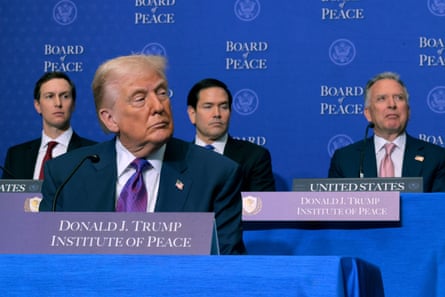
Caine has come across as more vocal about his concerns inside the Pentagon than when he has briefed Trump, in what officials have privately speculated as an effort to not appear to be advocating for a particular course of action, a person familiar with the matter said.
In a statement on Caine, the White House spokesperson Anna Kelly said Caine is “a highly respected professional whose job requires providing unbiased information to the Commander in Chief, which he does perfectly”, and that he has not been offering his personal views.
But there is also uncertainty inside the administration about whether airstrikes would be sufficient to strong-arm Iran into making a deal – or even bring about the ouster of Khamenei and his circle of religious leaders.
To that end, administration officials have also explored potential off-ramps to avoid military conflict. Among the ideas under discussion is allowing Iran to maintain limited nuclear enrichment capability strictly for medical research, treatment or other civilian energy purposes.
Rubio is also expected to travel to Israel to update its president, Benjamin Netanyahu, in meetings scheduled for 28 February on the outcome of negotiations, two people familiar with the matter said.
Yet ahead of what could be the final negotiating session, there were indications that positions were hardening.
Witkoff said on Fox News on Sunday that Trump’s directive was to ensure Iran would retain zero nuclear enrichment capability – only for Iran’s foreign minister, Abbas Araghchi, to say on CBS’s Face the Nation that Tehran was not prepared to relinquish enrichment.
As it prepares for the possibility of Trump authorizing military action, the US has assembled its largest concentration of air power in the Middle East since the 2003 invasion of Iraq. The USS Gerald Ford, the US navy’s most advanced aircraft carrier, is expected to arrive within days.
The carrier, which was moving south of Italy on Sunday en route toward Israel, would become the second aircraft carrier in the region. Its arrival would add to dozens of advanced F-35 and F-22 fighter jets, along with bombers and refueling aircraft already deployed.
The buildup would give Trump the option of sustaining an extended air campaign against Iran, rather than carrying out a limited strike like last summer’s operation, when B-2 bombers flew from the US to hit a small number of enrichment sites at Fordow, Isfahan and Natanz.






Comments