
 German (DE)
  English (US)
  Spanish (ES)
  French (FR)
  Hindi (IN)
  Italian (IT)
  Russian (RU)
  3 weeks ago
Donald Trump pulled back from the brink on Greenland but not before causing untold damage to the Nato alliance. The US president’s sabre-rattling may also have shaken the faith of his own Republican party.
Trump’s fleeting threat to conquer the Danish territory prompted the most strident Republican opposition to anything he has done since taking office a year ago. It came on the heels of challenges to his authority over military powers, healthcare legislation and the Jeffrey Epstein files.
The mini-rebellion suggests that a small but vocal minority of Republicans feel increasingly emboldened to speak out against a 79-year-old leader who, for all his dominance of the party, is polling dismally and could drag them down in November’s midterm elections.
“You’ve never had a president with this much influence and this much political and legislative success so in that sense he’s winning but his own party is starting to question and wonder out loud at what cost?” said Frank Luntz, a political consultant and pollster. “He has been the most influential president since Franklin Roosevelt but the public and even people in his own party are starting to wonder whether it’s too much.”
Speculating over Trump’s grip on the Republican party, and whether it shows any sign of slipping, has been a political sport for a decade, producing many false dawns along the way. Dissenting senators and representatives such as Liz Cheney have been ruthlessly purged or made to feel they have no alternative but retirement.
Trump’s biggest crisis came with his crushing defeat in the 2020 presidential election and a subsequent insurrection by a mob of his supporters at the US Capitol, prompting even loyalists such as Lindsey Graham and Kevin McCarthy to condemn him. But not even an attempted coup was enough to break the party’s cult-like fever.
Much-hyped pretenders to the crown such as the Florida governor, Ron DeSantis, could not compete and, when Trump roared back from four criminal cases to win the 2024 presidential election, Republicans reclaimed the House of Representatives and Senate and felt vindicated in sticking with their idol.
For much of Trump’s first year in office they gave the president such free rein on government downsizing, immigration enforcement and trade tariffs that critics said Congress had abdicated its responsibility, in effect setting up Trump as a monarch.
But there have been blips. In November four House Republicans – Marjorie Taylor Greene, Thomas Massie, Lauren Boebert and Nancy Mace – took a rare stand against Trump by signing a discharge petition to force a vote to release federal files related to sex offender Epstein.
Despite months of lobbying against the release, Trump abruptly changed course and announced his support for the bill after it became clear the vote would succeed with potentially dozens of Republicans joining Democrats in support.
Greene, once among Trump’s staunchest allies, resigned from Congress and accused the president of betraying his “America First” base and prioritising elites over his supporters’ concerns. In a New York Times Magazine profile, she described herself as “naive” for initially believing Trump was a true “man of the people”.
Earlier this month more than a dozen House Republicans defied leadership by voting for a Democratic bill to extend expired Affordable Care Act subsidies for three years without any restrictions. The party has also been scrambling in both chambers to narrowly fend off war powers resolutions intended to force the president to get congressional approval before engaging in military action overseas.

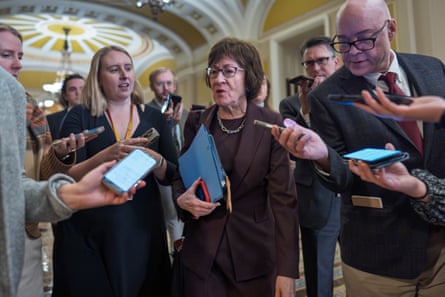
Meanwhile Senator Susan Collins of Maine, the most vulnerable of this year’s Republican incumbents, has criticised “excessive” tactics by Immigration and Customs Enforcement (ICE), including wearing masks and targeting immigrants without criminal records, which she said have been ordered by the homeland security secretary, Kristi Noem.
Tara Setmayer, co-founder and chief executive of the Seneca Project, a women-led super political action committee, perceived fractures. “I don’t think it’s as ironclad as it once was, evidenced by the Massies and the Marjorie Taylor Greenes and a few others who have begun to question the America First commitment of Donald Trump. Before, you wouldn’t have seen any of that; now you’re starting to see pockets of it.”
She added: “Whether that’s culminates into a larger rebellion remains to be seen because it is a midterm election year and these politicians want to stay in office so they’re going to continue to watch how the public reacts to Donald Trump’s decision-making and behaviour, which has been rather alarming and erratic. He’s showing signs of wear, his age – all of those things combined are becoming more difficult for rank-and-file Republicans to defend and the polling shows that.”
Few Republicans publicly dissented from the successful operation to capture Nicolás Maduro, the leader of Venezuela and many actively cheered it. But Trump’s bellicose rhetoric about seizing Greenland – threatening tariffs on European allies and refusing to rule out taking it by force – was seen by some as a bridge too far.
The Republican senators Thom Tillis of North Carolina and Lisa Murkowski of Alaska joined Democrats on a bipartisan trip to Denmark. Other Republicans took part in meetings in Washington with the Danish foreign minister and his Greenlandic counterpart where they discussed security agreements.
Murkowski and others pushed legislation that would prohibit Pentagon funds from being used to attack or occupy territory that belongs to other Nato members without their consent. On the Senate floor, the former Republican leader Mitch McConnell warned that any attempt to seize Greenland would “shatter the trust of allies” and tarnish Trump’s legacy with a disastrous foreign policy decision.
Tillis directed his criticism at Trump advisers such as the White House deputy chief of staff, Stephen Miller, rather than the president himself. “The fact that a small handful of ‘advisers’ are actively pushing for coercive action to seize territory of an ally is beyond stupid,” he said.
The most outspoken was Congressman Don Bacon of Nebraska, who told the Omaha World Herald that an invasion of Greenland would lead to Trump’s impeachment – something he would “lean” towards supporting.
It was notable, however, that McConnell, Tillis and Bacon have all announced that they will retire at the end of their current terms and therefore had little to lose by alienating Trump. Indeed the number of Republicans who broke ranks was perhaps less striking than the number who remained silent.
Setmayer, a former Republican communications director on Capitol Hill, said: “Given the gravity of Trump’s behaviour and the global consequences of his decision-making just in the last few weeks, the fact that there hasn’t been a Republican rebellion once again speaks volumes about the cowardice that got us into this position in the first place.
“He has to be reined in and the only people who can rein him in are the Republicans in Congress. Even with them facing electoral slaughter in November, they have yet to come together and work with Democrats to rein in Donald Trump.”
An Emerson College national poll this week found that 43% of likely voters approve of the job Trump is doing while 51% disapprove. Looking ahead to the midterms, 48% support the Democratic candidate on the generic congressional ballot and 42% plan on voting for the Republican candidate.
Trump himself is barred by the constitution from running for president again. Several shops that sell Trump campaign merchandise have recently announced that they are closing down. Next year the Republican political conversation will inexorably turn to the search for his successor, rendering him a lame duck with diminishing influence over the party.
Bill Galston, a senior fellow at the Brookings Institution thinktank in Washington and former policy adviser to President Bill Clinton, said: “I don’t see a lot of evidence that many Republicans are willing to break publicly with him. But there’s clearly a sense of unease spreading in Republican ranks as they contemplate running for election or re-election in an environment defined by increasing public discontent with the Trump presidency as revealed by all the standard indices.
“If the traditional relationship between presidential approval and the party’s fortunes in the midterm elections holds true then the Republicans are in for a rough November. They know that. They can’t break with the president but they can subtly distance themselves from him and I suspect that, unless the president’s numbers pick up substantially, that is exactly what they’re going to do.”















Comments