
 German (DE)
  English (US)
  Spanish (ES)
  French (FR)
  Hindi (IN)
  Italian (IT)
  Russian (RU)
  3 weeks ago
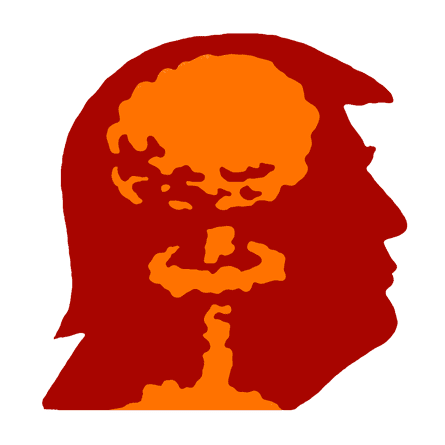
To many observers, Donald Trump’s open bellicosity – his threats to attack Greenland and Iran, and his recent kidnapping of Venezuela’s president, Nicolás Maduro – looks like an ideological reversal. “Donald Trump betrayed his MAGA base today [by] launching a war of choice to bring regime change in Venezuela,” tweeted Democratic congressman Ro Khanna on 3 January. The day before, former Republican representative Marjorie Taylor Greene wrote: “President Trump threatening war and sending in troops to Iran is everything we voted against in ‘24.” On 20 January, National Public Radio reported that “Trump supporters share confusion and anger over the president’s focus on Greenland”.
The sense of whiplash is understandable. As a candidate, Trump often denounced war. Now he is infatuated with it. But while Trump seems uniquely set on dismantling the postwar order in the service of his quest for global domination, there is precedent for his transformation.
Presidencies are not static. They evolve. And over the last half-century of US foreign policy, one pattern is clear: the more time passes since America’s last calamitous war, and the more presidents use military force without encountering costly resistance, the more aggressive they become. Successful wars are intoxicating; they turn doves into hawks. It happened in the decades between Vietnam and Iraq. And it is happening to Donald Trump today.
History also shows that hubris of the kind presently emanating from this White House generally ends in disaster.
To understand how American presidents move from caution to calamity, it is worth starting with the only president since the second world war who never sent troops into combat: Jimmy Carter. The reason has everything to do with timing: Carter was the first president inaugurated after Vietnam, the greatest US military defeat of the 20th century. Asked early in his presidency whether he would send troops to repel an alleged invasion of Zaire by communist Angola, Carter replied: “We have an aversion to military involvement in foreign countries. We are suffering, or benefiting, from the experience that we had in Vietnam.”
For all their ideological differences, Carter’s successor, Ronald Reagan, shared that aversion. Reagan’s cold war rhetoric was often fierce, and he lavished money on both the Pentagon and on anti-communist regimes and insurgencies overseas. But he was cautious about directly waging war. Like Trump in his first term, Reagan liked brief attacks that he could use as political theater. In 1983, he invaded the tiny Caribbean island of Grenada. The operation took only a few days, after which Reagan’s administration handed out more than 8,000 medals, even though the attack involved only slightly more than 7,000 US troops. Three years later, Reagan bombed Libya. Reagan in the aftermath of Vietnam was like Trump in the aftermath of Iraq. He liked short, dramatic acts of force against adversaries too weak to put up a fight.
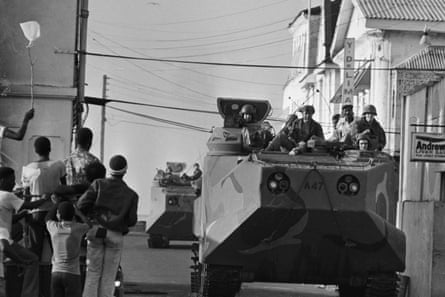
Reagan’s successor, George HW Bush, grew bolder. In 1988, a Florida grand jury indicted Panamanian dictator – and longtime CIA employee – Manuel Noriega on charges of drug trafficking. Reagan had called on him to resign but, fearful of another Vietnam, refused to invade. But after Noriega annulled an election, Bush – who was under pressure to appear tough on drugs – did. Bush’s invasion of Panama involved more than three times as many troops as Reagan’s assault on Grenada. Yet politically, the risk paid off. While the invasion killed hundreds of Panamanian civilians, only 23 US servicemembers died, and the US arrested Noriega in less than two weeks. America’s victory in Panama, according to Bush’s secretary of state, James Baker III, contributed to “breaking the mindset of the American people about the use of force in the post-Vietnam era”, and thus “established an emotional predicate” for the Gulf war 13 months later.
Obviously, past US military success is not the only factor that prompts presidents to wage war. They also respond to events. By invading Kuwait in 1990, and potentially threatening Saudi Arabia, Iraq imperiled what every US president since the second world war has considered a vital US interest: cheap oil. Despite this, Vietnam’s memory still haunted many US politicians. In his speech opposing the Gulf War, senator John Kerry asked: “Are we ready for another generation of amputees, paraplegics, burn victims, and whatever the new desert war term will be for combat fatigue?” Forty-seven senators voted to deny Bush the authorization to use force. But Bush attacked anyway. The US killed as many as 100,000 Iraqis, but lost only 147 US troops to enemy fire. Iraq surrendered after a ground war that lasted a mere 100 hours. “By God,” Bush exclaimed, “we’ve kicked the Vietnam syndrome once and for all.”
The consequences of that renewed enthusiasm for war were not apparent at first. Bill Clinton had vowed to focus on the economy, and with the Soviet Union gone, America’s leaders struggled to conjure foreign threats. “I’m running out of villains,” bemoaned Colin Powell, who served as Bush and then Clinton’s joint chief of staff. “I’m down to Castro and Kim Il-sung.” In the absence of great power adversaries, the Clinton administration launched “humanitarian wars”, which it justified less on security grounds than moral ones. But here too, America’s apparent success made it more aggressive. The United Nations security council authorized the US-led bombing campaign that helped end Serbia’s ethnic cleansing of Bosnia in 1995. But four years later, when Serbia menaced Kosovo, the US launched an air war without a UN mandate. That created a pretext for George W Bush to ignore the UN when he invaded Iraq two years later – which in turn created a pretext for Trump’s contemporary demolition of the “rules-based order”.
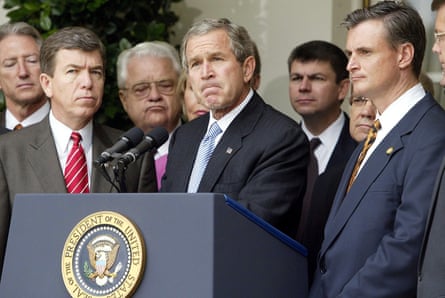
After 11 September 2001, fear, jingoism and rage powered the Bush administration’s decision to invade Iraq. But so did apparent military success. The US and its Afghan allies forced the Taliban from Kabul in just over a month, fueling the George W Bush administration’s confidence that it could topple Saddam Hussein as well. The Iraq war was far more ambitious than the Gulf war, which had aimed merely to expel Saddam from Kuwait, not overthrow him and install a new government. But it was now more than a quarter-century since the fall of Saigon. The “Vietnam syndrome” had been eclipsed by repeated American military victories. Bush’s plan to invade Iraq encountered far less opposition in Washington than his father’s bid to defend Kuwait. The number of Senate Democrats who voted to authorize war jumped from 10 in 1990 to 29 in 2002.
But in Iraq, America’s string of easy victories ended. Although the US deposed Saddam, it could not quash the insurgency that followed. As the war dragged on, the costs to Americans grew. In April 2004 alone, more than 1,200 US troops were wounded and 135 died. For the first time since the aftermath of Vietnam, opposing military intervention became a political asset. In his 2008 presidential run, Barack Obama’s opposition to the Iraq invasion helped him defeat first Hillary Clinton and then John McCain, who had both supported the war.

Careening toward the brink
From this shift in the politics of war, “America first” was born. Trump had supported invading Iraq. But in 2004, as the public mood turned, he grew more critical. When he ran for president in 2016, he pretended he had opposed the war from the beginning. With this lie, he followed Obama’s political lead – battering first Republican presidential frontrunner Jeb Bush, and then Clinton, for their associations with the war.
For Trump, “America first” didn’t imply any legal or moral opposition to foreign invasions. To the contrary, he criticized Bush for not seizing Iraq’s oil. He denounced regime change and nation building because they allegedly expended American blood and treasure on behalf of non-Americans. Instead, Trump promised short wars in which only foreigners died and the US took no responsibility for what happened once the shooting stopped.
Once in office, Trump in his first term resembled Reagan. He promised Americans peace while creating a spectacle of American dominance by killing foreigners who had no capacity to resist. He lifted restrictions designed to limit the number of civilians the US murdered in drone strikes. He killed dozens of Afghans when he dropped America’s largest non-nuclear bomb, which had never before been used in combat, on Islamic State forces. In his final year in office, he assassinated Qassem Suleimani, the commander of the al-Quds force, which directs Iran’s military operations abroad.
Trump viewed these attacks as political winners. He called the Afghanistan bombing “another very, very successful mission”. Like Reagan’s attacks on Grenada and Libya, Trump’s in Afghanistan and Iran sparked no significant resistance, either abroad or at home.
And as occurred in the late 1980s and 1990s, this apparent success has fueled greater ambition. In his second term, Trump has become even fonder of using the US military to stage demonstrations of national, and personal, dominance, both overseas and in America’s cities. One former Trump official calls it “propaganda through force”. As Al Jazeera notes, the US in 2025 attacked seven different countries. On Christmas, Trump ordered the bombing of Nigeria, supposedly to defend Christians. He has bombed Somalia more times than George W Bush, Obama and Joe Biden combined. This summer, he joined Israel in a massive airstrike on Iranian nuclear facilities, something his predecessors refused to do. And, as in his first term, Trump has paid no political price because none of his targets have been able to mount a costly response.
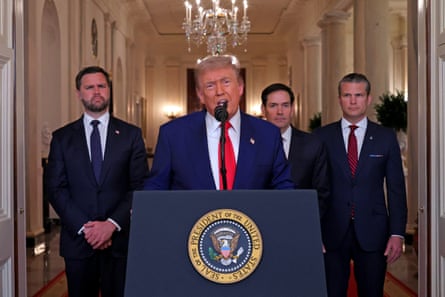
The more Trump exults in America’s capacity to pummel countries and networks that can’t fight back, the more his appetite expands. Although he once made opposing regime change a defining element of “America first”, Trump now embraces it. Last week, he announced: “It’s time to look for new leadership in Iran.” This week, a Wall Street Journal headline read: The U.S. Is Actively Seeking Regime Change in Cuba by the End of the Year.
Trump’s strikes on Venezuela have followed a similar logic: military attacks without significant military or political resistance have fueled greater aggression. Since last fall, he has escalated from attacking Venezuelan ships to kidnapping the country’s president to suggesting that the US may control Venezuela for years and declaring himself the country’s “acting president”.
Now, in his most reckless gambit yet, Trump is declaring his right to rule over Greenland and nakedly steal territory from a Nato ally. Unlike his predecessors, Trump does not even pretend that his imperialism serves any purpose nobler than American domination. And his vanity and stupidity leave him unable to imagine the costs that his unlawful occupations might entail. He has recently implied that controlling Venezuela’s oil could require US troops to guard its refineries, which would leave them vulnerable to insurgent attacks. Although Trump has for now ruled out force against Greenland, and says he wants to assume control of the territory peacefully, Greenlanders might resist a US occupation as well.
In response, America’s former Nato allies are starting to create a world order that isolates the US economically, thus punishing the Americans Trump promised to make rich. They are also forging closer ties to China – Canada just announced a “strategic partnership” with Beijing – thus making a mockery of Trump’s claim that his aggression strengthens America’s position in the world.
Trump’s approval rating has hit its lowest mark since he returned to the White House, with many Americans convinced that he should focus more on the economy and less on overseas adventures. For Trump’s domestic critics, all this makes his turn toward war even more inexplicable. But in the decades between Vietnam and Iraq, America traveled a similar path.
Trump is not the first president to grow intoxicated with the fruits of state violence, and to forget that wars do not only empower presidents. They destroy them too.
-
Peter Beinart is a professor at the Newmark School of journalism at the City University of New York, a contributing opinion writer at the New York Times, an editor at large of Jewish Currents and writes the Beinart notebook, a weekly newsletter. His latest book is Being Jewish After the Destruction of Gaza
-
Spot illustrations by Ben Hickey














Comments