
 German (DE)
  English (US)
  Spanish (ES)
  French (FR)
  Hindi (IN)
  Italian (IT)
  Russian (RU)
  3 weeks ago
Donald Trump’s posting of a video depicting former president Barack Obama and former first lady Michelle Obama as apes was the most overtly racist act of a president since Woodrow Wilson segregated the federal civil service – or since Trump’s previous racist gesture. The racist imagery Trump posted was so egregious that the video’s misogyny representing Hillary Clinton, Kamala Harris and Alexandria Ocasio-Cortez as animals was overlooked. Trump’s denigration of women is implicitly assumed as business-as-usual and not newsworthy: “Quiet, piggy!” And down the memory hole are the 3m long-suppressed documents from the Epstein files in which he is mentioned in its unredacted pages “more than a million times”, according to the Democratic representative Jamie Raskin, who was permitted access.
The only Black Republican US senator, Tim Scott of South Carolina, said of the Obama portrayal: “It’s the most racist thing I’ve seen out of this White House,” though Scott did not disclose any list, which could have been drawn from an encyclopedia of offenses beginning decades before Trump’s birther campaign. During Trump’s first administration, in 2020, Scott chose to call out one incident as “indefensible”: Trump’s tweet of a video of a supporter chanting “white power”. Trump’s latest racist post was preceded on 11 January by his predictable vandalism of Black History Month in an interview with the New York Times with a remark about the Civil Rights Act of 1964: “White people were very badly treated.”
The release of Trump’s Obama video runs parallel to his systematic purge of references to slavery at numerous national parks and sites, following his executive order of 27 March 2025, “Restoring Truth and Sanity to American History”. At Fort Pulaski national monument in Georgia, for example, Trump officials ordered the removal of a reproduction of the infamous 1863 “Scourged Back” photograph of an enslaved man named Gordon with severe whipping scars. At Harpers Ferry national historical park, signs about slavery were flagged for removal. At the Kingsley plantation in Florida, exhibits of the harsh living conditions of enslaved people were ordered for inventory. The historical information at President’s House in Philadelphia noting George Washington’s slaves’ presence there was removed.
But Trump’s video and remark about civil rights has its own inescapable history. However ignorant, indifferent or contemptuous of history he may be, he has evoked the language and imagery of the inaugural address of Governor George C Wallace of Alabama on 14 January 1963, in which Wallace decried “the tyranny that clanks its chains upon the south”, and “the international racism of the liberals seek[ing] to persecute the international white minority”, in order to transform Americans into a “mongrel unit of one under a single all-powerful government”,
Mongrelization, what Wallace called “mongrel complexity”, was in effect Trump’s theme in his tweet about the performance of Bad Bunny at the Super Bowl half-time show. Bad Bunny, a Puerto Rican recording artist who won the Grammy this year for best album, is a critic of ICE and sings in Spanish. His performance at the Super Bowl culminated in a parade of flags, ending with that of the US and his statement “God bless America”.
“It makes no sense,” complained Trump, “is an affront to the Greatness of America, and doesn’t represent our standards of Success, Creativity, or Excellence. Nobody understands a word this guy is saying, and the dancing is disgusting, especially for young children that are watching from throughout the U.S.A., and all over the World.” Perhaps Trump is confusing Bad Bunny with Elvis, and the early objections to his dancing and his Spanish-language song Guadalajara in his 1963 movie Fun in Acapulco. In the memes of identity politics, Trump as puritan is a novelty comedy act.
The Trump White House’s shambling explanation of the Obama video, trying to shift blame to an anonymous staffer, suggested an internal operation posting AI-generated images and videos. In October last year, Trump was made into a jet pilot who bombs protesters with excrement. On 22 January, just weeks before the Obama video, the White House communications office disseminated an altered photo of Nekima Levy Armstrong, a prominent Black woman, arrested at an anti-ICE demonstration in St Paul, Minnesota, in which her skin color appears darkened and her face changed to make her appear to be crying. (Armstrong is the former director of the Minneapolis NAACP and a former law school professor.) After the digital manipulation of the Armstrong photo was exposed, Kaelan Dorr, deputy White House communications director, posted on X: “The memes will continue.”
Initially, the White House press secretary, Karoline Leavitt, defended the Obama video as an “internet meme” and the reaction to it as “fake outrage”. Yet in the Armstrong instance, Trump’s White House was proudly defiant about producing it, not dismissive. Condemning “fake outrage” is the transparent projection of the outrage the Trump team regularly attempts to whip up through deepfakes. There was the doctored video in October 2025 of the Democratic House minority leader, Hakeem Jeffries, wearing a sombrero with mariachi music playing. “Bigotry will get you nowhere,” said Jeffries. But bigotry is the fuel of the memes.
The White House’s posting operation runs from deputy chief of staff Dan Scavino, dubbed “the conductor of the Trump Train”, through the communications and press offices. (The White House has said Scavino wasn’t behind the Obama post.) Leavitt’s particular role is to practice her talent for rapid-fire mendacity, instantly framing falsehoods and deflecting responsibility with an air of certitude as she is making it up.
In Trump’s fumbled alibi about the Obama video, he disclosed his operation. “I didn’t see the whole thing,” Trump said. “I looked at the first part … Then I gave it to the people. Generally, they look at the whole thing. But I guess somebody didn’t.” A phantom was blamed. Trump defended the video, half-confessing that he had given his approval. “I didn’t make a mistake,” he said.
Trump’s memes are more than distractions, heckling or the self-delusions of a cult shouting into an echo chamber. Just as the Obama video was neatly succeeded by the Bad Bunny tweet, Trump’s racist rants have melded with nativist nationalism. The two episodes together crystalize his political philosophy.
Like virtually all of Trump’s policies, from tariffs to immigration, and the AI cartoons of his White House image machine, Maga as a whole is an atavistic recrudescence, the return of the repressed. It is a recapitulation of the dark side of American history that cohered into the racist and nativist nationalism of a century ago in the 1920s.
The Obama video is a modern repetition of the pseudo-scientific racist theory of polygenism, propounded first in the 1854 book Types of Mankind by Josiah Nott and George Gliddon, filled with illustrations of the “Negro” head to show its resemblance to a chimpanzee rather than a “Caucasian” skull to prove a natural racial hierarchy. Nott argued that “the negro achieves his greatest perfection, physical and moral, and also greatest longevity, in a state of slavery”.
The literature of race-thinking grew to a vast proportion. In 1916, Madison Grant notably published The Passing of the Great Race, a combination of social Darwinism, racism and nativism, particularly focused on the Jews destroying Nordic “purity [of] the blood”. “The agitation over slavery was inimical to the Nordic race,” he wrote, “because it thrust aside all national opposition to the intrusion of hordes of immigrants of inferior racial value, and prevented the fixing of a definite American type … ” Grant served as vice-president of the Immigration Restriction League and an adviser on the Immigration Act of 1924, which prohibited eastern and central Europeans from the US. Hitler cited Grant’s book in Mein Kampf and praised it as “my Bible”.
The second Ku Klux Klan of the 1920s emerged as enormously powerful not only as a white supremacist organization but also as a nativist one that ranked whites by nationality and blood. The 1925 Klansman’s Manual stated as its “purpose”: “To unite white male persons, native-born, Gentile citizens of the United States of America”, and said “the movement is dedicated to the task of preserving the blood-purity, the integrity, the traditions, the ideals and the heritages of the white race in America”. (Fred Trump, Donald’s father, was arrested as a young man at a Klan rally in 1927.)
Trump dabbles in Hitlerian rhetoric without the theory: “poisoning the blood” was a favorite phrase of his during the 2024 campaign. (Trump has said he didn’t know this echoed Hitler.) He links blood purity to nativism with lurid depictions of immigrants as “animals” degraded by “bad genes”.
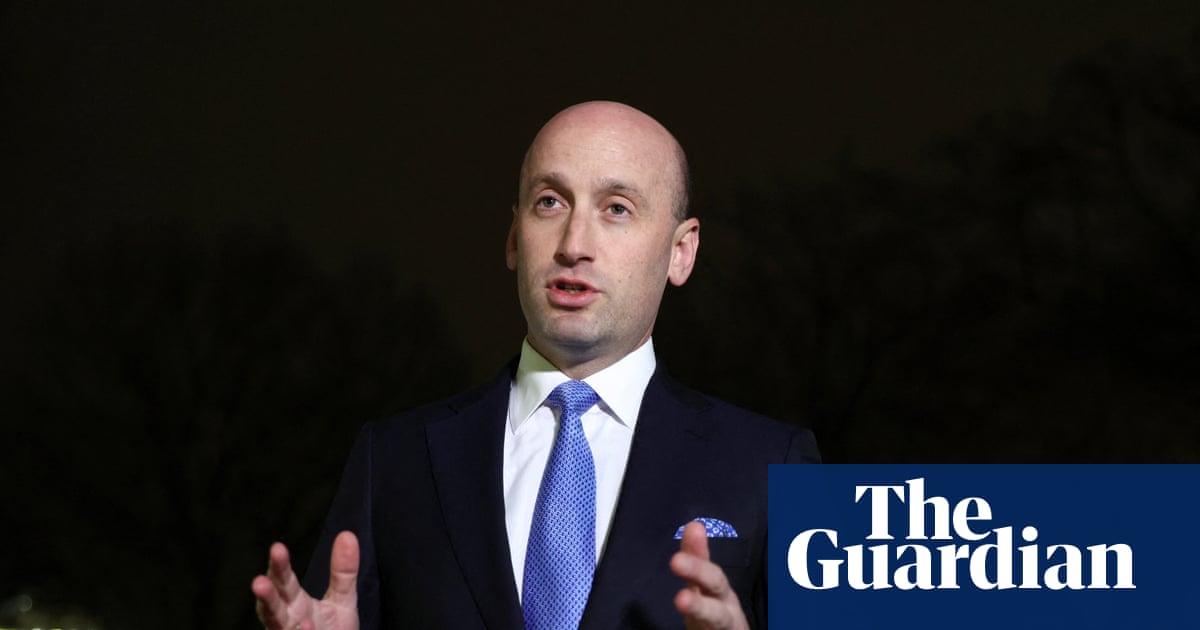
The man for theory, at least one theory, in his circle is the author of his immigration policy and field marshal of ICE, Stephen Miller, who has reportedly sought to promote a white supremacist novel, The Camp of the Saints, written in 1973 by Jean Raspail, which describes brown-skinned people from the Indian subcontinent invading and overwhelming white Europe. (The White House has claimed Miller opposes all forms of bigotry.) Raspail was a far-right French monarchist and his work a forerunner of the great replacement theory that provides the framework, if there is one, for Maga.
“This is the great lie of mass migration,” wrote Miller on X. “You are not just importing individuals. You are importing societies. No magic transformation occurs when failed states cross borders. At scale, migrants and their descendants recreate the conditions, and terrors, of their broken homelands.” Miller’s great-great-grandfather fled pogroms in Belarus and arrived at Ellis Island in 1903. And, Miller tweeted: “NYC is the clearest warning yet of what happens to a society when it fails to control migration.” Ad infinitum.
The memes will continue.
-
Sidney Blumenthal, former senior adviser to Bill Clinton and Hillary Clinton, has published three books of a projected five-volume political life of Abraham Lincoln: A Self-Made Man, Wrestling With His Angel and All the Powers of Earth. He is a Guardian US columnist












Comments