
 German (DE)
  English (US)
  Spanish (ES)
  French (FR)
  Hindi (IN)
  Italian (IT)
  Russian (RU)
  3 weeks ago
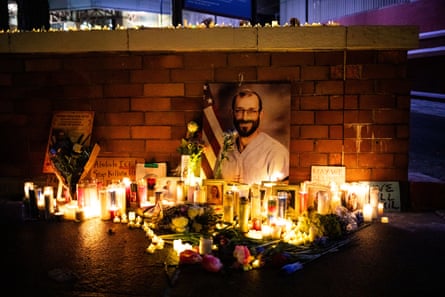
They could hear the shot that killed Renee Good in Tucson, Arizona.
When Good, a mother of three, was fatally shot by an immigration agent on the streets of Minneapolis in January, a group of lawmakers 1,300 miles away moved fast. Just two weeks later, Tucson city council voted unanimously to start a process to block Immigration and Customs Enforcement (ICE) agents and homeland security officials from using its property to stage enforcement activities, unless the agency had a warrant signed by a judge.
“How in the world would I be able to – well, let me see, I’ll just allow, you know, a few immigration raids to happen in our city? That’s not possible. That is just not possible,” said the Tucson mayor, Regina Romero. “You cannot compromise with crazy. Right? You cannot compromise with unconstitutional. And in my book, I cannot compromise with my long-held beliefs of protecting our residents, no matter their immigration status.”
Tucson didn’t take this step alone: cities and counties from Seattle, Washington, to Providence, Rhode Island, have made similar moves in the wake of the Trump administration’s crackdown on Minneapolis, during which Alex Pretti, an intensive care nurse, was also shot and killed by federal law enforcement officers.
But almost all of the cities that took such action are in states with Democratic majorities, like California, New York and Illinois. Conservative states often have state laws that prevent their cities from enacting anti-ICE legislation. And so does Arizona.
Arizona isn’t exactly a red state today: its governor, secretary of state and attorney general are Democrats, as are both US senators. But Donald Trump beat Kamala Harris in the state 52-47, and its legislature remains controlled by a narrow Republican majority in both chambers. Katie Hobbs’s election as governor in 2022 ended 13 years of Republican political dominance in Arizona.
The red state–blue city tension remains as a legacy of this Republican rule. Laws written to restrain municipalities remain on the books, and Republican lawmakers in the state use them whenever they can – especially where Tucson is concerned.
Tucson, known as the Old Pueblo, predates the American revolution. It incorporated as a city in 1877, and is now a progressive bastion of 550,000 residents. Home to the University of Arizona, Tucson often votes to the left of Phoenix, the state capital.
Trump won Maricopa county, which includes Phoenix, 51-48 – with a lead of about 70,000 votes – in 2024. Pima county, which contains Tucson, has half as many voters, but still gave Harris about 80,000 more votes than Trump, on a 57-42 margin.
Romero, Tucson’s mayor since 2019, was the first woman and first person of Hispanic descent elected to lead the city. She worked in the city’s social services sector for a decade before joining the city council, and campaigned for mayor on a progressive platform of aggressive water conservation, small business support, housing affordability, promoting social programs, in tandem with traditional policing and fare-free transit for the poor.
On local issues like a fight to curb a water-hungry datacenter, Tucsonians have proven to be strikingly effective political organizers. Immigration is also an intensely local issue.
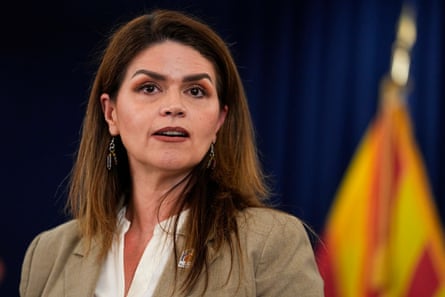
“We’re 60 miles away from the border,” Romero said. “Mexico is our number one trading partner. We rely heavily on visitors from all over Mexico. They leave close to $2bn in our economy.”
Donald Trump’s tariffs have been excruciating, she said. “Their actions are hurting our economy, are hurting our pocketbooks. And that’s just talking as a city, right? Families have their own issues, their own bills to pay. And it is hurting each and every one of us. And it’s just devastating to realize that mayors have to defend our city, and our residents, from our own state government and our own federal government.”
As ICE agents continued their raids in Minneapolis earlier this year, Tucson’s political leaders chose to act before the agency targeted the streets of their city.
Council members asked their city manager and city attorney to draft a municipal law and administrative guidance to prevent ICE agents from using city-owned or city-controlled property for “staging, processing, debriefing or other civil law enforcement operations, or any other non-city use without explicit permission or as required by law”. The council approved the measure in March.
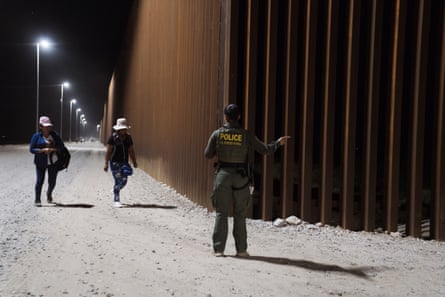
Signs have since gone up across the city, warning federal law enforcement agents that they cannot use Tucson city property for “civil law enforcement or civil immigration enforcement”. Pima county has passed a similar law of its own.
None of this is sitting well with Republican lawmakers. Last month, three Republican state senators – Warren Petersen, John Kavanagh and TJ Shope – invoked a state law allowing them to challenge a local law, demanding an investigation by the attorney general, Kris Mayes, into Pima county’s anti-ICE rule. Tucson was not named, but city leaders say it’s simply a matter of time. They have been here before.
Tucson has been drawing Republican fire for decades. Railroad and mining unions built Democratic strength in the city, and the university incubates progressive politics. Conservative lawmakers made the Mexican American studies program in the Tucson school system a political issue, outlawing classes that “promote the overthrow of the US government” or “advocate ethnic solidarity” in 2012.
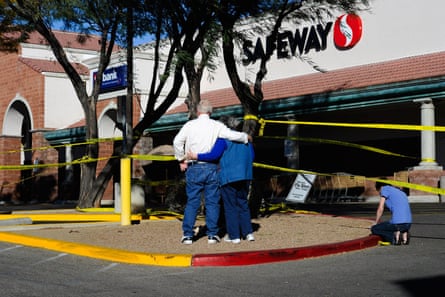
After a mass shooting in Tucson in 2011, in which six people were killed and 12 others injured – including the killer’s target, US representative Gabby Giffords – the city instituted a policy to destroy guns confiscated during police investigations. But Arizona Republicans responded to this in 2013 with a law requiring those guns to be sold at auction instead.
Tucson didn’t stop, daring the state to begin the lengthy process of a legal challenge. Tucson, a charter city, which gave it some legal insulation to pass local laws as it sees fit under Arizona’s constitution, protection that Arizona Republicans have tried to strip from other large cities, without success.
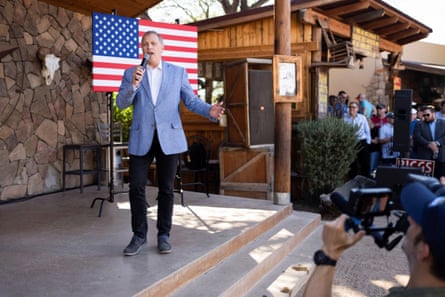
Republican Andy Biggs, then president of the Arizona state senate, had had enough. In 2016, lawmakers drafted SB 1487, allowing any state legislator to make a complaint to the state attorney general about any municipal law in the state that they deemed to conflict with state law. The attorney general’s office then has 30 days to rule on whether a city should rescind the law in question.
If a city does not comply, the state treasurer can dock the city half of its state funds – in Tucson, that’s more than 30% of its city budget.
That “marked a turn in abusive pre-emption from issue-specific authority to more wholesale attacks on the ability of local governments to function and to meet the needs of their communities”, said Katie Belanger, lead consultant for the Local Solutions Support Center, a municipal policy thinktank closely examining state laws pre-empting city laws. “It put the responsibility in the hands of a statewide partisan office to investigate and question what local leaders are doing on behalf of their constituents.”
Arizona state lawmakers have invoked a 1487 challenge 36 times since enacting the law in 2016. None were Democrats.
“There has been general hostility for a long time between the legislature and – not even just blue cities – but against localities in general and local control,” said Richie Taylor, a spokesperson for the attorney general’s office. “It’s often the legislature trying to crack down on what even more conservative cities or towns have done that relates to tax policy, or other things like that.”
The complaints are a laundry list of conservative issues: state Republicans challenged a Phoenix initiative to send confiscated guns to Ukraine, Sedona local rules on short-term rentals and campaign finance rules in Tempe.
Ten of the challenges have involved Tucson or Pima county. Tucson ultimately repealed its gun ordinance. Pima repealed a local proclamation with guidelines for reopening businesses during the pandemic, and its moratorium on evictions. Tucson dropped its Covid-19 vaccination mandate for city workers after the then attorney general, Mark Brnovich, a Republican, ruled it unlawful and filed suit.
Belanger said: “This kind of law is so broad, and is such a vague threat, that it makes local elected officials question whether they can challenge the status quo, whether they can take bold action that meets the needs of their communities, and whether or not they have the resources to fight the state if a partisan official doesn’t like the policy.”
State representative Quang Nguyen, a Republican, rejects the idea that 1487 complaints are inherently partisan. The current state attorney general, Kris Mayes, is a Democrat, he noted. “And she has agreed with me on multiple occasions, only because the law is the law.”
Nguyen, who chairs the judiciary committee of the Arizona House of representatives, has filed four complaints himself – most recently against Phoenix, for passing an anti-ICE law similar to Tucson’s. State law “basically says no official or agency of this state, or county, or city, or town, or other political subdivision, of this state may limit or restrict the enforcement of federal immigration laws to less than the full extent permitted by the federal law”, he said.
“I’m just doing my job,” added Nguyen. “I consider Arizona my home. And Arizona is a state of law and order. And so it’s very difficult for me to see city attorneys sitting down and do[ing] silly things like that. I mean, these guys are supposed to be seasoned lawyers and they’re not … following the state law.”
The 1487 process is a cudgel that replaces old-fashioned negotiation. It can be an instrument of political theater, suggested Matt Grodsky, a Democrat and seasoned political consultant in Arizona, fitting the current style of some hard-right conservatives. “Obviously, people are going to butt heads on a number of issues, right?” he said. “There’s never going to be total alignment, and some drama is going to create a little bit of a mess.”
The tension is real.
“Normally I would talk to the city official or the city representative or the liaison between the city and the legislature. But I have a history with the city of Phoenix,” said Nguyen. “The last time when I wrote letters, they pretty much ignored me. The same thing with the city of Sedona. They pretty much ignore my letter, and until I file a 1487 and they press the panic button at city hall and said, ‘You know, why – why did I go so heavy-handed?’ … I feel that there’s no reason for me to write a letter, that I need to go directly to a 1487.”
Laws like 1487 – passed “predominantly by conservative legislators, with the intention that they would be used by conservative officials”, noted Belanger, of the Local Solutions Support Center – were passed in a different political era. “And now, when you have a power change in a state like Arizona, what does that mean for the pre-emptions that have been passed?”
Republicans’ grasp on power in Arizona is no longer as tight as it was when the party first introduced 1487. At the time, lawmakers in a red state were trying to exert their control over its blue cities. But now the state has elected a Democratic governor and attorney general, what happens if the legislature flips, too?
“If we can manage to flip the legislature, and you’ve actually got a situation where you’ve got a blue governor, blue legislature, and then these blue cities, you know – totally different dynamic,” Grodsky said. “What the hell happens then? That could be fun for some of us, right?
“But until then, when you’ve got kind of this weird balance of blue on top, red in the middle and blue on the bottom, you’ve got to be creative.”












Comments