
 German (DE)
  English (US)
  Spanish (ES)
  French (FR)
  Hindi (IN)
  Italian (IT)
  Russian (RU)
  3 weeks ago
As a ceasefire was declared in the Middle East, Volodymyr Zelenskyy sought to draw attention to the war in his own country, posting on social media that Ukraine had consistently pushed for a ceasefire in the war “being waged by Russia here, in Europe”.
Efforts to end the war in Ukraine have largely stalled since the Iran war began, with trilateral talks between Kyiv, Moscow and Washington, which had already yielded little, frozen since February 2026. The war, meanwhile, has continued, with air attacks on Ukrainian cities and heavy fighting on the battlefields as Russia launches a spring offensive.
A possible visit to Kyiv this month by the White House envoy Steve Witkoff and Donald Trump’s son-in-law, Jared Kushner, which would be their first since negotiations began, may help to reboot talks to end the conflict. But the war in Iran has exposed divisions between Washington and its European allies more starkly than at any point since Russia’s full-scale invasion in early 2022 and fuelled concerns in Europe over the depth of US commitment to any potential peace deal.
One European official, speaking on condition of anonymity, said: “You can see Trump’s team is running out of patience in Ukraine and wants a quick solution.”
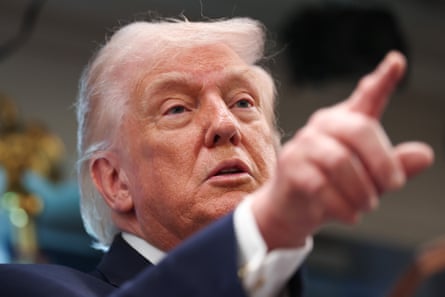
For any tangible peace deal to take shape, two key issues must be addressed: the fate of Ukrainian-held territory in eastern Ukraine and the question of US security guarantees.
The official said that recent US rhetoric risks convincing Moscow that Washington is not serious about its long-term support for Ukraine. Frustrated by European reluctance to become more directly involved in the Middle East conflict, Trump has in recent days described Ukraine as “not our war” and openly questioned his continued support for Nato. The European official said: “Ukraine is rightfully questioning whether these American security guarantees really stand for anything.”
Two European officials said there was growing concern that Trump, eager for a geopolitical win before the midterm elections, could increase the pressure on Kyiv to cede territory it still controls in the Donbas, eastern Ukraine, which is Russia’s central demand in the talks.
As warmer weather sets in, Russia has launched a spring offensive, according to military analysts, people familiar with Kremlin thinking, and statements from Ukrainian officials.
Kyiv expected renewed pressure this month and into the summer on the fortified eastern cities of Slovyansk and Kramatorsk, said Mykola Bielieskov, a researcher at Kyiv’s National Institute for Security Studies.
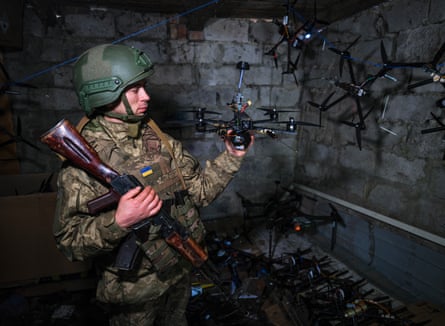
Yet expectations of a Russian breakthrough remained low, analysts and officials said, with Moscow’s forces continuing to struggle against Ukraine’s dense network of drone defences.
Rob Lee, a senior fellow at the Foreign Policy Research Institute who frequently visits the Ukrainian frontline, said: “The battlefield situation is better for Ukraine right now than it was in 2025.”
Across much of the frontline, both sides have turned large stretches of terrain into “kill zones”, areas saturated with drones and other unmanned systems, where any movement is quickly detected and struck.
Russian forces advanced at roughly half the pace in early 2026 compared with a year earlier, according to the Institute for the Study of War.
Lee said: “There are some signs that Russia’s manpower advantage may be narrowing, and without it, their advances could slow.”
He added that while Ukraine continued to face serious manpower shortages, it had significantly scaled up its mid-range drone capabilities, targeting Russian air defences and military command posts deep inside Russia.
Earlier this year, Ukraine mounted its own counteroffensive in the southern Zaporizhzhia region, recapturing about 100 sq miles (260sq km) of territory in the first two months of the year.
“I wouldn’t be surprised if we see additional Ukrainian offensives this year,” Lee said.
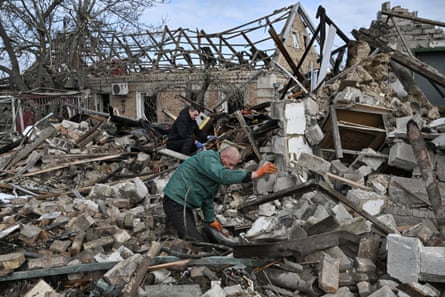
For millions of Ukrainians, however, this offered little relief. Russia fired more drones at Ukraine in March than in any month since the full-scale invasion began, according to Kyiv.
Last week in western Ukraine, a Russian drone strike killed a serviceman and his teenage daughter just moments after they had visited his wife and newborn son in a maternity hospital. In Kherson, an elderly woman was killed by a drone as she stood in the courtyard of her home.
Vladimir Putin, meanwhile, has signalled that he is willing to maintain constant pressure and wear Ukraine down over time if it refuses to leave Donbas.
“From the start of the war, Putin has believed time is on his side,” said a person familiar with Kremlin thinking. “The talks had already lost momentum and were going nowhere.”
In conversations with business elites in Moscow last month, Putin indicated the war would continue until Russia captured the remaining parts of the Donbas still under Kyiv’s control, according to two people familiar with the meeting.
Ukraine, for its part, has sought to show it still holds cards.
One source close to the Zelenskyy administration said: “We are still positive that our partner, the US, will help us. But we also need to show we are still in this fight.”
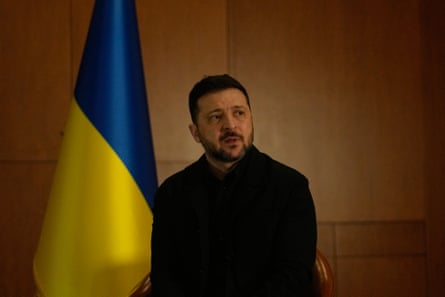
Zelenskyy has asserted Russia is suffering heavy casualties, with more than 35,000 troops killed or wounded in March alone, as Ukraine seeks to inflict losses faster than Moscow can replenish through recruitment. These claims could not be independently verified. But Russia’s mounting losses appear to be seeping through in reports from pro-war Russian bloggers who are often embedded with the military.
Romanov, a prominent war blogger, wrote: “We find ourselves in a situation where Ukrainians are killing more than 30,000 Russians per month, and we cannot replenish our army.”
Ukraine has also increased strikes on Russian energy infrastructure, aiming to erode the financial gains Moscow has reaped from higher oil prices triggered by the war in the Middle East.
The attacks have targeted ports and oil terminals in the Baltic and Black Sea, exposing weaknesses in Russia’s air defences and temporarily halting up to 40% of export capacity, according to Reuters.
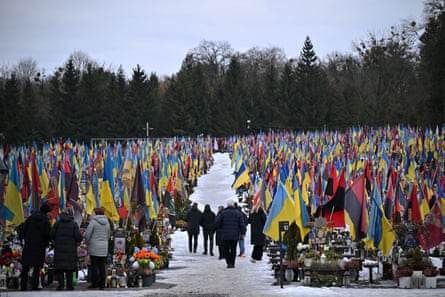
But Ukraine is paying a heavy price too. Kyiv does not publish its casualty figures, but Ukrainian officials, including Volodymyr Zelenskyy, have said the country’s losses are roughly a third of Russia’s – a figure that would still amount to about 10,000 killed or wounded each month.
On a recent Guardian visit to a newly opened military cemetery outside Kyiv, rows of freshly dug graves stood as a stark reminder of the war’s toll.
Ukraine also continues to grapple with recruitment challenges, which at times have spilled into the open.
Draft dodging persists, and viral scenes of conscripts being forcibly taken to recruitment centres remain a fixture on Ukrainian social media. In Lviv last week, a mobilisation officer was stabbed to death while attempting to draft a man.
At the same time, Kyiv faces mounting financial pressure. Ukraine risks running out of funds to sustain its defence within months, with Hungary’s vetoing of a €90bn EU package underscoring the fragility of western support.
Despite the high costs for both sides, a European official said that, without a diplomatic breakthrough, the war was expected to continue into next year.
“Both sides still have enough resources to keep going,” they added.











Comments