
 German (DE)
  English (US)
  Spanish (ES)
  French (FR)
  Hindi (IN)
  Italian (IT)
  Russian (RU)
  2 weeks ago
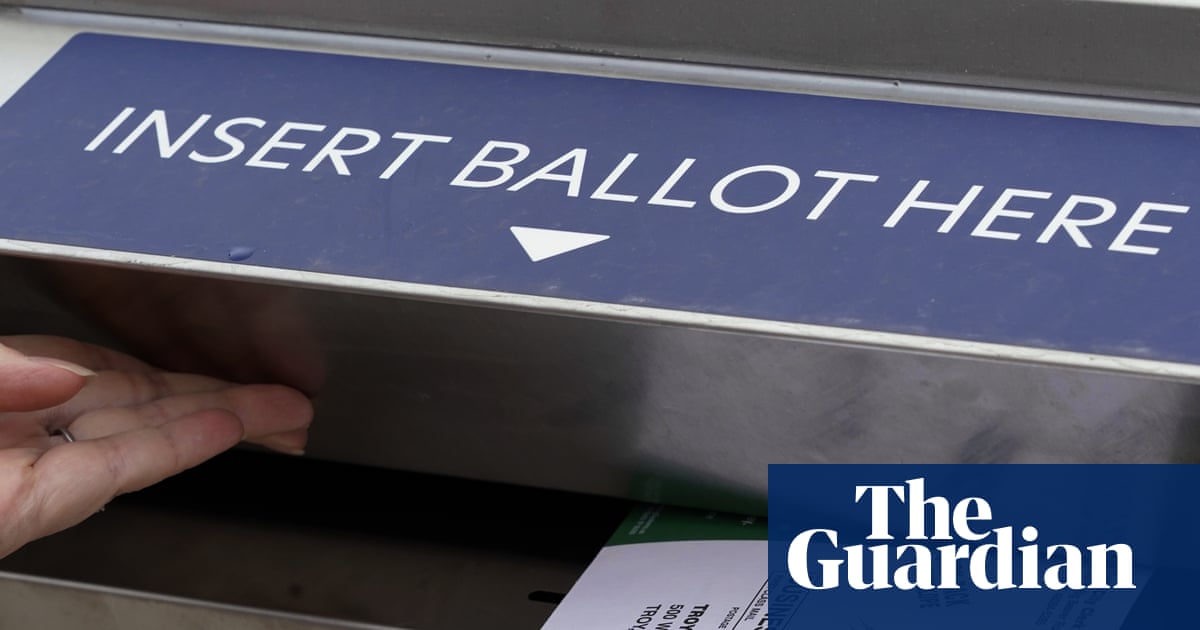
The US supreme court on Wednesday revived a lawsuit by a Republican congressman in Illinois that challenges a state law allowing mail-in ballots to be counted if they are received after election day.
The lawsuit from Mike Bost was viewed by Donald Trump-aligned conservatives as an avenue to continue attacks on mail-in voting. Bost argued that the Illinois law allowing ballots to be counted up to two weeks after election day if they are postmarked by the deadline unconstitutionally allows an extension of the election period.
Chief Justice John Roberts wrote the 7-2 decision, with two of the court’s liberal justices dissenting.
“Candidates have a concrete and particularized interest in the rules that govern the counting of votes in their elections, regardless whether those rules harm their electoral prospects or increase the cost of their campaigns,” Roberts wrote. “Their interest extends to the integrity of the election – and the democratic process by which they earn or lose the support of the people they seek to represent.”
In a dissent written by Justice Ketanji Brown Jackson and joined by Justice Sonia Sotomayor, the liberal justice said she would have ruled against Bost because “political candidates can and should be held to the same actual-injury requirements as other litigants”.
“By carving out a bespoke rule for candidate-plaintiffs – granting them standing ‘to challenge the rules that govern the counting of votes,’ simply and solely because they are ‘candidates’ for office – the court now complicates and destabilizes both our standing law and America’s electoral processes,” Jackson wrote.
Oral arguments in October centered on whether a federal candidate has standing to challenge the law, not whether the practice itself is constitutionally valid. Justices asked questions about whether they should view a political candidate as an “object” of the law – an entity for whom a regulation bears a direct consequence, and whether the odds of mail-in ballots tipping an election had bearing on whether a candidate had a right to challenge the law.
Sixteen states as well as Guam, Puerto Rico, the Virgin Islands and Washington DC accept and count mailed ballots received after election day when postmarked on or before that date. Eight states send a mail-in ballot to every voter while also offering in-person voting. Four of those states – Washington, Oregon, California and Nevada – also count late-arriving mailed ballots.
Republicans have been eager to challenge mail-in ballots, with Trump centering it in his attacks on the electoral process. The president issued an executive order in March instructing the attorney general to “take all necessary action” against states that are “including absentee or mail-in ballots received after election day in the final tabulation of votes for the appointment of presidential electors and the election of members of the United States Senate and House of Representatives”.
The Brennan Center, the American Civil Liberties Union, the League of Women Voters and other organizations immediately sued to block the order from taking effect.
The Illinois case reached the supreme court after lower courts threw Bost’s suit out, ruling that the conservative congressman in his fifth term did not suffer an injury and had no standing to sue. The appeal argued that the cost of staffing a campaign past election day is a financial injury giving him sufficient standing to challenge the law.








Comments