
 German (DE)
  English (US)
  Spanish (ES)
  French (FR)
  Hindi (IN)
  Italian (IT)
  Russian (RU)
  3 weeks ago
In an incredibly polarised society, there are fewer and fewer things that seem to unite both sides of the aisle in the US political system. Yet it turns out that an objection to Wall Street’s grand heist of single-family homes has done just that.
We might expect Alexandria Ocasio-Cortez and Elizabeth Warren to rail against the incursion of institutional investors into residential real estate markets, causing rent prices to jump and effectively locking millions of households out of home ownership. However, I admit I was surprised to see JD Vance and Marjorie Taylor Greene striking a similar note. But I was completely dumbfounded to see the real estate tycoon and Wall Street darling Donald Trump sing from the same hymn sheet.
Earlier this month, Trump announced his intention to ban large institutional investors, such as asset managers and pension funds, from acquiring single-family homes. On Tuesday, he signed an executive order doing just that and called on Congress to pass it into law. “Homes are built for people, not for corporations,” he told the audience at Davos the next day.
Although this stance against the corporate takeover of housing might seem sensible to readers, it places Trump far to the left of Britain’s Labour party. In fact, Keir Starmer and Rachel Reeves have spent much of their time in power attempting to win over firms such as Blackstone, once the largest owner of single-family rentals in the US. They are now one of many financial companies about to have their wings clipped by the Trump administration’s most recent policy shake-up.
Starmer is staking his reputation on his pipe dream of building 1.5m homes over the course of parliament and inaugurating the next generation of new towns. Steve Reed, the UK’s latest housing secretary, announced his ambitious plans for the sector at Labour’s party conference in Liverpool in September while sporting a red cap with the slogan “Build Baby Build!”. Many found his performance evocative of Maga’s knack for spectacle, with its abrasive rhetoric and sartorial choices.
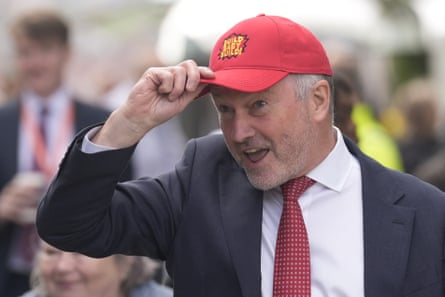
Real-estate industry insiders expect large institutional investors to play a critical role in delivering new housing in Britain. They point out that the new towns plan is implausible without such investment. Corporate landlords are set to deliver up to a quarter of these new homes through build-to-rent schemes, including developments with single-family rental homes.
Single-family rentals, whether in the US or UK, can comprise detached homes or low-rise blocks of flats owned and managed by a single investor or consortium. In the UK, investment is pouring into wealthy commuter towns in Cambridgeshire and Hampshire. In the US, it’s the suburbs of affluent cities in the sunbelt region – sprawling places such as Atlanta, Georgia, Jacksonville, Florida and Charlotte, North Carolina. Institutional investors now own one in every four or five single-family homes in these rental markets.
The UK’s single-family rental market remains small in comparison, even in localised areas with high levels of investment. This might change quickly, as Trump’s announcement has already prompted analysts to forecast a shift in activity towards the UK. According to real estate consultancy Knight Frank, single-family rentals now account for 40% of all investment in the booming build-to-rent sector. This represents remarkable growth for an asset class that essentially did not exist prior to 2020.
As for Trump, it remains uncertain why he decided to tread this path. Taking an educated guess, I believe he is responding to his lack of progress on the affordability agenda he campaigned hard on (and won) in 2024.
The most recent figures released by the Bureau of Labor Statistics show rents and food to be the main drivers of US consumer inflation. Trump’s desperation to slash costs and bring back a sense of prosperity to the electorate is seen most plainly in his unprecedented threats and criminal investigation into Jerome Powell, the chair of the Federal Reserve. He knows he’s in hot water if he doesn’t turn the macroeconomic picture around before the November midterm elections.
The issue, however, is that Trump draws immense support and millions in donations from a real estate industry that benefits hugely from persistent rent-price inflation. But desperate times call for desperate measures – and the president seems to be willing to bite the hand that feeds him in order to try to remain in power.
The Trump administration likely realises that 19 of the 20 largest single-family rental markets are located in states Trump won in 2024. He also knows that his electoral heartlands lie in the middle-class suburbs that are rapidly shifting away from home ownership and towards renting. There is a clear political necessity here that must override allegiances to the donor base.
In stark contrast, Starmer hasn’t a clue where his vanishing base lies. Communities across the country are already mobilising a front against his new towns plan. Social housing-led developments could help overcome this aversion, given two-thirds of voters are supportive of the expansion of council housing stock. But Reeves’s self-imposed fiscal rules make direct public investment in housing a nonstarter, leaving the government without any other option but to knock on Wall Street’s door with a begging bowl in hand.
In the UK’s fractious political system, there is still one thing that unites renters and homeowners, the working class and the aristocracy, racists and anti-racists. It is our deep and unshakeable distaste for the government of the day. Housing policy seems to be yet another area where no one is particularly happy.
-
Adam Almeida is a writer and researcher living in London














Comments