
 German (DE)
 English (US)
 Spanish (ES)
 French (FR)
 Hindi (IN)
 Italian (IT)
 Russian (RU)
 48 minutes ago
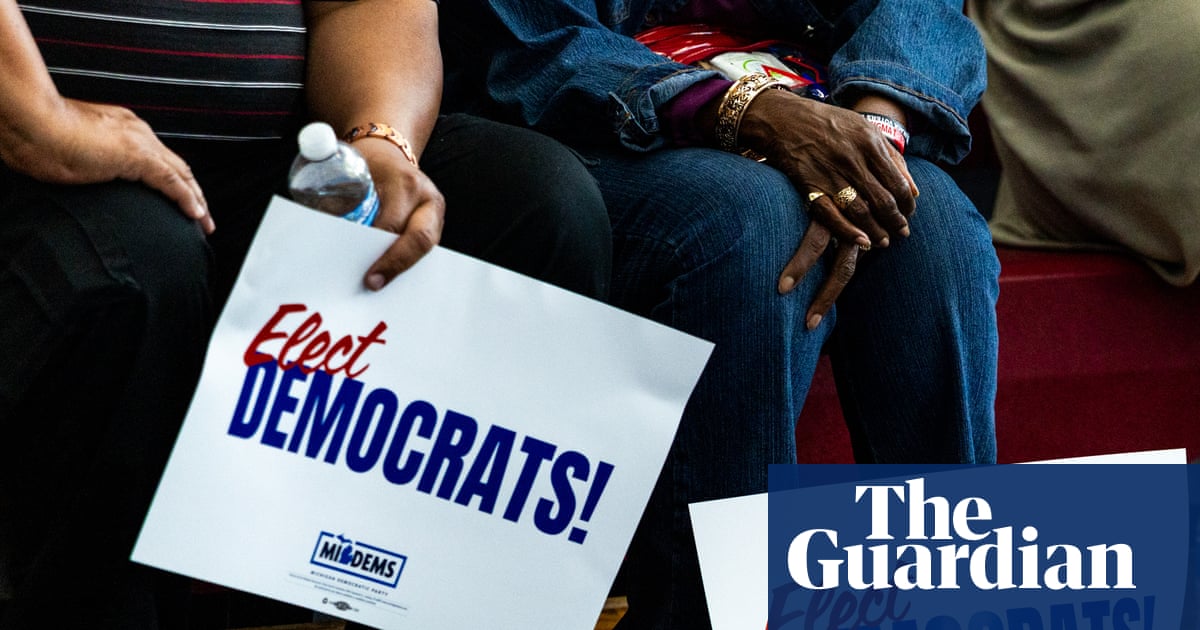
Fresh from an overwhelming victory, Democrats might quickly divide over what should be seen as unnecessary fracture.
Establishment figures demand a focus on “kitchen table issues”, while others insist that successful candidates did not just campaign on the cost of living, but managed to connect people’s daily struggles with the unprecedented corruption of the Trump administration.
Indeed, Democrats have a mandate to enforce accountability. And it is imperative not to treat accountability as some kind of abstract moral question; even the most hard-headed politicians have to understand that the inability to deal with crimes and misdemeanors now will come back to haunt them – and, in fact, the nation as a whole.
Kamala Harris counseled that Democrats should concentrate on “commonsense legislation”, since the votes for impeachment simply are not there; Barack Obama has – as always – called for politicians to bring the country together.
As wise as this advice might sound, they would amount to continuing what the writer Richard Beck has called our “impunity culture”. Richard Nixon was forced to resign, but then promptly pardoned by his successor; Ronald Reagan’s Iran-Contra shenanigans never had any real consequences; after Abu Ghraib, Obama urged us to move on.
We moved on – and eventually found ourselves with Donald Trump, whose whole experience in life, business and politics has been one long morality tale about how elite figures get away with it. He has also made it a basic principle of his approach to governing that impunity can be exchanged for loyalty: after all, his underlings believe that he will pardon them before 20 January 2029.
What has happened more than once is likely to happen again. If Democrats do not find ways of holding Trumpists accountable, the message to present and future politicians will be: there are never consequences. This will also provide an incentive for those fearing the law to enter politics.
What’s more, the repercussions of impunity for Trumpists are not confined to the US: for any other government ever to trust an American administration again, there would have to be globally visible accountability, as well as a comprehensive cultural distancing from Trumpism.
Concretely: no triumphal arch or statues, golden or not, can remain standing; no foreign visitors should ever land at airports named after a president who both inspired and oversaw hitherto unknown levels of corruption (as well as cruelty).
And in the short run? Democrats can force both administration officials and associated oligarchs to testify under oath. Of particular interest would be figures who claim to be civilians, but de facto exercise state power: think Jared Kushner.
And, of course, Elon Musk. As the political scientist Dan Moynihan has pointed out, it is absurd that Elon Musk has appeared more often on Saturday Night Live than in front of Congress to talk about Doge; the country needs answers about what his vandals did in 2025, whether they stole and weaponized data, and how exactly his companies remain untangled with the American state – creating a kind of dependency on one person that, as Ukraine discovered already, is incompatible with any kind of responsible governance.
As in the last years of the first Trump administration, those called to testify might simply ignore the invitation to the Hill. Democrats can go to court, and they will win, but all that takes time.
The policy scholar Norm Ornstein has suggested the Capitol police should simply capture recalcitrant individuals and hold them at the Capitol. That is legally possible and even has precedents; but it is unlikely to happen (though it would also provide a symbolic closure of the period that began with Maga hordes assaulting Congress on 6 January 2021).
Direct legal consequences are also unlikely, as long as the Department of Justice sees itself as merely an extension of the president’s will. Many lawyers have left; the sycophants who replaced them are often unqualified, and, in any case, unwilling to do anything about rampant corruption and criminality.
That leaves impeachment. While the votes might not be there in the Senate, Democrats could start to go after the most egregious cabinet members – Hegseth and Robert F Kennedy Jr might compete for the top of the list.
Impeachment has a political purpose – it is meant to prevent further damage to the Republic – but it can also serve a pedagogical function. It shows citizens the evidence for crimes and misdemeanors, and that evidence, carefully assembled, can then eventually also be helpful to a Department of Justice that has regained its integrity.
If nothing else, the country, just like societies emerging from authoritarianism elsewhere in the world, will need a precise record of what happened, for a sense of closure, if nothing else.
Republicans will cry “weaponization” – again. But that simply shows that they are unwilling to entertain any limits on the behavior of their leader and what must be called his extended mafia state.
And, who knows, some Republican senators might jump ship when confronted with the question of whether they still support a secretary of defense, who has done enormous damage to US military power.
Self-declared moderates among the Democrats will say that precious political capital and public attention should not be squandered on issues which have no impact on people’s day-to-day lives.
But this profoundly underestimates citizens’ desire for justice; it also fails to see that, with a large majority in the House, one can do more than one thing. As Raphael Warnock keeps reminding his party, one can walk and chew gum at the same time.
-
Jan-Werner Müller is a Guardian US columnist and a professor of politics at Princeton University














Comments