
 German (DE)
  English (US)
  Spanish (ES)
  French (FR)
  Hindi (IN)
  Italian (IT)
  Russian (RU)
  3 weeks ago
Some of the Democratic party’s most prominent figures – and possible 2028 presidential contenders – descended on New York City this week for the annual National Action Network (NAN) convention hosted by the Rev Al Sharpton, where discussions centered around the upcoming midterms, affordability, the war in Iran and the future of the Democratic party.
“Now more than ever, it’s on all of us to stand up for the future of our country, doing some public service – at a minimum, everybody has to go vote in this coming election,” the Illinois governor, JB Pritzker, told the crowd on Thursday.
The convention, which began on Wednesday and runs through Saturday, marks one of the largest gatherings of potential 2028 contenders for the Democratic party seen yet.
Lawmakers including Pritzker; Maryland’s governor, Wes Moore; Pennsylvania’s governor, Josh Shapiro; the California representative Ro Khanna; and the Arizona senator Ruben Gallego have all taken the stage. Expected on Friday and Saturday are the former transportation secretary Pete Buttigieg; Kentucky’s governor, Andy Beshear; the Arizona senator Mark Kelly; the South Carolina representative Jim Clyburn; and former vice-president and 2024 Democratic presidential nominee Kamala Harris. (It has been reported that California’s governor, Gavin Newsom, and the New York representative Alexandria Ocasio-Cortez were unable to attend.)
Basil Smikle Jr, the former executive director of the New York state Democratic party, told Bloomberg this week that the convention “has become a very important convener for issues specific to the African-American community and the activist community”.
“No candidate will be successful in a primary or win a general without Black voters,” Smikle said, adding that the conference is a key step in Sharpton’s endorsement process.
On Thursday morning, Moore, who was elected as governor of Maryland in 2022 and is viewed as a rising figure in the Democratic party, took the stage with Sharpton, who asked him about the war in Iran.
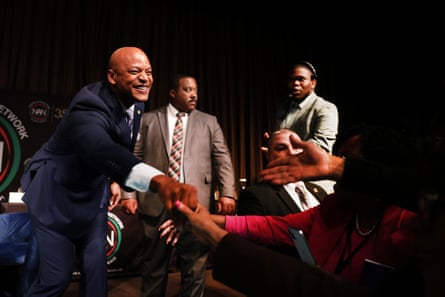
A combat veteran, Moore described the war as “personal, because I know what these soldiers are going through right now, and what their families are going through”.
“The conversations that are happening or not happening with Iran and all of our global partners is challenging; the biggest challenge for me, though, is the lack of conversation that’s happening with the American people,” he said.
“These are our taxpayer dollars that are being used to do this. We are now watching how our gas prices continue to skyrocket, energy prices continue to skyrocket, groceries are more expensive, and we are doing this foreign war that none of us asked for, but it’s being done in our name.”
Moore continued: “The United States military is the best military in the history of the world, there is nothing that the United States military, militarily cannot do, [but] the question is: should we be doing it? And I do not think that the president of the United States has answered that question.”
Like many speakers, Moore repeatedly returned to the issue of affordability, sharing how his own mother’s energy bill has increased in the last year.
When Sharpton pressed him on 2028 and whether he would run, the audience erupted in applause. But despite the speculation on his future, Moore, who is running for re-election this year, did not speak about his possible 2028 ambitions, but instead stressed the importance of the 2026 elections.
“Anyone and any of these people who are thinking about 2028, I need to see that you’re taking 2026 seriously,” he said, before adding: “I’m hungry, but I’m not thirsty. I need people to take this moment seriously and understand the type of assault that we are under right now and show me something now.”
Upon Pritzker, who is also up for re-election this year as governor of Illinois, joining Sharpton on stage, he told the crowd: “We won’t have a future for this country if we do not fight to preserve our democracy, so that’s just a predicate to everything else.”
But, he noted, “you don’t win elections by talking to the public about democracy”.
Pritzker said people’s most important issues are often how they will pay rent, bills or education costs, let alone retirement.
“I know everybody uses this word, ‘affordability’, but we need to talk about it in very plain language. It needs to be about lowering costs for people,” Pritzker said, adding: “We also need to raise the minimum wage in this country.”
Like Moore, Pritzker avoided speaking about his 2028 plans, instead emphasizing his re-election campaign and the importance of the midterms.
“I’ve been involved every presidential election, one fashion or another, since I wasn’t an adult, and I’m going to be more involved than ever before in 2028 because we can’t lose,” Pritzker said.
Gallego, who represents Arizona in the Senate and has also been floated as a 2028 contender, talked about shifts he saw among working-class voters, particularly Latino men in the 2024 election.
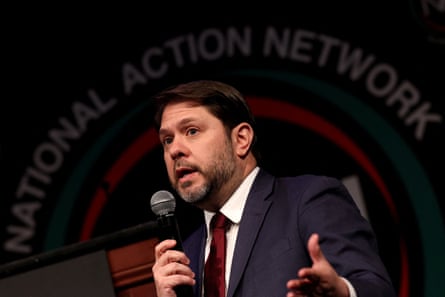
“In 2024, we saw working-class Latino men cross over and go for Donald Trump,” he said, adding that when he spoke with them, “one of the things they were always talking about is ‘I want to buy something, I want to build something, I want to own something, I want to feel like someone’s fighting for me’”.
Gallego said that he believes if the Democratic party focuses on those things, then it will be victorious.
“Then we need to actually follow through on the actions once we win,” he added, before also deferring questions about his presidential ambitions.
“We’ll deal with those questions post-2026,” he said.
The broader debate about the Democratic party’s direction surfaced repeatedly throughout the convention.
Ro Khanna said on Wednesday that the party needs “more moral clarity” and “conviction”.
“We are going to stand for human rights in this country,” he said. “We’re going to stand for economic rights and economic justice, and we’re going to stand for a moral vision of America. What I would say is that the Democratic party, we need to let it rip a little more. We need to talk about our moral vision a little bit more. We need to be conviction-based.”
Also during Wednesday’s program, Josh Shapiro, the governor of Pennsylvania, framed the midterms as a “national referendum on Donald Trump and on what is happening in Washington DC” and urged people to get out and vote.
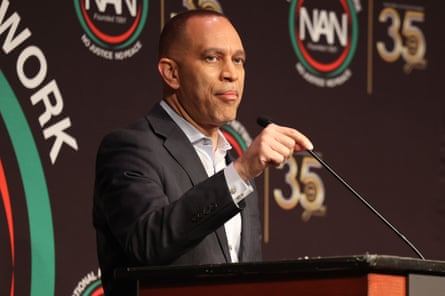
Other conference attenders included the Democratic House leader, Hakeem Jeffries, the Massachusetts representative Ayanna Pressley and others.
Harris is scheduled to join Sharpton for a “fireside chat” on Friday. In interviews since leaving office, she has not ruled out another presidential bid. Sharpton recently told Politico that Harris is an “absolutely a potent force in the Black community” and that he believes that “she has been ignored, and we’re going to raise that at our convention”.
At the convention on Thursday, Monet S Wilson from Chicago described the speakers as “inspirational” and told the Guardian that she valued the opportunity to engage with people about what’s to come in 2026 and 2028.
She pointed to Pritzker’s remarks on housing and affordability, and said she’s also watching figures like Moore, Newsom and Khanna for 2028. She said she was looking forward to hearing from more speakers on Friday and Saturday.
“I’m excited for the energy,” she said.
Other attenders echoed that enthusiasm. Wallace Bradley, also from Chicago, described Pritzker’s remarks as “right on time” and said that he appreciated Moore’s remarks. Bradley emphasized that he would support any Democratic nominee “that’s understanding the needs of the people”.
“We got to listen to the people,” he said, adding that he believes that Democrats need to be more focused on the agenda in the midterms and in 2028 to win.
Benita Barnes, who traveled from Houston, Texas, and recently joined her local NAN chapter, said the current political climate motivated her recent involvement. The convention, she said, has left her feeling more hopeful and inspired.
Still, for some, it’s simply too early to make decisions about 2028.
New York resident Annette Wilcox told the Guardian that she feels as if she hasn’t heard enough yet from the possible Democratic presidential contenders to make up her mind.
“It’s very early,” she said.







Comments