
 German (DE)
  English (US)
  Spanish (ES)
  French (FR)
  Hindi (IN)
  Italian (IT)
  Russian (RU)
  3 weeks ago
Before the street outside her mother’s home filled with gunfire, before panicked partygoers sprinted through the front yard, before she discovered that the body on the ground was a young man she had watched grow up, Khlilia Daniels knew something in Bogalusa had to change.
It was December of 2022, and Daniels had spent the year watching her home town on Louisiana’s border with Mississippi become a steadily more frightening place. Murders, once rare, now seemed to be happening almost every month, shootings every other week, and in a city of just over 10,000 people, that violence felt close, the losses personal. The victims and perpetrators were predominantly Black, usually young and too often cousins, neighbors or the children of friends, people whom Daniels would see around, until suddenly they were gone.
When her niece wanted to have a party to celebrate her 15th birthday, Daniels became worried, because such gatherings had turned violent in the past. She took every precaution possible to make the birthday a safe one, holding it at a property next to her mother’s house, and enlisting two friends to search everyone who came inside for weapons. When a boy she suspected was involved in gun violence arrived, Daniels approached him with a request: “Please don’t shoot my building.”
For two hours, 50 or so kids danced to music on a pleasant December evening. Then, without warning, two gunmen opened fire into the crowd, sending people crashing through her mother’s front door and fleeing through the neighborhood. When the shooting stopped, Daniels walked outside to see two people wounded on the ground, and a third, 15-year-old Ronié Taylor, fatally injured.
Daniels had known him since he was in kindergarten, and his death changed something for her. “It’s just like a light came on, and I knew what I needed to do,” she recalled.
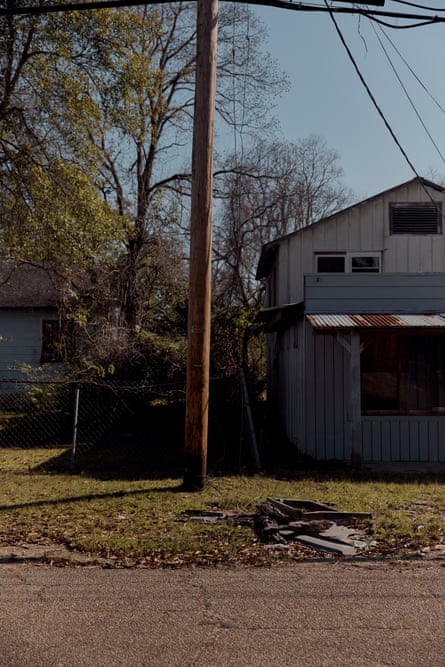
Not long after, Daniels founded Forever Takes a Village, a group that she hoped could address the societal forces in Bogalusa that had caused its violent crime rate to skyrocket. Her effort had a far away but powerful champion: Joe Biden, whose justice department had just won Congress’s approval to spend hundreds of millions of dollars supporting community violence intervention (CVI) programs, which seek to address the root causes of crime just as it was spiking across the United States in the wake of the Covid pandemic.
Daniels would later be awarded a $250,000 federal grant and, together with national criminal justice advocacy group Equal Justice USA, put together a plan to turn Forever Takes a Village into the sort of intervention group that had been working in nearby New Orleans and Baton Rouge for years. Staff would be hired, office supplies purchased and, perhaps somewhere down the line, Daniels would open a youth center, to give young people a safe place to congregate in a city that offered them little.
Her plans ground to a halt in April of this year, shortly after Donald Trump returned to the White House and embarked on a controversial campaign of slashing government spending. His justice department cancelled $800m in funding meant for groups combating gun violence, sexual assault, hate crimes and related issues nationwide, which included the grant Daniels received. Equal Justice USA lost so much funding that, after more than three decades pursuing criminal justice reform, it was forced to close.
To 32-year-old Daniels, the funding cuts have a singular consequence for her hope of making her community safer. “We’re back at stage one,” she in an interview.
In 2018, Daniels left her job at a charter school to open a bakery on Bogalusa’s main drag, thinking that making cupcakes and brownies was how she’d spend her life. Her plans changed in the wake of the Covid pandemic, when the business became unviable, and the city she thought she knew changed for the worse.
Built so fast in the early 20th century that it gained the nickname “Magic City”, Bogalusa was established around a saw mill situated amid the pine forests of south-eastern Louisiana. The Ku Klux Klan was known to be powerful in the town amid the civil rights struggles of the 1960s, and as recently as 2008, local police tied the nearby killing of an Oklahoma woman to the Klan.
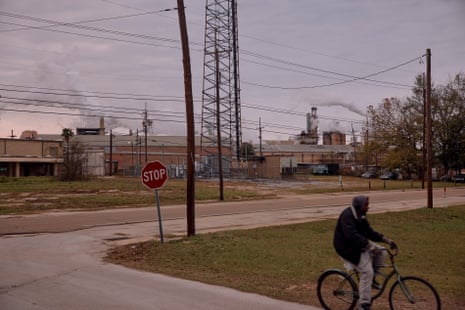
The mill remains operating in the center of the city, fed by a steady stream of trucks bearing denuded logs and emitting ceaseless vapor clouds over its neighborhoods. The smell of rotten eggs pervades the streets nearest to it, and this year, the Environmental Protection Agency fined its operator International Paper $500,000 over violations of the Clean Air Act.
Yet the mill has not rescued the town’s economy. About one in three Bogalusa residents live below the poverty line, and the population, today predominantly Black, is about half of what it was at its peak in the 1960s, according to census data. It has also lost much of what Daniels believes its young people need. The bowling alley she remembers from her childhood is gone, as is the movie theater. So, too, is the sense of safety Bogalusa’s streets once had.
Daniels thinks the lack of activities for the youth could be the reason why crime became so common as Covid spread. Or perhaps it was social media, and the way it allowed insults to turn into beefs that culminated in fights. Or maybe it was just in line with the national increase in violence that accompanied the pandemic, in which children became the victims, killers, or both.
“Our community, the way everybody knows everybody … I think we’ve kind of lost our way a little bit,” said James Smith, the police chief who is the first African American to hold the job. “But we’re slowly working our way back, especially with the 2022 situation.”
There were nine homicides that year, which helped push Bogalusa’s violent crime rate to an average of 646.1 per 100,000 people, according to Equal Justice USA. That was close to double the national average, and above the rate for the whole of Louisiana, which has some of the worst violent crime in the country.
Among the victims was 24-year-old Javorius Scott, better known as the rapper JayDaYoungan, shot to death in a case that remains unsolved. Jerry Smith, 16, was gunned down outside Bogalusa high school’s homecoming football game, and a teenager was later convicted of manslaughter. In the immediate aftermath of that shooting, a rival high school decided to forfeit its match against Bogalusa rather than travel to the city to play.
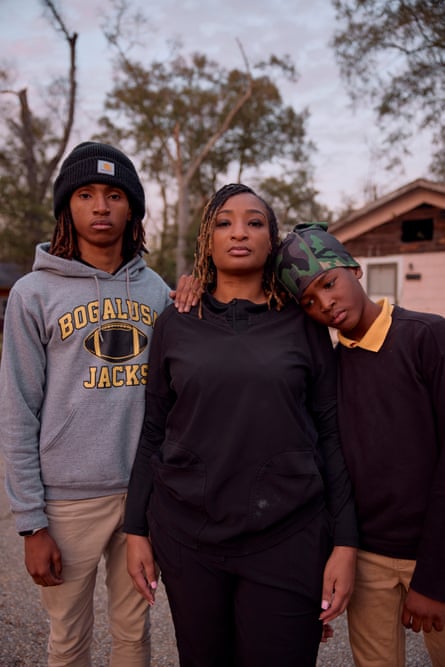
In August of the following year, 19-year-old Tajdryn Forbes, a former high school football standout, came to visit Bogalusa from his job on an offshore oil platform. In the early hours of a Saturday morning, he left his mother Naketra Guy’s house to see his girlfriend. Seconds later Guy heard a barrage of gunfire, and ran outside to find him lying prone in the street, his body riddled with bullets fired by gunmen who hid in a nearby house. She watched as her 60-year-old mother, who had been staying with her, knelt over Forbes, trying to give him CPR.
“He was the glue to the family. He the one that kept everybody together,” Guy said. She still does not know the motive for her son’s murder, but days later, police arrested a cousin in relation to Forbes’s death. He later pled guilty to manslaughter and was sentenced to 20 years in prison. In January, police announced a second arrest related to Forbes’s death, but a grand jury could not reach a decision on his indictment, a spokesperson for the district attorney covering said.
Again and again, the victims were people Daniels knew. Aaron Brown, an 18-year-old brother of a classmate, was fatally shot in 2021 as he was walking through a neighborhood, not far from where school busses were letting off students. Right after the gunfire at her niece’s birthday party the following year, Daniels remembers seeing two attendees sobbing on her mother’s porch. One would be murdered outside a basketball game in 2024, at the age of 14. The same year, the other would be indicted on charges of second degree murder and attempted murder, at the age of 15.
Daniels’s grandmother used to tell her, “it will for ever take a village to raise a child”, and she chose that saying as the name for her new group. In early 2023, she began organizing get togethers with mothers who had lost their children to gun violence, people who Daniels said otherwise did not get much support.
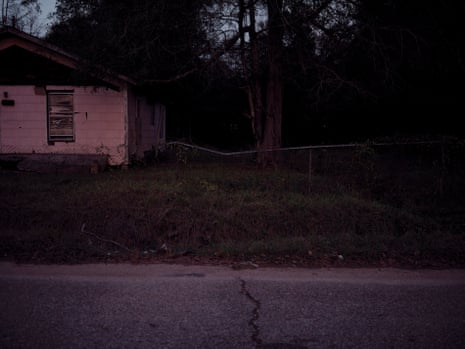
“She helps whoever. It doesn’t matter if they’re related or not, she’ll try to help you, and she allows our kids to have a voice and us to be able to speak for our kids,” said Tawasha Bonner-Hargrove, whose 17-year-old son, Ja’Quarius Tyler, was murdered in 2020 in a town about 15 minutes north of Bogalusa.
Around that same time, Equal Justice USA began working with the administration of Tyrin Truong, a 23 year old who had just won election as Bogalusa’s first Black mayor. They began strategizing on ways CVI could make the community safer, and it wasn’t long until Josie Alexander, a strategist with Equal Justice USA, met Daniels.
“She wanted to do an organization to save young people,” Alexander said.
There’s no one way to run a CVI program, said Insha Rahman, vice-president of advocacy and partnerships at the Vera Institute of Justice, a non-profit that is suing the Trump administration for cutting the justice department grants. Some work with police, others don’t, some hire professional staff and others operate more like a “labor of love,” she said. But all are focused on addressing the things a community lacks that drive the cycle of violence and retaliation, and are beyond the mandate of the police and prosecutors.
“Things like rec centers, after-school programs, opportunities for young people, mentoring, youth employment are all actually very strongly associated with preventing and reducing gun violence and youth violence in general,” Rahman said.
Daniels and Alexander began collaborating, and over the months that followed organized listening sessions with specific groups of residents that were intended to get a window into what plagued Bogalusa.
“We had a 16-year-old boy tell us he’s never seen safety for him to tell us what it looks like,” recalled Alexander. Another session gave parents whose children had been lost to gun violence the opportunity to share the pain they carried everyday. When they sat down with the white residents who make up 40% of Bogalusa’s population, the conversation was dominated not by gun violence, but by the toll of drug overdoses.
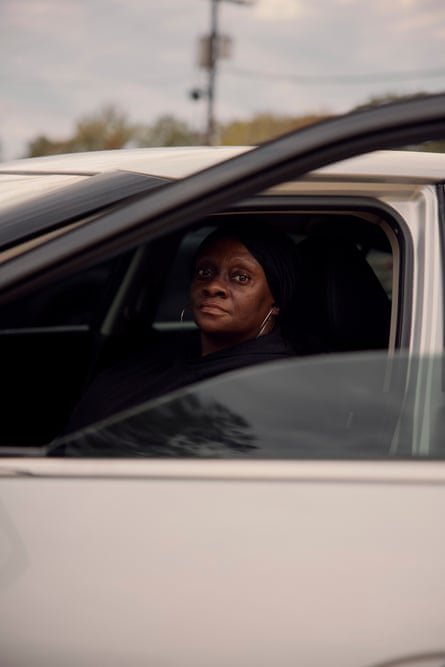
“It helped a lot, because it helped with the ones that lost family members or whatever to gun violence, and some that family had been a part of it,” Daniels said. At one point, a woman stopped her at a high school homecoming parade, and told her: “You have put families together that hadn’t liked each other for years.”
When Biden took office in 2021, his administration was ready to embrace CVI as part of the criminal justice reform agenda he had proposed after George Floyd’s murder, according to Amy Solomon, a former US assistant attorney general who oversaw grant-making at the justice department. With the help of appropriations from Congress, as well as a bipartisan law meant to address gun violence after the Uvalde massacre in Texas, the department awarded about $300m in grants to about 100 different CVI programs in 35 states during Biden’s term.
“We have a good deal of evidence that shows that these type of approaches are effective in saving lives,” Solomon said in an interview. “We were only funding programs that were focused on the highest risk individuals in neighborhoods or jurisdictions with high violent crime rates, and they were organized around the elements of what works in CVI programs.”
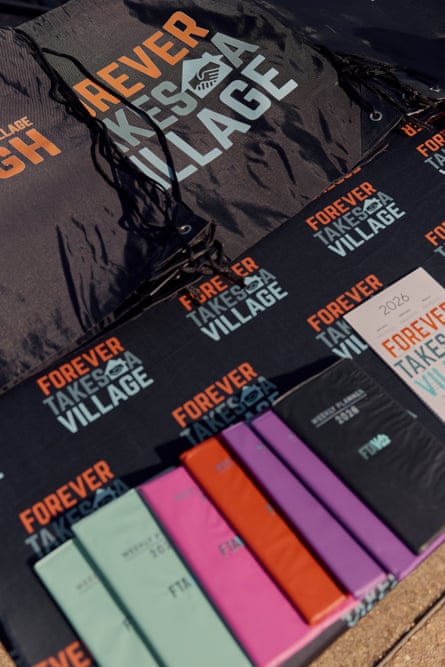
Equal Justice USA was among the recipients, and in December of last year awarded Daniels a $250,000 sub-grant that she could use to build out Forever Takes a Village. But Daniels said it took until January 2025 to get access to the funds, and she could only use them to reimburse expenses – which was a problem, because she said the only cash Forever Takes a Village had was whatever she could spare from occasionally selling baked goods.
One day in April, Daniels received a call informing her that the grant was being canceled. She was initially unfazed, then recognized it for what it was: the loss of the momentum she thought Forever Takes a Village had. “I felt like everything was moving forward, and we just got a blow in the back,” Daniels said.
A justice department spokesperson did not address why funding for Forever Takes a Village or Equal Justice USA was cut, but said: “This Department of Justice is focused on prosecuting criminals, getting illegal drugs off the streets, and protecting all Americans from violent crime. Discretionary funds that are not aligned with the administration’s priorities are subject to review and reallocation.”
The department reopened CVI funding in September, but only for city, county or tribal governments – meaning neither Daniels nor Equal Justice USA would be eligible. Recipients would also have to promise to comply with federal immigration enforcement efforts.
Bogalusa recorded four homicides in 2023, and two in both 2024 and 2025 thus far, according to police data. Former city council member Michael O’Ree said stepped-up enforcement by the police and prosecutors played a role in that, as did the efforts of Daniels’s group.
“With one domino fallen, with her not receiving her new funding, I mean, all it would take us a couple of dominoes to fall and we’d be right back in the same boat,” O’Ree said.
In January, Truong was arrested as part of a sprawling drug-trafficking investigation. He has pleaded not guilty, and did not respond to a request for comment. Later that month, Louisiana’s fiscal review committee appointed an administrator to take over Bogalusa’s finances, citing concerns with its ability to pay its bills.
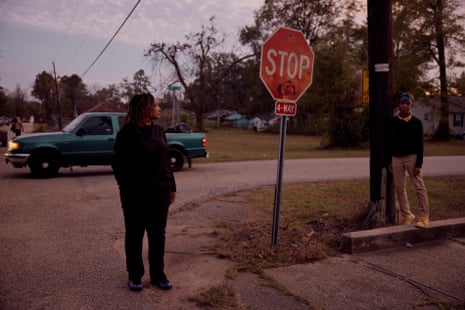
Daniels tried to give baking another go in the back of the same faded blue building where she held her niece’s birthday party, but found working there too disturbing. “We repainted the inside, but I knew where the bulletholes was,” she said.
On a windy Wednesday morning in early December, Daniels set up a folding table alongside a host of other social services in the parking lot of a senior center to collect expired medication, in exchange for frozen turkeys. Forever Takes a Village is still alive, and such events were helpful in getting the word out about her work.
As she handed out tote bags and stickers bearing the group’s name to a slow stream of passing motorists, her mind was elsewhere. A couple of days prior, two people had been injured in a shooting on a street about a mile from where her niece had her birthday. From what Daniels had heard, the incident was connected to a burglary, and one of the victims’ mothers had been approached by someone who warned that the next time he saw her son, he’d kill him.
“I’m hoping it doesn’t lead to something else,” she said.













Comments