
 German (DE)
  English (US)
  Spanish (ES)
  French (FR)
  Hindi (IN)
  Italian (IT)
  Russian (RU)
  3 weeks ago
Millions of people are expected to protest the Trump administration at more than 3,000 No Kings events in cities and small towns across the country on Saturday. Ezra Levin, co-founder of Indivisible, one of the groups coordinating No Kings, said he expected it to be “the biggest protest in American history”.
This will be the third No Kings protest since Trump was re-elected. A flagship event will be held in Minnesota’s Twin Cities – Minneapolis and St Paul – after residents stood up to the surge of federal immigration agents the Trump administration sent into the region earlier this year. In January, agents killed two residents, Renee Good and Alex Pretti, who were observing Immigration Customs Enforcement (ICE) activities.
Levin said in January that the third No Kings is a response to many Americans’ growing outrage over ICE and the Department of Homeland Security’s (DHS) “reign of terror” in communities across the country. Invisible co-founder Leah Greenberg recently told the Guardian that the Iran war is also motivating people to step out into the streets.
“Every No Kings is going to be about the issues that are driving people most at that moment,” said Greenberg, “and it’s also going to be about the collective ways in which they begin to harm our democracy.”
What are the No Kings protests?
The first No Kings protest took place in June 2025 as a response to what organizers saw as rising authoritarianism from Donald Trump, and built off the success of earlier “Hands Off” rallies coordinated by Indivisible, an anti-authoritarianism group with more than 2,000 chapters,
As immigration enforcement ramped up across the country, the second No Kings event in October drew 7 million people to 2,700 locations.
The No Kings Coalition emphasizes the importance of safety and non-violence. Organizers were trained in de-escalation, the coalition said, and were working closely with local partners to make sure protests stay safe and lawful.
Who are the groups associated with No Kings?
No Kings is coordinated by the protest organizations Indivisible, which was founded in 2016 after Trump was first elected president, and 50501, which stands for 50 protests, 50 states, one movement. The groups also bring in a broad range of partner organizations, labor unions, legal organizations such as the American Civil Liberties Union, and advocacy groups such as the Movement for Black Lives.
Where are the No Kings protests?
The upcoming No Kings has more than 3,000 associated events, according to its online tracker. Groups outside the US are holding protests, too – in Cuba, Mexico, Ecuador and throughout Europe.
Where can I find No Kings in my area?
All of the events planned for 28 March can be found on the No Kings’ tracker on its website.
What’s happening in Minneapolis?
The “flagship” No Kings event will be in Minnesota’s Twin Cities, where residents have continuously protested against the presence of ICE agents and the killings of residents Good and Pretti. Senator Bernie Sanders, actor-activist Jane Fonda, and singer-songwriters Joan Baez and Maggie Rogers will headline the rally.
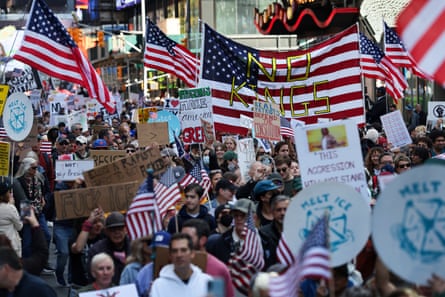
In January, Levin told the Guardian that the people of the Twin Cities are setting a gold standard for what resistance under Trump could look like: not stopping at just one day – or form – of action.
“You need to develop the muscle and the sophistication of your pro-democracy movement that you’re able to do more than show up on a Saturday in historic numbers,” Levin said. “You have to show up in the way the Twin Cities did, but do it everywhere.”
What issues are people protesting exactly?
When announcing the 28 March No Kings event, Levin described No Kings’ animating goal as to “safeguard democracy from an authoritarian” with “organized, nonviolent, insistent people power everywhere”.
More recently, Greenberg told the Guardian that the two motivating issues they’re currently hearing about are the Trump administration’s war on Iran and ICE agents’ continued presence in US cities.
On their site, No Kings organizers also note they are protesting the administration’s mass deportation campaign, the criminalization of protesters, attacks on voting rights and the expense being spent on war while domestic social services flounder.
Why aren’t No Kings protests more frequent?
The No Kings coalition hosts several online trainings in English and Spanish – including “know your rights” – to help communities build other types of resistance skills outside the coalition’s large, single-day protests. It’s part of Levin’s idea of “developing the muscle” for a pro-democracy movement.
Putting five months between the last No Kings and now was also a way to help grow the movement and ensure that Saturday’s turnout surpasses the previous record of almost 7 million people, Levin said.
What other actions are organizers calling for?
According to Greenberg, organizers hope to invite attendees to join other forms of protest or advocacy, such as attending a local ICE watch training, participating in economic boycotts, testifying against a planned DHS warehouse or joining a mutual aid group. She said that the guiding principle of No Kings is that it is only one of many ways to resist.
“We want to get the big show of defiance, but what we think is actually more important is the ways in which these large-scale gatherings fuel ongoing organizing,” said Greenberg. “If we’re doing it right, it’s all connected, and it’s all designed to support the kind of activism that is possible only when there’s genuine local leadership and people who are owning the fight everywhere in the country.”
Do protests work?
Whether or not the No Kings protests will alter the course taken by the Trump administration remains to be seen, though experts and historians say that in general protests do have the power to change policy and public opinion.
In Trump’s second term, Americans have adopted various protest strategies, especially when responding to ICE. When ICE agents arrived in Los Angeles in June, protesters chased them out of their hotels with bullhorns and a band playing Mexican songs. Amid the surge of federal agents in Washington DC in August and September, residents banged pots and pans in a tactic from Latin America. Whistles, blown to alert neighbors of agents in the area, have become a recognizable symbol of ICE monitoring and an accessory at protests nationwide.
A Guardian analysis of data from the Crowd Counting Consortium found that protests last year outnumbered those in the first year of Trump’s first term. Erica Chenoweth, a protest researcher, told the Guardian: “It is a very historic time, in the sense that people are mobilizing where they live in ways that I don’t think I have seen before in my lifetime.”
According to Levin, the third No Kings rally is designed to not only push back against what he called the Trump administration’s authoritarianism and the lawlessness of ICE agents, but also to invite in people who have not participated in protests before.
“No Kings 3 is not the end of the movement,” said Levin. “Authoritarians typically do not give up power willingly … You need to develop the muscle and the sophistication of your pro-democracy movement that you’re able to do more than show up on a Saturday in historic numbers. You have to show up in the way the Twin Cities did, but do it everywhere.”







Comments