
 German (DE)
  English (US)
  Spanish (ES)
  French (FR)
  Hindi (IN)
  Italian (IT)
  Russian (RU)
  2 weeks ago
The lawyer Mike Godwin famously came up with the “law” that, as an online discussion grows longer, the probability of a comparison involving Nazis or Hitler approaches one (or 100%).
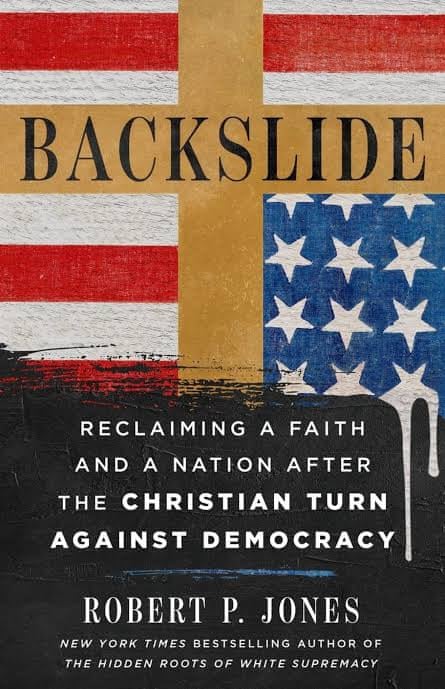
Robert P Jones thought long and hard about whether to go there in his latest book. But the more he studied US demographic numbers, considered the rise of Christian nationalism and heard Donald Trump use the language of racial purity, he found the conclusion inescapable. “This is our 1933,” he writes.
So it is that Backslide: Reclaiming a Faith and a Nation After the Christian Turn Against Democracy begins with the rise of the Nazi party and the complicity of the German people, including German Christians and churches.
Jones cites Martin Niemöller, a Lutheran pastor imprisoned for opposing Hitler, remembered for the poem First They Came. But for the first four years of Hitler’s reign, he notes, Niemöller did not fully oppose the Nazis. He later regretted that he and the Protestant German church did not speak out sooner.
Backslide returns to the analogy in its epilogue. He writes: “Just as God asked Niemoller where he was between 1933 and 1937, God will ask us where we were between 2025 and 2028. Just as Germans who backed Hitler and the Nazi Party after 1933 were fully aware of what they were joining, so Christians who have backed Trump and the MAGA movement a second time know and bear responsibility for what they are now endorsing.”
Sitting in his downtown Washington office, the president and founder of the Public Religion Research Institute (PRRI) contends that US democracy is experiencing a severe “backslide” that is directly aided and abetted by an “apostate” white Christianity, including Trump’s language on the campaign trail.
“This dehumanising language, talking about immigrants as vermin, and this racial purity language, like they’re ‘poisoning the blood of our country’. What does that mean? If they’re poisoning the blood, what’s the pure blood? We know where that story goes,” he said.
Trump has repeatedly used the concept of genetic inheritance. In 2020, addressing a mostly white crowd in Minnesota, he declared: “You have good genes, you know that, right? You have good genes. A lot of it is about the genes, isn’t it, don’t you believe? The racehorse theory, you think we’re so different? You have good genes in Minnesota.”
Normalisation is a perennial danger.
“If don’t want to live in a place where we have a thuggish police force that’s kidnapping people off the street in masks and killing US citizens in the streets, now’s the time to speak up,” Jones said.
Backslide cites historian and philosopher Hannah Arendt’s 1950 The Aftermath of Nazi Rule report for Commentary magazine based on interviews with postwar Berliners: “A great number of Germans, especially among the more educated, apparently are no longer capable of telling the truth even if they want to.”
Jones grew up a Southern Baptist in Jackson, Mississippi, went to church five times a week and earned a master of divinity degree. His previous books include The End of White Christian America in 2016, White Too Long in 2020 and The Hidden Roots of White Supremacy and the Path to a Shared American Future in 2023. He called this one Backslide very deliberately.
In international political science, “democratic backsliding” has become the established academic term for the systematic erosion of democratic norms, judicial independence and voting rights. Yet Jones recognises that the term carries an even older resonance.
“In the evangelical world I grew up in, backslide was a word we heard all the time – a theological word about the fear of falling away from the faith,” he says, tracing the word’s history back through the Oxford English Dictionary to the 16th-century Protestant reformer John Knox.
In Jones’s diagnosis, white American Christianity has committed a profound act of apostasy by trading its spiritual core for political dominance. By endorsing anti-democratic tactics, white Christian institutions have become the primary engine behind the country’s autocratic slide.
To understand how a major religious tradition arrived at this moral impasse, Jones turns to the arithmetic of demographics. When Barack Obama was elected president in 2008, white Christian Americans still constituted 54% of the US population. By 2014, that figure had dropped to 47%. Today, white Christians account for 41% of the country.
The decline among white evangelicals, long considered a bedrock of conservative politics, is even steeper. At the turn of the 21st century, white evangelicals represented a quarter of all Americans; today, they make up barely 13%. The Southern Baptist Convention, the country’s biggest evangelical denomination, has lost more than 3 million members since its 2006 peak.
Faced with shrinking numbers and cultural marginalisation, white evangelicalism embraced not spiritual renewal, but existential panic – creating fertile ground for Trump’s demagoguery.
“Trump loves to talk about the art of the deal and, in many ways, there’s been a massive quid pro quo deal struck between a declining white evangelical population and Trump,” Jones observes. “His big appeal to them was less about policy and more anti-immigrant: I’m going to restore an America that looks like you, and I’m going to restore power to the Christian churches.
“He was literally saying on the campaign trail: this is a quid pro quo deal. Give me your votes and you won’t even have to vote again. I’ll fix it so you don’t have to vote again.’”
This transactional alliance marks a complete departure from the religious right of the late 20th century, which wrapped its political ambitions in the language of morality.
“You don’t hear those words any more,” says Jones, contrasting today’s movement with Jerry Falwell’s Moral Majority or the “Values Voters” summits of the George W Bush era. “What we have now is an overtly anti-democratic Christian nationalism flying under the banner of: ‘We believe this country belongs to us, and we’re going to use the power we can to claim it.’”
This Faustian bargain relies purely on power rather than shared theology – a dynamic starkly highlighted by the contrast between Trump and his running mate, JD Vance. While Vance recently discussed the End Times with 22-year-old evangelical podcaster Bryce Crawford, awkwardly reflecting on his evangelical upbringing and subsequent conversion to Catholicism, Trump operates largely without theological pretence.
Jones continues: “He makes straight appeals to self-interest: if you’re for me, I’ll be for you. Evangelicals are willing to forgive a whole host of sins for the idea that he is going to bring them back into power as their numbers are dwindling.”
The real world manifestation of this transaction plays out every Sunday across thousands of congregations. While high-profile megachurches such as First Baptist church in Dallas make their political allegiance explicit, Jones contends that overt political sermonising is rarely needed.
“Once you have churches that are largely segregated by race and increasingly segregated by partisanship, all you really have to do is keep out any critique. It’s reinforced by Fox News, Christian radio and going home to people of like mind. You don’t have to overtly teach Christian nationalism; you just keep it from being critiqued.”
PRRI’s extensive empirical data undermines the widespread belief that religious attendance automatically fosters civic tolerance or democratic values.
Jones says: “Particularly among white evangelicals, on several measures around Christian nationalism, anti-immigrant views, anti-Black views, and anti-Muslim views, going to church actually makes your views more extreme. It’s not the case that more church is the answer to democracy.”
The dangerous potential of this theological radicalisation materialised dramatically during the January 6, 2021 attack on the US Capitol. Christian symbols were displayed prominently throughout the insurrection, including wooden crosses set up on Capitol grounds and rioters holding “Jesus Saves” banners alongside Confederate flags.
Yet official investigations largely overlooked this central element, influenced in part by political figures like Congresswoman Liz Cheney on the House select committee. “I was stunned to see very little of it in the House select committee report,” Jones recalls. “It was a huge loss and a huge skewing of public perception that we didn’t take those Christian symbols at the riot seriously.”
Today, this blend of Christian nationalism and military authority reaches into the upper echelons of the national security apparatus. The defense secretary, Pete Hegseth, sports tattoos featuring Crusader iconography – including the medieval battle cry Deus Vult (“God wills it”) next to a Jerusalem cross – while renaming the Department of Defense as the “Department of War”. Hegseth has welcomed vocal Christian nationalists such as Pastor Doug Wilson to lead a worship service at the Pentagon.
Jones comments: “I can’t imagine much more dangerous than somebody who thinks, ‘I am the instrument of God, I alone understand how the forces of good and evil are aligned,’ while holding the power to deploy the most powerful military force the world has ever seen. While George W Bush took care after 9/11 to explicitly state that the US was not at war with Islam, today we are making radicalisation propaganda films for extremists by presenting ourselves as a Christian nation at war with Islam.”
Behind the public spectacle of rallies and political theatre, ideologues such as Russell Vought, a key architect of Project 2025 and advocate of the “unitary executive” theory, are laying the groundwork for a government rooted in Christian nationalist principles. “They are building an apparatus designed to institutionalise this worldview across the federal government,” Jones warns. “It is an intentional, long-term project to reshape American democracy in their own image.”
Despite the alarming trajectory detailed in Backslide, Jones resists total pessimism. The central message of his book is that “backsliding is not irreversible” and that national recovery remains possible through honest confrontation with history and sincere repentance.
Across the country, alternative Christian voices are beginning to organise against Christian nationalism. Figures such as James Talarico, a Presbyterian seminarian running for the US Senate in Texas, and Methodist pastor Adam Hamilton in Kansas are offering a pro-democracy theological vision.
“For a long time, mainline Protestants were taught propriety and politeness, leading to a reticence to speak out,” Jones notes. “If we don’t want the public and future face of Christianity to be only Christian nationalism, we have to present a public version of Christianity that is compatible with democracy – one that leans into care for the orphan, the widow and the immigrant.”
Ultimately, Jones argues, neither sacred texts nor historical precedents will dictate the future of US democracy. He hopes his book will make white Christians realise they face a decision similar to the one that confronted the establishment Christian church in Nazi Germany in 1933.
“It’s a wake-up call to see the bright lines that are being crossed, to be clear-eyed about how dangerous that is, and for those readers who are Christian – particularly white and Christian – to realise we have a particular responsibility to offer a different version of faith. Because it is our faith that’s been hijacked and used to legitimise this illiberal, anti-democratic, authoritarian movement that’s running rampant and taking over in the US.”






Comments