
 German (DE)
  English (US)
  Spanish (ES)
  French (FR)
  Hindi (IN)
  Italian (IT)
  Russian (RU)
  1 hour ago
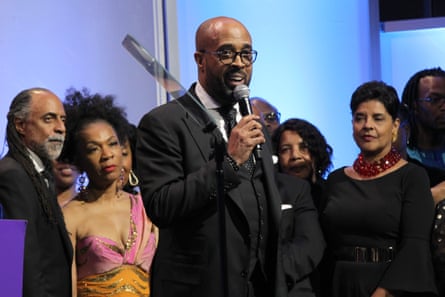
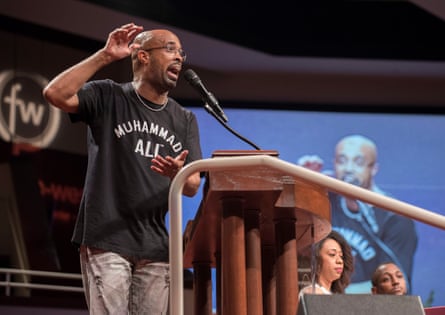
It was that point in the evening: dinner plates were cleared; speeches had run long; people were chatting, milling or eyeing the exit. But then the Rev Dr Frederick Douglass Haynes III took the stage. Bald, bearded, bespectacled and dressed in black, he delivered a mix of fiery sermon and performance poetry. Soon the guests were back in their seats – rapt, listening, clapping and whooping.
Haynes’s rolling cadence was evocative of the pulpit but the political message was far from kumbaya. Aiming to succeed Democratic star Jasmine Crockett in Texas’s 30th congressional district, he danced like a butterfly with references to the boxer Muhammad Ali and rapper Tupac Shakur. But he also stung like a bee, branding Donald Trump as “President Pickpocket” and Republicans as the authors of racist gerrymandering and voter suppression.
“It’s not enough for us Democrats to diagnose the demolition,” Haynes, 65, thundered at last month’s Opal Lee empowerment gala, a Democratic fundraiser in Fort Worth, Texas. “We have to have the vision for a new reconstruction. You see, it’s one thing to talk about how sorry, trifling, cheating and tacky the Republicans are. That’s well known. It’s another thing to have our own vision of reconstructing what this nation should look like.”
The speech reflected a growing trend of religious left candidates aiming to reclaim a faith-based politics they believe has been hijacked by white evangelicals allied with Trump. Haynes, who is African American, is unabashedly progressive, advocating for equitable urban planning, a living wage, laws to dismantle environmental racism, universal healthcare, and the abolition of Immigration and Customs Enforcement (ICE).
Yet for four decades as senior pastor at the Friendship-West Baptist church, a progressive megachurch in Dallas, Haynes had consistently resisted calls to seek office. When Crockett vacated her House seat in the 30th district to run – unsuccessfully – for the US Senate, young progressive activists urged Haynes to run. He initially declined.
When he spoke to the Guardian in Fort Worth, and in a phone interview earlier this year, Haynes recalled: “I have always seen myself, in the language of Jesse Jackson, as a tree shaker and not a jelly maker. We try to make a difference from the outside, working with those who are on the inside.”
The turning point came last December, a week before the filing deadline, when activists challenged him on theological grounds: he had offered political excuses but had not prayed about it. “I find that ironic,” Haynes laughed, “that they would challenge a pastor to pray!”
After consulting the Georgia senator and pastor Raphael Warnock, Haynes reflected deeply. “In one of my prayer times I felt the spirit saying to me, ‘You’ve been talking a lot of smack from the outside, now you have a chance to do something significant on the inside: it’s time to step up.’” Haynes won a decisive primary victory and is likely to succeed Crockett after next month’s midterm elections.
Social justice is embedded in Haynes’s DNA. Born in Dallas and raised in the San Francisco Bay Area, he was named for his grandfather, the Rev Frederick Douglass Haynes Sr (who had named himself after the abolitionist Frederick Douglass), pastor of Third Baptist Church of San Francisco and, in 1945, the first African American to run for the city’s board of supervisors.
His grandfather’s church hosted giants such as WEB Du Bois, Paul Robeson, Josephine Baker and Martin Luther King Jr. His father, Frederick Douglass Haynes Jr, also pastored the church but died at 46 on what was the 14-year-old Haynes’s first day of high school. “Understanding that personal piety and social responsibility go together is part of my DNA and my understanding of the Black prophetic church tradition,” Haynes said.
After college and a brief stint at a San Francisco bank, Haynes returned to Dallas in 1982 to pastor Friendship-West. Over 40 years, he grew the congregation from 83 members to more than 13,000.
A benevolence fund quickly expanded into a wider critique of poverty. He explained: “We should not just be concerned about doing ministry to those who’ve been made poor but we’ve got to question the systems in the richest country on the planet that create poverty.” That led him to team up with the California congresswoman Maxine Waters to fight predatory payday lending in Texas.
Members of Haynes’s church and local Democrats view his foray into politics with enthusiasm. Alan Bean, founder of Friends of Justice, a grassroots alliance that advocates for criminal justice reform, has known Haynes since 2006 and the Jena Six case in Louisiana, when six Black teenagers faced severe charges meant for adults.
Bean, a retired Baptist minister, said: “Freddy Haynes and his church sent six buses of people to Jena. Long before running for Congress, Dr Haynes has been a real presence across Texas and the country as a leader for justice.” He praised Haynes as a “man of action, conviction and deep integrity”, adding that his preaching “blends old-style Black preaching with hip-hop rhythms and language … The media will eat him up because he’s great for a soundbite.”
Bean’s daughter, Lydia Bean, 45, who is running for the Tarrant county clerkship, commented: “For all these years we’ve been working together to hold elected officials accountable to better values, so it’s exciting to see him becoming an elected official. Now we’re going to have to hold him accountable as well!”
At last month’s fundraiser in Fort Worth, EJ Carrion, 37, a business owner, welcomed Haynes’s politics. “I’m excited about the progressive values – fighting for equity and against racism and standing up for DEI. His authenticity and passion are so present. He tackles social justice without creating an us-against-them friction; he does it in a way that’s nuanced and clear.”
Clergy members saw politics as a seamless extension of faith. Pastor Dwayne Hysmith, 59, who oversees 23 Fort Worth churches, said: “He’s very charismatic. He connects with the audience. He can speak from poetry to R&B to spiritually connected all in one, so a person that’s 16 years old to a person that’s 95 can understand the message.”
Hysmith was not surprised to see Haynes running for elected office. “The Bible is a political and a social justice realm, so from Exodus all the way to Revelation, you’ll see politics and social justice in it.”
Haynes’s candidacy is part of a broader movement of progressive clergy taking on the Christian right. At least 14 Democratic clergy members are running in the midterms across a dozen states, including fellow Texan James Talarico, a Presbyterian seminarian running for US Senate against the state’s attorney general, Ken Paxton.
Haynes draws a sharp distinction between progressive liberation theology and white Christian nationalism. Quoting King, he lamented that “white evangelicals are so busy being white, they don’t get around to being evangelical”. He traces Christian nationalism directly from slave traders and Bull Connor, an Alabama politician who unleashed dogs and fire hoses on peaceful protesters in the 1960s, to the present.
“Unfortunately, it’s the same DNA that can support a Donald Trump, who has no Christian tendencies whatsoever,” Haynes argued. “As a matter of fact he’s closer to the antichrist than anybody I’ve ever witnessed. Yet they support him because he appeals to their whiteness and so, even if they marry wickedness to it, as long as their whiteness is taken care of, they’re fine with it.
“That’s dangerous. It’s anti-Christian, it’s anti-Christ, but unfortunately in this country they are the heirs to a legacy of misusing faith in order to further an agenda of greed and power.”
But Haynes does not spare his own party from criticism. He believes Democrats have made a strategic and moral error by retreating from faith-based rhetoric. He points to the presidential campaigns of his mentor, the Rev Jesse Jackson, in 1984 and 1988. Haynes, who briefly succeeded Jackson as the president of the Rainbow Push Coalition, credits Jackson with introducing progressive policies into the Democratic mainstream from a “faith-based prophetic perspective”.
Does this risk alienating the increasing number of secular or non-Christian voters? “The common denominator for all of us is humanity. If you care about human beings, we can work together. I’m not trying to proselytise. I believe every American should have access to opportunities from a justly wired society.”
Haynes’s platform rests on three domestic pillars and an uncompromising foreign policy. First, economic security through economic justice. Labelling it absurd that 140 million Americans are economically insecure, Haynes demands true cost-of-living wages and universal healthcare.
He slammed Trump’s midterm convention in Dallas as a “hot mess” and a burden on taxpayers: “We cannot afford Trump – he’s the face of the affordability crisis. We cannot afford Republican policies that cater to the Epstein billionaire class while crushing those who are poor and left behind.”
Second is environmental justice. In Dallas, life expectancy varies by 15 to 20 years between neighbourhoods just 15 minutes apart due to pollution and asthma. Haynes pledges to fight corporate encroachment and datacentres in vulnerable areas. Third is ending the “cold civil war” driven by Confederate-era policies and corporate greed, building unity around common solutions.
This domestic vision is paired with an unflinching critique of US foreign policy. He views the Trump administration’s global actions as a “disaster for humanity”, pointing to the hypocrisy of the US targeting Venezuela and Iran out of an agenda driven by greed and a thirst for oil.
In a departure from the Democratic establishment, Haynes is uncompromising in his condemnation of US policy regarding Israel and Gaza. “This country has sided with Israel in a full-on genocide,” he said. “I want to clearly state that hatred in any form is dead wrong, and so antisemitism is dead wrong, but so is Islamophobia, so is the extermination, the genocide of people in Gaza.”
Echoing King’s warnings about Vietnam to argue that the bombs dropped abroad inevitably explode the moral authority and spirit of the country at home, he added: “America’s hands are bloody when it comes to what has taken place with the Palestinians, what is going on in Iran. America’s hands are bloody and dirty and it’s something that people of good conscience and goodwill believe is wrong.”
Haynes said his campaign listening sessions strengthened his resolve to get big money out of politics. “Right now we are calling ourselves a democracy but we are tilting toward fascism fueled with oligarchic tendencies.”
Haynes is a longtime friend of Crockett and has been taking her advice during the campaign. He describes her as “a unique superstar” and “the most popular Democrat in the country right now”. Yet Talarico defeated her in the Democratic Senate primary in March.
With Crockett having won the 30th district with 85% of the vote in 2024, Haynes appears poised for victory over Republican Everett Jackson, a small-business owner and community organiser, in November. Meanwhile, polls show Talarico in an excruciatingly tight race with Paxton.
Haynes believes Texas can finally turn blue. “When you look at the numbers of people who voted in the primary, we win. That’s the big fear that Republicans have because unfortunately they don’t have vision except to suppress and to hold people down and make sure the billionaire Epstein class is taken care of,” he said.
“Democrats have a vision, and all we have to do is continue to organise and give voice to those who feel they have no voice and lift up a vision of liberty and justice and affordability. If we do that, there’s no way we cannot win. If we take advantage of that fighting spirit of Jasmine Crockett, we can turn this state blue.”













Comments