
 German (DE)
  English (US)
  Spanish (ES)
  French (FR)
  Hindi (IN)
  Italian (IT)
  Russian (RU)
  2 weeks ago
In the event of a midterms election battering, it is possible that a deflated Donald Trump, constrained by a Democrat-controlled Congress, will gradually have to face up to the indignity of irrelevance.
While continuing to sign off Truth Social posts with his usual, “Thank you for your attention to this matter”, no one will actually be paying much attention. His meandering press conferences will no longer be carried live by TV networks. The Republican party will move on to the question of his successor. Trump could announce he had changed the name of the Champs-Élysées to Sunset Boulevard and even Google Maps will stifle a yawn. He would become that most pitied of political animals, the lame duck.
Yet somehow this scenario does not seem to fit the Trump personality, the US media landscape or indeed the recent history of other presidential endings. Just before completing their own terms in office, George W Bush launched the Iraq war “surge”, Bill Clinton got China into the World Trade Organization and Ronald Reagan helped end the cold war.
Trump will also surely rage against the dying of the light.
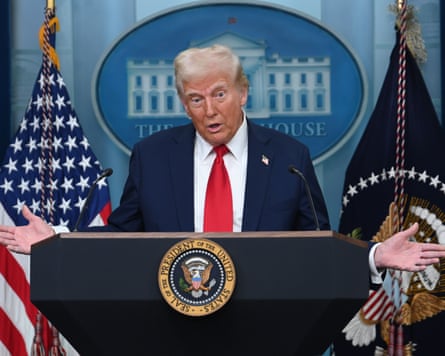
Many observers, including the former US secretary of state Hillary Clinton and the former UK foreign secretary David Lammy, predict Trump will concentrate even more on his disruptive foreign policy after November’s midterms, seeking to go even further and faster. Potential legislative gridlock in Congress would block him off from domestic initiatives, so the thinking goes, but much less so foreign policy.
The likes of António Guterres, attending his final UN general assembly as secretary general this week, who have tried to impress on Trump that the US could achieve more in alliance with others than alone, are likely to receive short shrift.
Those hoping for a return from the orderless world to one of order, loosely built around a set of recognisable values, are likely to be disappointed. In short, there is more to come.
That assessment is accelerating a trend across the world of countries forming a complex web of diplomatic, military and trading alliances designed to act as protective shields from an unpredictable and predatory US president. These hedging alliances, born out of fear of entrapment or of abandonment, are springing up across the globe, changing the matrix of diplomacy, often but not always in favour of the other superpower of the age, China.
John Bew, a foreign policy adviser to four former British prime ministers, describes the process as the creation of “a sub-threshold international order”.
As Mark Carney, the Canadian prime minister, urged in a speech at Davos in January, the middle powers are reorganising. The trend is most obvious among former US allies.
Mark Leonard, the director of the European Council of Foreign Relations, said: “The world is moving from a situation where countries saw themselves within the context of an alliance system – ‘How do we plug and play and make it all about interoperability with American grand strategy?’ – towards one where the primary goal is: ’How do we hedge and how do we make sure that we can defend ourselves if America isn’t there?’”
Wherever one looks it is the alliances in which the US does not feature – from Brics to the Shanghai Cooperation Organisation (SCO) – that are thriving and deepening.
The recent Brics summit in Delhi ended with a declaration 140 dense paragraphs long that centred on how sovereign states can insulate their economies, supply lines, and payment infrastructures from weaponised western financial networks. The aim was to show that the “global south” can shape rules without turning into an anti-American alliance. “The operational strategy does not aim to eradicate the dollar overnight,” the Indian commentator Navroop Singh explained, “but to construct a parallel, non-dollar pipeline through which bilateral commerce, especially in strategic commodities like oil, gas, agriculture, and critical minerals can flow unhindered by extraterritorial oversight of the United States.”
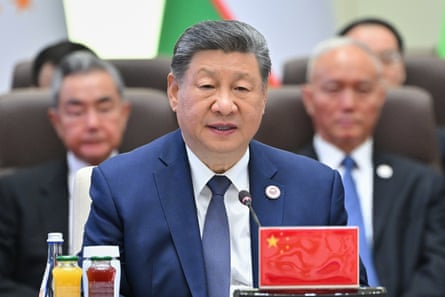
At this month’s SCO meeting at Bishkek in Kyrgyzstan, China’s president, Xi Jinping, said: “The overwhelming majority of countries do not subscribe to power politics, do not want conflict and confrontation, and do not wish to remain closed off and left behind. Instead, they aspire to secure an equal place on the world stage through their own development and international cooperation.”
Formed to manage border disputes among former Soviet states, the SCO’s activities long ago expanded to include an economic dimension fostering connectivity, trade and investment.
By contrast, in the groupings that the US dominates, such as the G7 and Nato, the recent key ambition has been to shape an agenda that avoids a Trump walkout. Success is measured according to whether the west avoids public disintegration.
Sometimes these new ad hoc alliances are relatively mundane. Some operate inside existing institutions, others involve the creation of specific new cooperation trading mechanisms such as memorandums of understanding on trade in critical minerals or the development of new overlapping institutions. In the case of the UK, the Chatham House thinktank suggests as many as six different mini-alliances could be formed to build submarines and air engines, share critical minerals, or promote free trade.
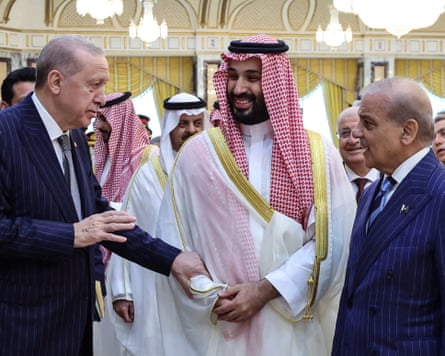
The biggest and most striking recent manifestation of this new order came in the Middle East on 7 August, when Turkey, Pakistan and Saudi Arabia signed the Mecca pact – a defensive military alliance that for some is about ending the dependency on the US military umbrella, and for others combatting Iran. Either way, it is likely to rewrite the Middle East’s security architecture.
Trita Parsi, from the US foreign policy thinktank the Quincy Institute For Responsible Statecraft, said: “If you sit in the Gulf Cooperation Council countries right now, you must feel tremendously vulnerable because you have put all your eggs in the American security basket and it turned out not only not to work, but it was supposed to be a guarantee that others would be deterred from attacking you. Instead, the US started a war against the wishes of most Gulf countries and within that war, the entire infrastructure of the US bases turned out not to be a deterrent, but a magnet.”
Not only were exposed bases pummelled by Iranian missiles and drones to the point, in the words of Gen David Petraeus, that they became “no longer viable”, the Gulf states also discovered the US was prepared to allow Israel to bomb Qatar’s capital, Doha, in the hope of assassinating the Hamas leadership. It was the first such attack on a GCC state, and changed the GCC’s security calculations as to whether Iran or Israel ultimately was the primary threat in the region.
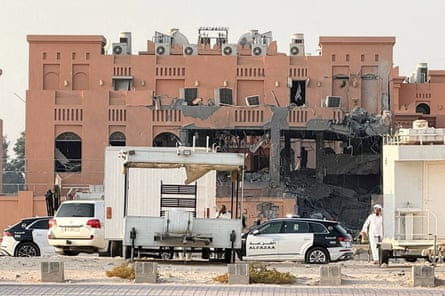
The US insists in public it will reinvest in better-protected bases and will shortly lay out a postwar vision in which the US remains indispensable to the Gulf’s security. But Majed al-Ansari, Qatar’s foreign ministry spokesperson, said: “Gulf nations cannot rely solely on the US and other international alliances for their security. Self-sufficiency when it comes to security is the only way forward.”
Parsi admitted it was not clear what kind of tree would grow out of the seed sown in Mecca. “Is it another bloc formation that at its core divides the region, leading to rivalry and confrontation, or is it, as the Turks insist, an open constellation that is not targeting anyone but based on collective security?”
Saudi Arabia’s Vision 2030, meanwhile, requires foreign investment, tourism and reliable energy routes. Endless wars promoted by Israel and not constrained by the US for purposes not in Saudi Arabia’s long-term interest are a ball and chain on the Saudi economy.
In all this, there are deep implications for India, a country dependent on the Middle East for nearly 60% of its crude oil and about 70% of its liquefied natural gas requirements. It may need to form its own hard power security partnerships in the region.
Writing in Foreign Affairs magazine, Marc Lynch, a professor of political science and international affairs at George Washington University, asked recently: “If Washington could not even be counted on to consult its allies, defeat its adversaries, or protect its partners from the fallout of its regional misadventures, then what good were its promises? The fundamental bargain the United States offered has crumbled, and it will not be easily rebuilt”.
The same set of questions has been posed in Europe, leading to calls for a more Europeanised Nato, most often perceived as an alliance of its five main military powers, a constellation that conveniently bypasses Brexit and would allow Germany, France, Italy, Poland and the UK to work together to face the Russian threat, assuming these democracies next year remain led by forces opposed to Putin’s authoritarianism.
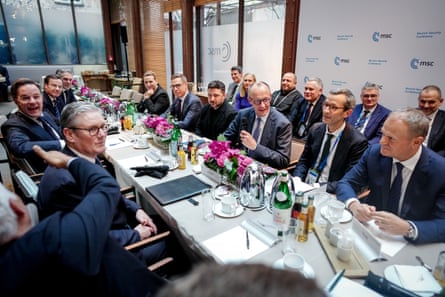
Debate about this alliance, promoted at the Munich Security Conference, is driven by the twin fears of the hybrid war conducted by Moscow and the US plan to leave the conventional defence of Europe to the Europeans. Trumpites treat Europeans primarily as trade competitors and sometimes a civilisational threat, not allies. No one can assume that the US would come to Europe’s defence in the event of a Russian attack. Not surprisingly, Poland, the Baltics and Scandinavia have since 2022 increased their defence spending by 71%, 134% and 126% respectively. The call to buy European arms is growing.
Such is the concern about where Trump could go next after his threats to Greenland, that some European diplomats privately express relief that the US was unable to repeat the success of Venezuela in Iran. There is no love for the Iranian government, save for its ability to remind Europe of the risks inherent in relying on US military and technological supremacy.
The country that most acutely faces the American dilemma is of course Canada. Now entering an asymmetric trade war with the largest and most powerful country in the world, it has little doubt about the rupture it is confronting. Bob Rae, a former Canadian ambassador to the UN, recently wrote: “Canada’s nextdoor neighbour is a predatory hegemon [that] tears up treaties, makes a mockery of international law and clearly has a different concept of the relationships between might and right, and between law, morality and self-interest.”
But there was an ambiguity deep in Carney’s Davos message. Was he seeking simply to locate new markets blocked by US tariffs, or was he trying to build a network of countries – a third bloc – with like-minded liberal values? Rae argued that for the middle nations alliance to thrive, Carney needed to be clearer about what values Canada stands for, including upholding international law. He wrote: “We can succeed in defeating such aggression only if we are willing to extend economic, political and military support to other countries and jurisdictions facing similar attacks and threats.”
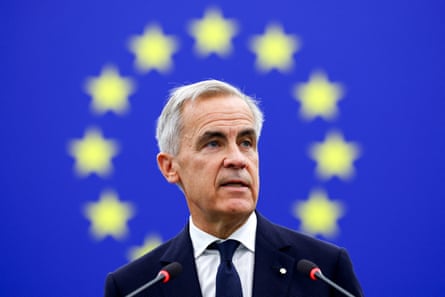
In his speech to the European parliament this week while trying to provide the cure to the harsh realities his Davos speech diagnosed, Carney argued that associate membership of the EU would not just be about economics, but an affinity of deep-rooted shared values that implicitly Canada no longer shared with the US. But the rules-based EU does not give access to its markets readily, and the big vision could soon become entangled in the small print Brussels adores.
Sometimes this crisis of the west is seen as an exclusively European phenomenon. But South Korea finds itself in a similar place to Canada. Ulchi Freedom Shield, the annual joint military exercise that the US and South Korea held to counter the North Korean threat, was abruptly scaled back by Washington just before it was due to begin in August. Trump ordered the drills cut from 11 days to five, citing costs, his desire to improve relations with the North Korean leader, Kim Jong-un, and South Korea’s reluctance to support his war on Iran. The decline in US military stocks due to the Iran war has hardly helped.
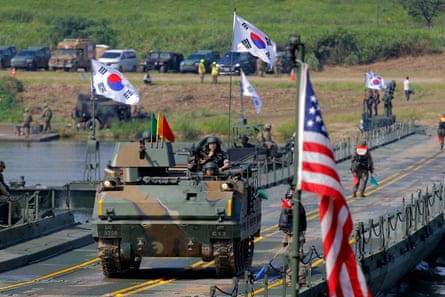
It has intensified a debate in South Korea, and in Japan, about pursuing independent nuclear weapons, especially given the apparent indifference of the US and the international community to North Korea’s programme.
The friction has given Xi a golden opportunity to promote China to South Korea and Asia as the more reliable ally.
Optimists such as Kurt Campbell, who under Joe Biden’s presidency latterly as deputy secretary of state did more than anyone to reconstruct American alliances across Asia after the Trump first term, insists his task can be repeated. There is no need to panic, he said, arguing that “by the winter there will be a dramatic resurgence in discussion, debate, hope and, frankly, optimism about what comes next”. The old centrifugal forces including European aversion to Chinese protectionism and US dominance in artificial intelligence, will resurface.
The counterview is that something fundamental has changed. Once bitten, twice shy, the old transatlantic order will not be restored, and something new, less predictable, more fragmented is already taking shape.












Comments