
 German (DE)
  English (US)
  Spanish (ES)
  French (FR)
  Hindi (IN)
  Italian (IT)
  Russian (RU)
  3 weeks ago
Over the past year, whistles have become a symbol of the collective resistance of ordinary people standing up to federal immigration enforcement. As the Trump administration expands its immigration crackdown to cities and towns across the US, people are relying on whistles to warn their neighbors about the presence of Immigration and Customs Enforcement (ICE) agents.
But not all activists agree on their efficacy. Some organizers, including those in rural areas of the US, say that whistles can heighten panic in the communities they serve. Others say they can create unnecessary confusion for children, the elderly and those with disabilities.
When a few grassroots organizations across the country, from Washington state to Maryland, posted on social media about their decision to keep whistles out of their activism, a debate exploded online. But scholars of social movements say that tactical adaptability is a healthy part of organizing, as coalitions emerge, coalesce and continue to transform to meet the needs on the ground.
“I see this actually as a sign that the movement is actually listening to the people they claim to care about,” said Fernando Tormos-Aponte, a professor at the University of Pittsburgh who studies social movements.
How whistles became a symbol of solidarity
On a late August weekend in Chicago’s Pilsen neighborhood, as crowds gathered for an annual art fair, volunteers handed out an unexpected item alongside their crafts: bright plastic whistles.
“Things had already heated up in Los Angeles,” said Teresa Magaña, a co-founder of the Pilsen Arts and Community House, referring to the immigration enforcement raids that swept the city in the summer of 2025. Later that summer, Chicago, too, had been threatened with federal occupation. “Everybody at that time was feeling very helpless, like, what do we do?”
The whistles were part of an instant community alert system that activists in Los Angeles had begun using to warn neighbors when ICE agents were afoot.
In Pilsen – a historically Mexican Lower West Side neighborhood with deep activist roots – Magaña and locals in the maker community saw a tangible way to respond. They initially ordered whistles in bulk online to distribute for free, but within weeks, local 3D printing enthusiasts reached out, offering to produce them instead.
Now, six months later, Magaña estimates that the grassroots volunteer operation they launched back when Trump set off “Operation Midway Blitz” that rounded up hundreds of Chicagoans has distributed close to 30,000 whistles, shipping orders to organizers and volunteers in roughly 25 states.
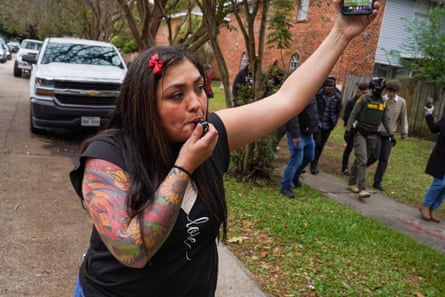
The group has also produced nearly 100,000 copies of a bilingual zine that explains how the alert system works: blow in short blasts if ICE is “driving or lurking” and blow continuously “if ICE is abducting someone”. If someone hears a whistle, they should go somewhere to be safe or “follow the sound, form a crowd, and stay loud”.
“People are seeing each other and connecting in ways they never had before,” Magaña said.
Whistles have helped families in real time, according to Veronica, a lead organizer with Migra Whistle, Portland, Oregon’s ICE alert whistle coalition who declined to share her last name over fears of being tracked by immigration authorities. The term “migra” – Spanish slang for immigration enforcement, or “inmigración” – has been used as a warning call for neighbors to be on the lookout for ICE.
Now, with whistles around their necks, “migra watchers” on bikes or in cars, can identify unmarked vehicles believed to belong to ICE, confirm their presence and then blow a whistle to alert the area. Sometimes neighbors honk their horns, amplifying the signal.
“They don’t like to be noticed,” Veronica said of federal agents. “They do run away from it.”
The idea for Migra Whistle developed last September after Veronica attended a conference about mobilizing community power. There, she heard about whistles being used in other cities as a safety tool. Back in Portland, she connected with a small group of people, including someone experimenting with a 3D printer, and floated the idea.
“It just took off like wildfire,” she said.
Within days, her organization’s group chat ballooned to more than 150 people. Some volunteered to print whistles overnight, while others folded zines, sourced yarn for lanyards, or filled sandwich baggies for distribution. The effort was deliberately decentralized.
“There’s no cap on ideas,” Veronica said. “It’s as decentralized as it can be.”
Today, volunteers help produce hundreds – sometimes thousands – of whistles a week. Some stay in Oregon while others are shipped to Minnesota, Texas and Colorado, among other places, where similar groups have formed. Whistle organizing has strengthened community ties, say organizers, reawakening once dormant networks of people and bringing new energy to neighborhood spaces.
How resistance tactics shift to meet the moment
But not all advocates have had the same experience with whistles.
Late last month in Shoreline, a city about 10 miles north of Seattle, a volunteer was documenting the detainment of Ivan Guzman, a Mexican immigrant father and cook. Guzman was driving his two-year-old son to daycare on a Sunday morning when masked and armed federal agents surrounded his car with four vehicles at a busy intersection.
As officers arrested Guzman and placed him in one of the unmarked cars, advocates say Guzman’s toddler remained in the backseat of an ICE vehicle for more than a half hour. As ICE agents waited for the child’s mother to arrive at the scene, the volunteer began writing down badge numbers, taking video recordings of the immigration agents, and gathering contact information to notify additional family members and lawyers in the Washington Immigrant Solidarity Network (WAISN).
Then, people with whistles began to show up and blow.
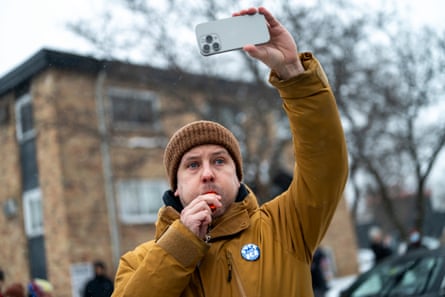
The sharp sound pierced the air. The child, already in shock, began to panic and cry, and agents grew more aggressive as the situation escalated, advocates told the Guardian. It became harder for the volunteer, dispatched through the organization’s rapid response hotline, to hear and capture the time-sensitive details needed to support the child left behind.
For WAISN, which has built up a deportation defense system over the past decade, the moment underscored why it has chosen not to adopt whistles as part of its advocacy strategy.
“We are not against whistles,” said Brenda Rodríguez López, one of the group’s executive directors. “But our strategies are informed by almost a decade of organizing and by recent and longtime direct conversations with rural and urban communities.”
In those conversations, families have reported feeling heightened anxiety when whistles were used in already fraught encounters with immigration enforcement agents, Rodríguez López said.
Other groups say their communities encourage the use of whistles. “I’ve not talked to a single person who’s actually been impacted by ICE or vulnerable to ICE, that is like: ‘Please let this happen as quietly and silently as possible,’” said Veronica. “If someone is taking my loved one, you better make noise about it. Why is this disappearance occurring in silence?”
Regular communication with families across Washington state has informed WAISN’s decision to not use whistles. The organization doesn’t believe whistles and other “loud tactics” don’t make families safer but can increase fear, stress and draw more unwanted attention to families at risk. Advocates with the organization say that whistles can particularly create confusion and fear for elders, children, and people with disabilities in their communities.
How disagreements in movements foster change
The whistle debate illustrates how movements shift and grow to meet the moment and how movements should vary, said Tormos-Aponte of the University of Pittsburgh.
“The mark of a strong movement is often the ability to adapt strategically to the nuances of how things vary across regions,” he said.
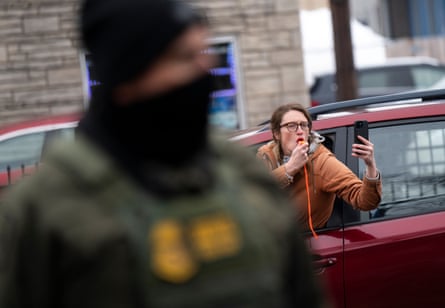
“Strategies are not copy-and-paste,” said Rodríguez López, a recipient of the Deferred Action for Childhood Arrivals program who immigrated to the US from Mexico. “What matters is that we stay focused on defending our communities and building.”
In rural towns such as Basin City, Washington, where she grew up, homes are far apart and downtowns are not easily walkable. Whistles may not be heard – or could draw unwanted attention in areas where hostility toward immigrants already runs high. More than a quarter of reported detentions in Washington occur during traffic stops, often on highways where whistles would be ineffective.
For WAISN, the question is not whether whistles are inherently good or bad, but whether they center the needs of those most affected. As enforcement intensifies, she hopes disagreements over tactics will not fracture the broader movement.
“There is a role for everyone,” Rodríguez López said.









Comments