
 German (DE)
  English (US)
  Spanish (ES)
  French (FR)
  Hindi (IN)
  Italian (IT)
  Russian (RU)
  3 weeks ago
A year into his second term, Donald Trump’s pledge to stage the “largest deportation operation in American history” has already made an indelible mark on the nation.
Nearly 300,000 people have been deported, and a record 65,000 people are being held in detention centers. Aggressive raids by Immigration and Customs Enforcement (ICE) and Customs and Border Protection (CBP) agents, sometimes with the backing of federalized national guard units, have terrorized immigrant communities from Charlotte to Chicago, New Orleans to New York. Enabled by a supreme court ruling that “effectively legalized racial profiling”, immigration enforcement has separated families, forced targeted individuals to miss work, school and doctors appointments, and caused communities to cancel festivals and gatherings.
Despite the best efforts of the Trump administration to suppress dissent, however, Americans have responded to the aggressive assault on immigrant communities with defiance. In cities and communities across the US, residents disgusted by Trump’s attack on their neighbors are banding together in group chats on Signal, an encrypted messaging app, to coordinate community defense. The Guardian spoke with several activists – some seasoned, some brand new – about what they are doing to help.
The real-estate appraiser chasing ICE agents on bicycle
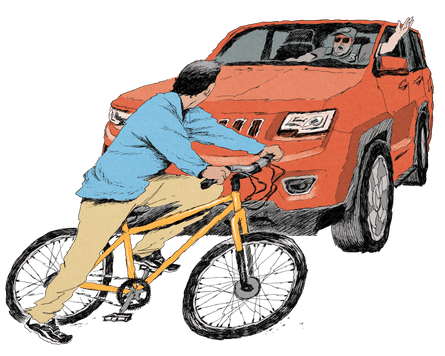
Jose was working from home on the North Side of Chicago on 9 October when he got the message on Signal: “They’re here.”
The Trump administration had launched “Operation Midway Blitz” in early September, sending hundreds of federal agents to Chicago to crack down on supposedly criminal immigrants and intimidate a largely Democratic-voting population; now they had been spotted in Rogers Park, the neighborhood where Jose had lived his entire life, harassing a well-known tamale vendor. (Jose, like many of the activists interviewed in this piece, asked to be identified by a pseudonym out of fear of being targeted by the government.)
Jose jumped on his bike and rode to the intersection in question, where he spoke to bystanders and workers in a nearby restaurant to find out what had happened. When he and a fellow responder spotted a Jeep that matched the description witnesses had given them, they chased it, catching up at a stop light. Jose pulled in front of the SUV and attempted to impede its way. The driver – possibly an ICE or CBP agent – started yelling and threatening arrest; at the urging of another activist, he decided to let the car go. Three days later, when ICE returned to the neighborhood, Jose and his fellow rapid responders had all begun wearing whistles. They followed the agents’ vehicles through the streets on their bikes, blowing their whistles to alert their neighbors to the raid.
A 49-year-old father who in the past dedicated his free time to performing in Gilbert and Sullivan productions with a local community theater, Jose had no experience in community organizing when he volunteered to join the core team of Protect Rogers Park, a group that had organized resistance activities during the first Trump administration.
“My job is real-estate appraiser of all things,” he told the Guardian. “I mean, what a double life.”
Over the spring and summer, he pitched in as the group organized neighborhood assemblies and trainings to prepare for ICE raids or direct actions. “This might seem cliche but the trainings do work,” he said. “We try to simulate what it’s like when ICE agents are in your face and yelling at you and grabbing. It’s like rehearsal, so you don’t have as much stage fright.” There was also a social component; the group set up a book club and everyone read Timothy Snyder’s On Tyranny together. “It’s community building,” he said. “It’s getting to know the people you’re going to be with when the time comes to go up against ICE. Now, obviously, we’re in it.”
When Operation Midway Blitz began, Jose volunteered to do “rapid response”, but he wants others to know that confrontation is not the only way to help. “You don’t have to go chase after ICE agents,” he said. “If you can be a person behind the computer screen directing people or checking license plate numbers – that’s so helpful. Even just standing on a corner with a whistle around your neck provides incredible peace of mind to vulnerable people.”
For those who are up for chasing ICE around: “We have a few goals,” he said. “The first is you want to get more help if you’re alone. The next is you want to try to help the victim as much as possible. The last thing is slowing them down. I’m not going to be able to go up against armed ICE agents with just my bike, so I’ll just stop traffic. We want to make it so it’s just not worth their while.”
“We’re going to outlast them,” he added. “They can’t sustain this forever.”
The fetish shop owner distributing whistles
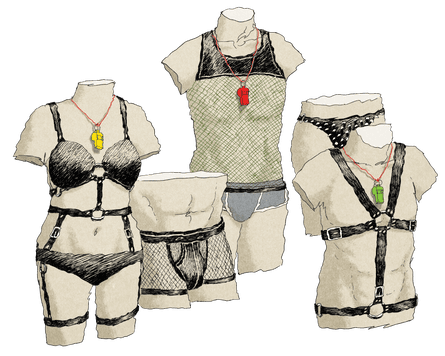
The mannequins in the windows of Red Vault in Chicago’s Rogers Park neighborhood tend to wear a selection of the shop’s fashion and fetish wares, from adult onesies to mesh tank tops and leather harnesses. Starting in October, however, store owner Mark Selner added a new accessory to the display: a cheap plastic whistle worn around the neck.
“I’ve been really angry because I was bullied when I was young, and these are bullies,” said Selner, 59, of the ICE and CBP agents who have flooded Chicago during Operation Midway Blitz. “I’m working in the store all the time so I can’t necessarily attend [protests], so what can I do? I saw people handing out whistles and I was like, let me use some of my white privilege for good.”
Sellner ordered a batch of whistles and put up a notice outside the shop that he was giving them away for free. He also posted a sign warning ICE and CBP agents that they cannot enter his business without a judicial warrant, and, on the advice of community organizers, posted a sign on his backroom that says: “Private Area, Authorized Employees Only”. Within a few weeks, he had distributed almost 400 whistles.
“I don’t want any of my customer base to be afraid to be in here,” he said. “I have the sign on the backroom so that, if need be, someone can go back there and [ICE] is not supposed to go back there legally.”
Customers have been supportive and appreciative, Sellner said.
“I had a customer ask me: ‘How much did you pay for the whistles?’ I said it was $22 and he goes: ‘Here’s $22.’ I said: ‘You don’t have to do that,’ but he was like, ‘No I want to. I’m glad you’re doing this.’
“So I used that to buy more whistles.”
The student delivering groceries to families
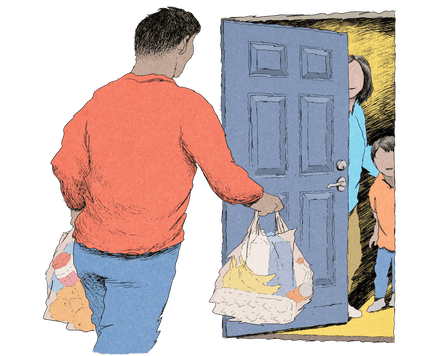
When the Trump administration launched a series of aggressive immigration raids in Los Angeles in June, Miguel Montes quickly saw the impact on Boyle Heights, the heavily Latino neighborhood where he was born and raised. Montes is in his final year of studies for a degree in public health, and he also works full-time as a certified medical assistant at a public hospital.
“I noticed that people were not showing up to their appointments at my job,” he said. “People were not even going out to get food, because they were scared.”
Montes’s passion for providing public health resources to his community had seen him set up an organization, Raíces Con Voz, that ran educational events about hypertension, diabetes and the health effects of climate change in his community. Now, the needs were much more immediate. With a small group of close friends, Montes spread the word that he was organizing grocery delivery for families scared of being detained by ICE. The group circulated an online signup form for families in need of support and solicited donations of goods and cash.
Since June, Montes and his group have delivered groceries to about 1,500 families. They are hoping to expand their reach to the Inland Empire; they also want to figure out a way to connect more people with mental health resources. It’s a personal issue for Montes, whose mother was undocumented until recently. As a child, he had not realized how difficult her lack of legal status made things for her.
“Being a first generation Latino, I don’t know anybody who started their own non-profit,” Montes said. “Everything that I’ve done has been trial and error.”
The parents making sure everyone gets to school safe

When the Trump administration deployed the national guard and amped up immigration enforcement in and around Washington DC this summer, some parents at a predominantly Latino elementary school in Montgomery county, Maryland, proposed setting up “walking school buses” to accompany children to school. The only problem: not everyone wanted them to.
“The community was like, ‘Nah, we don’t need the white folks walking us to school,” recalled Sarah Hunter, 47. “There were folks saying this is necessary, and folks saying ‘I don’t want you here.’ Sometimes you just have to stand in the fray and be willing to mess up.”
Hunter and her co-parent, Jane Palmer, worked with fellow parents, organizers with the Montgomery County Immigrant Rights Collective and school administration figures to come up with a plan for something that would be actually helpful. The compromise plan they hit upon may still be unwanted for some, but they decided that having to work through any conflict was worth it. “That’s not the worst outcome,” Hunter said. “The worst outcome is that we’re not there and people are getting kidnapped.”
They now have a network of about 30 volunteers who are stationed at set locations around the school for a half hour each morning and afternoon during student arrival and dismissal. The volunteers initially identified themselves with a button, but after a parent had 1,000 made, the button spread to the entire school community.
The parent organizers are in touch with other groups that are organizing ICE watch and rapid response in the area, but their volunteers are focused exclusively on the school. “Whenever ICE has been in our school area, we’ve learned about it on Signal before we saw anything visually,” Palmer said.
“We’re really not trying to do surveillance,” Hunter said. “We are greeting families in our community and getting to know each other, saying ‘good morning’, developing friendships.”
“If this does nothing but build community across these populations, then we’ve succeeded,” said Palmer. On Halloween, she wore an inflatable costume of the school’s mascot during her shift outside the school and handed out stickers with the same design as the buttons.
“It was like I was Lady Gaga or something,” Palmer said. “Everyone was talking pictures with me. Some lady handed me her baby to take a picture with … It’s about ICE watch but it’s also about how we build community.”
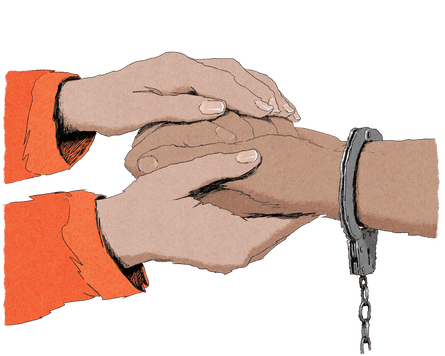
A chilling scene keeps playing out in the halls of Manhattan’s federal office buildings. Asylum seekers attend hearings before immigration judges, receive a future hearing date, and go to leave, only to be surrounded by a crowd of masked ICE agents who arrest them and whisk them away to the bank of elevators.
The detention trap at New York’s immigration courts has attracted a cadre of dedicated court watch volunteers who bear witness to the daily abductions. Their efforts gained national attention in June, when city comptroller and then mayoral candidate Brad Lander was arrested as he attempted to accompany an asylum seeker from his hearing to the subway.
As Lander’s arrest showed, there is nothing the court watchers can do to prevent these detentions. Instead, they do their best to get individuals to fill out a form with their name, A-number and emergency contact. Those forms are then passed on to Mi Tlalli, a volunteer collective whose mission is both simple and expansive. “We provide ongoing care,” said Maria, a member of the collective.
What that care looks like depends on what people need, Maria said. The group has been in contact with 3,000 people and families since May, and has provided direct support to 300 detainees. For those who are being held in ICE detention centers, Mi Tlalli puts $50 in their commissary account weekly. A collective of mental health care providers meets with affected children and family members; the group also has a weekly mutual aid distribution for basic necessities.
“We maintain contact with people who have been deported,” Maria said. “It’s not like we can build them a house, but we can send some money for clothing, and give them some hope that someone cares.”
The knowledge that immigrants are cared for is crucial to Maria, who is a social worker in mental health. She recalled a recent case where an individual was detained on a Friday in New York and sent to a detention facility in Louisiana that Sunday. Mi Tlalli spoke to the individual’s family and contacted an activist group in Louisiana, which arranged to have someone visit the immigrant before they were deported.
“That was the last caring interaction that this person had,” Maria said. “That’s better than going to your court appearance and being put on a plane in chains without ever knowing that someone cared about you.”
“Right now, every undocumented person is at risk,” said Maria, who is undocumented herself. “We may not be able to save everyone, but is that going to keep us from helping anyone? As a person who has had relatives kidnapped, and is at risk of being kidnapped myself, I have to hold on to the idea that there is a way we can organize not just being resilient, not just saying ‘deal with it,’ but coming together to care for each other.”
Spot illustrations by Chris Kim













Comments