
 German (DE)
  English (US)
  Spanish (ES)
  French (FR)
  Hindi (IN)
  Italian (IT)
  Russian (RU)
  3 weeks ago
In spring 2004, Gen Anthony Zinni uttered about Iraq the dreaded words in US politics: “I spent two years in Vietnam, and I’ve seen this movie before.” A year after George W Bush’s declaration of “mission accomplished” – when the war had hit its peak popularity at 74% – the invasion had descended into quagmire, marked by a raging insurgency, the Abu Ghraib torture scandal and US casualties nearing 1,000. For the first time, a majority of Americans judged the war a “mistake”. In this, they echoed what millions of Americans, predicting fiasco, had been saying since before its start.
By the summer of 2005, with Iraq exploding in civil war, public support further eroded. Vietnam comparisons abounded. Running against the war, Democrats had blowout wins in the 2006 midterms. The new Congress empaneled the bipartisan Iraq study group, which concluded that the war had to end. Its fate was sealed by the election of Barack Obama, who made good on his pledge to withdraw US troops (though US forces later returned to take on the Islamic State).
By 2019, 62% of American adults – and a staggering 58% of Iraq/Afghanistan veterans – judged the Iraq war “not worth fighting”. These numbers belie what feels like a deeper, bipartisan consensus that Iraq was a “stupid war”, never to be repeated. Something like an “Iraq syndrome”, similar to skittishness about major military interventions following Vietnam, had taken hold.
With the capture of Venezuela’s Nicolás Maduro, we may be witnessing the opening scenes of a dismal sequel, now to the movie called Iraq. Propelling Trump’s aggression is his gleeful defiance of traditional constraints to war-making, whether international treaties, global norms, congressional consent or the opinion of historic allies. Bush had his own unilateralism, wrapped in cowboy bluster. But his administration secured congressional approval for the Iraq war and at least tried, though failed, to win the same from the UN security council.
Trump rejects even a whiff of constraint. “I don’t need international law,” he boasts. He dares the world to stop or even slow him.
We desperately need an antiwar movement to at least try. At stake is whether we accept a new era of impunity – not, in the near term, of American power per se, but of a largely unpopular leader, claiming God-like omnipotence, to kidnap and kill, bully and bomb without limit.
Here the Iraq syndrome may offer some hope. Perhaps the only limit Trump sees is his pledge, vital to part of the Maga base, to avoid “stupid wars”. This hardly makes him a prince of peace. He clearly revels in violence and coercion. “Stupid wars” are for Trump simply those America can’t easily win, measured by prohibitive costs in (exclusively) American blood and treasure.
Hence his reluctance so far to commit “boots on the ground”. Instead, Trump punches down, using military strikes on the high seas against hapless civilians, special ops, one-off bombings, naval blockades and lethal threats to an expanding list of weak foreign states. America, his administration insists, is not actually at war with Venezuela, even as it kidnaps its leader and he claims to run the country.
Democratic leaders have rightly invoked Iraq to frame the current danger. “I fought in some of the hardest battles of the Iraq war,” the senator Ruben Gallego wrote. “Saw my brothers die, saw civilians being caught in the crossfire all for an unjustified war. No matter the outcome, we are in the wrong for starting this war in Venezuela.” Some traditional Maga loyalists, from Steve Bannon to Marjorie Taylor Greene, have likewise warned of another Iraq.
Trump is at a perilous crossroads. Certain that Maga will never abandon him, he may choose a maximalist course of sizable deployments to Venezuela, or even Cuba, in a bloody bid for “regime change” and the seizure of oil and land. Or he may, mindful of Iraq, pursue supremacy with minimal losses by using threats and remote killing. It’s the difference between imperialism hard and imperialism lite, united in the naked lust for oil profits. Trump could also reverse the current escalation, spinning whatever outcome as victory.
Which scenario prevails may depend on the existence of robust, visible and broad-reaching opposition to war. The antiwar movement of the early 2000s can be instructive.
The movement did not in itself account for the dramatic shift in public opinion on the Iraq war and, at a slower pace, US policy. The war’s utter failure broke Americans’ faith in it. Antiwar activists take little comfort in being vindicated. Hundreds of thousands of Iraqis, many of them civilians, and more than 4,500 US military personnel died in the conflict.
But antiwar protest helped catalyze the turning by steadily appealing to Americans’ hearts and minds. Stepwise, events on the ground validated protesters’ steady narrative of the war’s deceitful origins, disastrous course and intolerable costs, including to Iraqis. As the war worsened, the movement gained greater salience.
The brave stand of the Gold Star mother Cindy Sheehan, demanding to know from Bush “for what noble cause” her son died, had great emotional resonance. New voices, including veterans of the Iraq war, spoke out. Burgeoning antiwar sentiment trickled up to the political class.
In late 2005, the Democratic representative John Murtha – a Vietnam war veteran and vocal war hawk – sent shockwaves by demanding a US withdrawal. Murtha, who had visited severely wounded soldiers and read his constituent mail, concluded that the “American public” was “way ahead” of Congress in wanting the troops home now. The antiwar movement had led the way.
A main lesson from the antiwar movement – widely judged as a failure for not stopping the US invasion – is that steadfast protest can help erode the perceived legitimacy of a war and hasten its end.
The task for today’s antiwar resistance, much as the antiwar movement faced in 2002 and 2003, is to stop war before it more powerfully starts. It won’t be easy. Just building an effective coalition will be a challenge.
The left, sure to lead a new antiwar movement, cannot alone restrain Trump. Only a bipartisan groundswell can. Trump sees the left as an enemy, to be attacked, not listened to. From his own ranks, he demands total loyalty, lashing out at even mild dissent. (After angry phone calls from Trump, Republican senators backed off from efforts to have a war powers resolution guide Venezuela policy.) Antiwar Republicans, facing their own struggles, should be encouraged, not questioned.
Progressives may bristle at making bedfellows with Maga loyalists, even just on the issue of war. Universes separate them, including on Iraq. Leftists generally decry the Iraq war as part of a neo-imperialist project, using 9/11 as a pretext and willful deceit about weapons of mass destruction, for renewed US hegemony. The war failed because Iraqis expelled a clumsy and brutal occupier. For America Firsters, the war was a well-intentioned, but overly ambitious, exercise in “nation building”. It failed because an ungrateful people proved themselves unworthy of the gift of freedom. The war was not so much wrong as wrong-headed. Its authentic victims were the US soldiers sacrificed to Bush’s “globalism”, not the Iraqis.
Neither side has the luxury of requiring broad-ranging affinity as a condition for alliance. The anti-Iraq war movement made decisive electoral and policy inroads only when a sliver of Republicans – who supported the war by a large majority until its bitter end – defied Bush.
Progressives may also wince at “imperialism lite” – in which Trump’s aggression is limited, but not fundamentally challenged – as the best achievable goal. Absent Americans in body bags, much of the country will likely shrug at Trump’s imperial ploys. But even a restrained Trump is a dangerous Trump.
Wins are relative, as the left’s own history shows. In the 1970s and 1980s, a North American “solidarity” movement took hold. A main goal was to prevent the United States from engaging in full-bore military interventions to overthrow popular leftwing governments, like in Nicaragua, or suppress socialist insurgencies, like in El Salvador. Heeding both the “Vietnam syndrome” and this protest, Ronald Reagan used proxy forces, covert action and foreign security services, who ran death squads and employed torture, to pursue his anti-communist ends. Tens of thousands of civilians died. Still, the US left helped to forestall even greater bloodshed, and could claim qualified success. Something similar may be the current hope.
Against this sobering realism, there is a way to dream bigger, grounded in its own realism. The anti-Iraq war movement was profoundly right that the time to stop a war is before it starts. Once unleashed, the destruction is hard to turn back, as “endless war” proved. The tendency of empire is to overreach. Aggressors claim the mantle of virtue, while promising swift and decisive victory. That was the lesson of the Afghanistan and Iraq wars: in December 2002 and May 2003, respectively, Bush declared them over, though they had hardly begun.
Trump may, as his critics joke, “chicken out” on tariffs and select other issues. But with violence, including on America’s streets, his tendency is to double down. So much can go wrong, following from the opening salvos of imperialism lite. That should be enough, if the disaster of the Iraq war holds any lesson, to call the current madness off. May a new antiwar movement make the case.
What’s giving me hope now
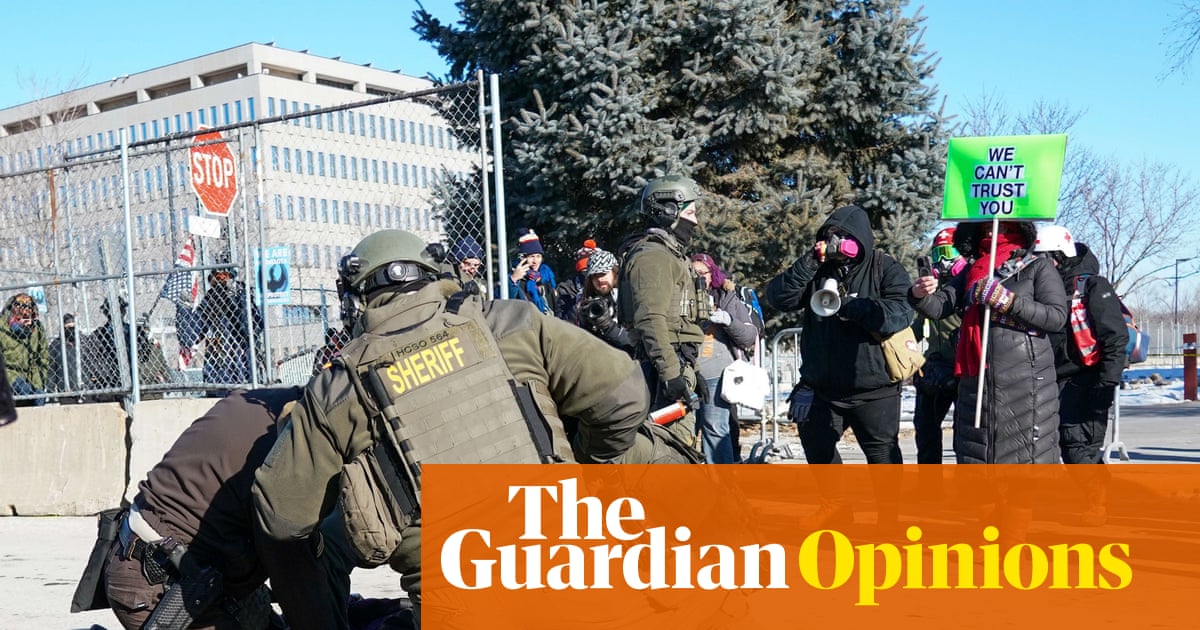
The anti-Trump resistance is rapidly incorporating antiwar messaging – including a critique of imperialism – into its pushback against Trump’s authoritarianism. The nationwide protests last weekend, following the killing of Renee Nicole Good, were billed as: “No Kings, No ICE, No War.” It’s so important to see unchecked aggression at home and abroad as parts of the same authoritarian system we have to dismantle. Many people in the United States remain deeply committed to the US constitution, the welfare of their neighbors and common standards of decency. Even some Trump supporters are souring on his strongman act. We are poised for a democratic renewal, if we work for it.
-
Jeremy Varon is the author of Our Grief Is Not a Cry for War: The Movement to Stop the War on Terror (University of Chicago Press, 2025)












Comments