
 German (DE)
  English (US)
  Spanish (ES)
  French (FR)
  Hindi (IN)
  Italian (IT)
  Russian (RU)
  3 weeks ago
Some historians are wary of discussing their work in light of modern events, comparing subjects to current political players. Not Matthew Pinsker of Dickinson College, the author of both a major new book, Boss Lincoln: The Partisan Life of Abraham Lincoln, and the Substack What Would Lincoln Do?.
“I’m not running away from it, that’s for sure,” Pinsker said from Carlisle, Pennsylvania.
“Obviously, with any historical analogy, there are more differences than similarities, and history never repeats itself. And I don’t want to weaponize Lincoln to just support my view and oppose other views.
“But I feel like we’re in a moment of crisis for democracy and Lincoln is the greatest democratic politician in the history of the world, arguably. And it’s fair to try to draw some inspiration from him, and that’s what I try to do … he can offer insight for Democrats, Republicans, independents and even those who are disaffected. He was human. He wasn’t perfect. But I think all of us would appreciate having a few more Lincolns in politics today.”
The 16th president took office in 1861, as the union disintegrated. When he was assassinated in Washington on 14 April 1865, the civil war was won, slavery defeated. Lincoln is often rated the greatest president. Pinsker is often asked to compare him to another Republican rated among the worst.
Speaking to NPR about Donald Trump’s gaudy White House redecoration and destruction of the East Wing, Pinsker noted that Lincoln’s wife, Mary Todd Lincoln, “was charged with renovating the White House … and she overspent the budget, and he was furious. He complained that he had to pay for the ‘flub-dubs’ for this damned old house. Now, Trump loves flub-dubs.”
It might not be the technical term for Trump’s gold appliqués allegedly from Home Depot, but Pinsker was making a point about Lincoln’s belief that the White House belongs to the American people, compared with Trump’s belief the whole country is his playground. And so, in conversation, it’s impossible not to throw out pitches of one’s own. We’re talking hours after the supreme court enraged Trump by ruling his tariffs unconstitutional. What would Lincoln have done?
Pinsker is “confident that Lincoln understood the court was the ultimate arbiter of the law. He objected to the court’s handling of the Dred Scott decision [1857, saying Black people could not be citizens], and yet he said that the solution was to go to the people, win elections and appoint new justices. The only recourse to a supreme court decision you don’t like is to win more elections and change the nature of the bench over time.”
Next question: what would Lincoln have done about a scandal like that now roiling Washington and the world, about the financier and sex offender Jeffrey Epstein and his links to powerful people, Trump to the fore?
“Lincoln had fundamental moral beliefs and if he had a cabinet officer who violated them, he would have no trouble removing them. But he didn’t deal with anything quite like the Epstein scandal. I can’t really find any historical precedent for this kind of moral scandal. It’s shameful.”
Under Trump, some things are simply beyond compare.
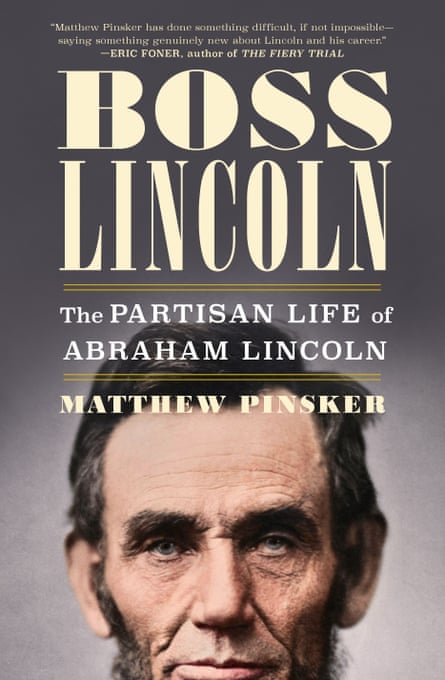
Boss Lincoln echoes Pinsker’s first book, Lincoln’s Sanctuary: Abraham Lincoln and the Soldiers’ Home, in earning praise for finding new angles. A study of Lincoln as a hard-nosed party leader – as a Whig in the 1840s, encompassing his term in Congress; in the next decade, as the Republican party formed against slavery; as wartime president – Boss Lincoln was years in the making.
“My boys teased me that the book has its own bar mitzvah,” Pinsker said. “But I’ve been working on this project on and off since I was a college student, a research assistant to [Lincoln biographer] David Donald, and I’ve always been working on Lincoln as a partisan and a politician. I knew there was a book in it, it just took me a while to get to this version.
“The key to writing new things is to find new evidence. And the not-so-hidden mystery of Lincoln is that every year we find a few new documents hidden in some archive or attic trunk. Each of them individually is not earthshaking, but over the last couple of decades there have been dozens of these private and confidential communications that he’s written that have turned up, that reveal a different side of him.
“That’s the kind of foundation of the material I use and then the rest comes from digitizing so many sources. I live in this digital era. Historians from the past had to only work through archives and printed sources, and so it was harder to make connections between the fragments. It’s much easier for people in my era to do it, and that creates a richer set of opportunities for understanding behind-the-scenes politics.”
Much of Boss Lincoln deals with such strategising, planning and dealing, the offer and counter-offer of politics. Tense moments happen in smokey rooms – though Pinsker contends that one famous instance of Lincoln’s political genius, the passage of the 13th amendment that abolished slavery, has been overplayed in popular culture, not least by Steven Spielberg in Lincoln, his Oscar-winning movie from 2013.
“It shows Lincoln after all of the hard decisions had been made and won,” Pinsker said. “By that point [January 1865] they knew they could obtain a 13th amendment … they didn’t need to bribe people to support it. The movie suggests Lincoln condoned bribery. That’s not Boss Lincoln.”
Pinsker’s Lincoln is to be found in episodes such as that of the Blind Memorandum from August 1864, three months before election day.
Amid seemingly endless war, re-election did not seem likely. As Pinsker writes, on 23 August, Lincoln “wrote out two sentences that he shared with no one. ‘This morning, as for some days past,’ he scratched out in pen, ‘it seems exceedingly probable that this Administration will not be re-elected. Then it will be my duty to so co-operate with the President elect, as to save the Union between the election and the inauguration … as he will have secured his election on such ground that he can not possibly save it afterwards.’”
Lincoln signed the document, sealed it and asked his seven cabinet members to sign it. Then he filed it away.
“That shows Lincoln at his greatest,” Pinsker said. “I don’t think you can appreciate what’s going on in August ’64 unless you recognize everything that I have been describing in the decades before, which is that Lincoln was an independent strategist. He operated alone. That’s another reason why I use the title Boss Lincoln. He’s not somebody who leads by consensus.
“At this critical moment, when almost everybody within his party is in revolt, they think they’re going to lose, the factions are pulling in different directions, he undertakes this kind of behind-the-scenes manipulative strategy to try to hold everyone together. He writes up this document like the final plan B that he’s going to show to the Democrat who beats him, in case he does lose, but he doesn’t show it to his cabinet officers. He has them sign the back of it.
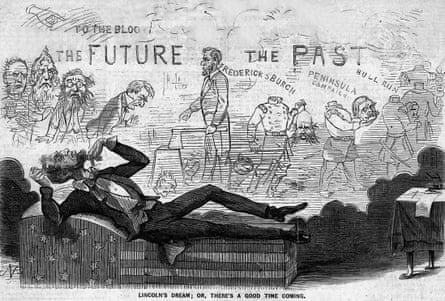
“Most historians have thought they were signing their loyalty over to him, that they’re joining his pledge to work with the Democratic president-elect between November and March, before the inauguration, to try to end the war. But they didn’t see it that way. These guys were tough-minded politicians. They weren’t signing anything except as a date stamp, and Lincoln wanted that in case he had to prove to the man who beat him that he knew he was going to lose for weeks and he wasn’t planning to arrest him or cancel the elections or worse, because that’s what Democrats thought of Lincoln. They viewed him as a tyrant, and Lincoln knew that.
“So that’s why nobody in the cabinet wrote about this moment. They didn’t gossip about it. It meant nothing to them. He told nobody about it until after the election, when he showed them. In the close of the book, I use that as a way for people to appreciate that Lincoln was operating in a supremely independent fashion, and even the people closest to him were kind of ignorant about what he was doing.”
Among smaller but similarly telling passages in Pinsker’s book there is the story of Anna Dickinson, a young Pennsylvania Quaker who became a prominent public speaker. In January 1864, “America’s Joan of Arc” was invited to address Congress on the “Perils of the Hour”. What she said did much to solidify Lincoln’s hold on power.
“Dickinson does appear in civil war books and Lincoln biographies,” Pinsker said, “but I think most people have overlooked the critical role she played in the winter of 1863-64. She was a well-known political speaker – an influencer, you might say – and the Republicans, the Unionists as they now called themselves, invited her to speak to Congress.
“What was critical about that was she was a radical, an abolitionist, and [treasury secretary] Salmon Chase, the leading radical, was trying to displace Lincoln as leader of the party, to become the nominee … and so her endorsement for Lincoln, delivered in Congress, was an important turning point. It deserves more attention.”
Harking back to Pinsker’s point about history in a digitised age, his work on Dickinson owes something to one of his students. In 2021, searching the Library of Congress, Gracie Perine found the fullest known account of the Capitol speech. According to that report, from a Republican paper, Dickinson’s endorsement was met with “tremendous and long-continued applause”.
-
Boss Lincoln, published by WW Norton & Company, is out now










Comments