
 German (DE)
  English (US)
  Spanish (ES)
  French (FR)
  Hindi (IN)
  Italian (IT)
  Russian (RU)
  3 weeks ago
Jamie MorrisSouth of England, Oxford
Could golden orb web spider silk repair nerves?
Scientists are using spider silk to help develop surgical devices for nerve regeneration.
"It acts like a scaffold for nerves to grow along like a rose on a trellis," Dr Alex Woods explains, holding threads of silk worthy of Spider-man.
Standing in a room with around 30 hand-sized golden orb-web spiders, he says it reminds him of his days studying for a PhD in Zoology - in fact, he's a trauma and orthopaedic surgeon for the NHS in Oxford.
At the Wood Centre for Innovation, his start-up business Newrotex "want to try and bring this really cool ancient technology to patients".

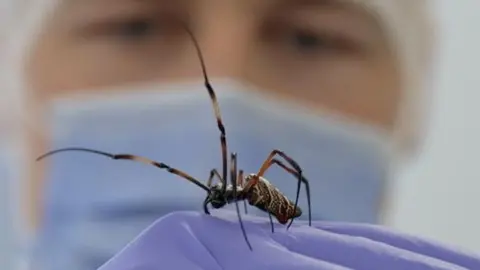
It's the first time the silk of golden orb-web spiders has been used to make a formal medical device
Golden orb-web spiders are native to southern and east Africa, with the arachnids at Newrotex coming from Madagascar.
"They're quite territorial so we keep them in their own terrariums and we keep the room very humid to mimic their natural environment," Prof Woods explained.
They are considered harmless to humans and are predominantly found sitting in large webs often more than a metre in diameter.
And it's the strength and structure of their silk which is of particular interest to scientists here.
When a nerve is cut it sprouts a basic scaffold that it tries to regenerate along, but which only last about 10 days.
"So if that gap is more than 1cm with nerves regenerating at about 1mm a day it can't bridge big gaps and breaks down," Woods said.
He said the type of silk the golden orb-web spiders produce to dangle - the "drag-line silk" was similar to the body's "scaffold".
"Except it lasts for 150 days," he said. "So now we can allow the nerves to get across the gap."
The silk fibres are implanted into a vein or hollow conduit to repair a nerve and eventually degrade into the body.
 Helen Hide-Wright
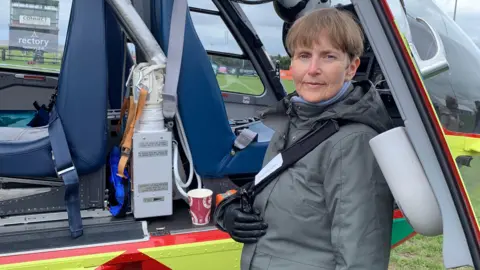
Helen Hide-Wright, who had a nerve graft taken from her leg, thought the silk device was "an exciting opportunity"
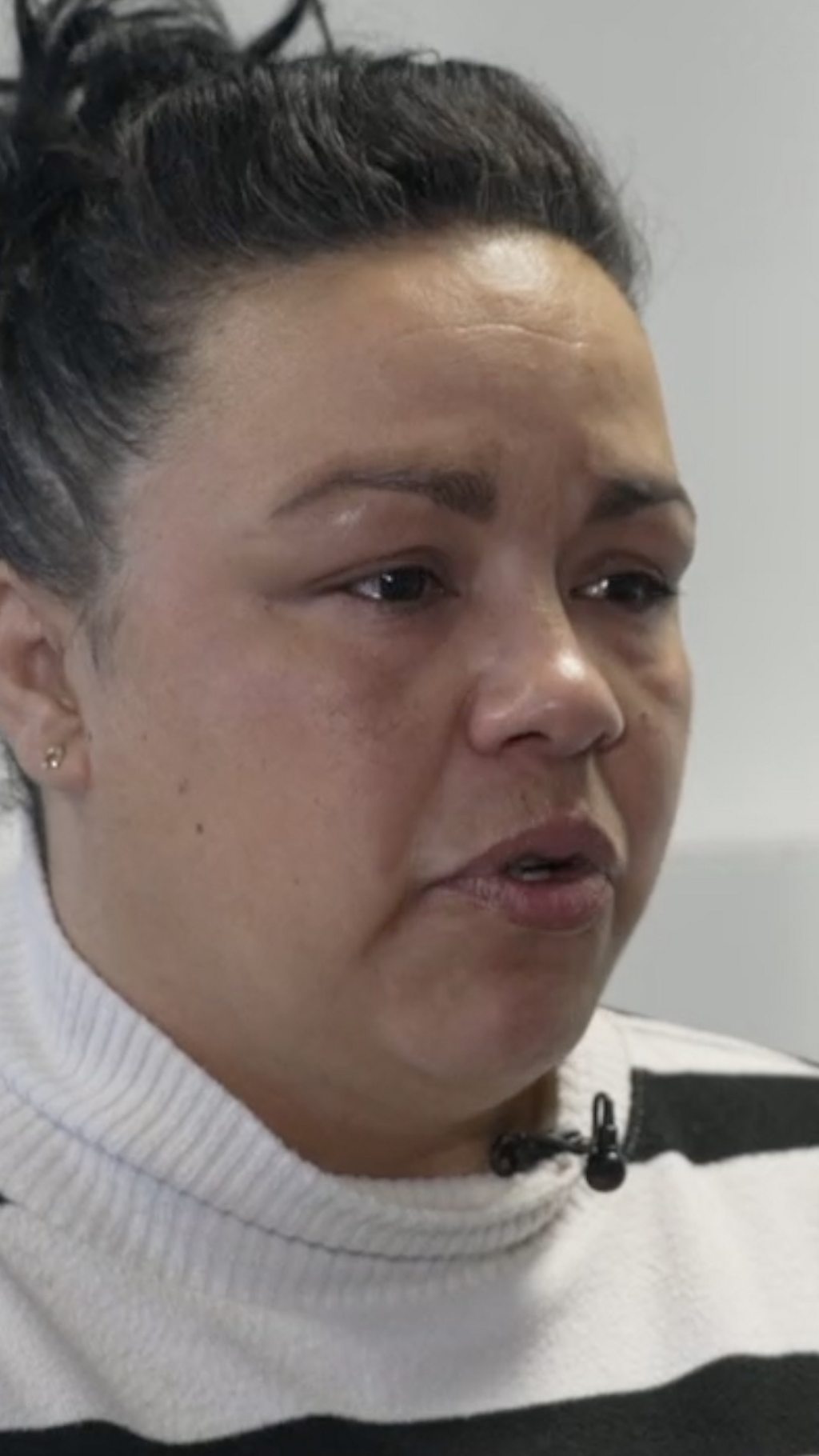
In 2022, Helen Hide-Wright, from Fenny Compton, suffered a heart attack at the wheel and crashed into a lorry on the other side of the road - breaking "almost every bone" in her body.
Her right arm is still weak where she severed the nerves there and had to have them taken from behind her foot, which has left her without sensation.
Hide-Wright said the surgery she had was "brilliant" but it sounded like the silk device could have given her a better recovery.
"The surgery was brilliant, but what Alex is offering would appear to be far more beneficial, a very exciting opportunity," she added.
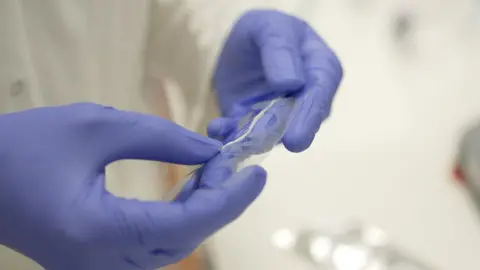
The device is made from fibres of the silk the spiders use to dangle from
But Woods said there was still the risk the product could never reach surgeons or patients.
"I'm convinced that if my nerve was lacerated tomorrow I would have our implant put in," he said.
"Seeing all the steps you need to get through and the cost and the evidence you need to produce to bring that to patients has been really eye-opening, but there's still a risk it'll never see the light of day."
He also thinks it could save the NHS money as current practices for a nerve graft like Hide-Wright's involve a secondary operation.
"It's an extra operation site that has associated harm and that has a cost you won't need if you have a device you can take and repair the nerve straight away," he said.
 Newrotex
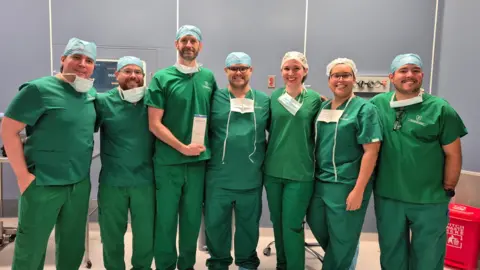
Dr Alex Woods (third from left) and the surgical team during their first-in-human trial in Panama
He hopes his silk-based devices could also help treat the nerve injuries caused by surgeons, following mastectomies or prostate cancer surgery.
"These are huge problems, which are nerve injuries which, right now, struggle to be treated," he said.
"So there's a really exciting opportunity to take this simple device and open it up to people in all those different specialties."
The device is currently undergoing its first-in-human study in a hospital in Panama to prove it's safe before further studies in the UK and the US.













Comments