
 German (DE)
  English (US)
  Spanish (ES)
  French (FR)
  Hindi (IN)
  Italian (IT)
  Russian (RU)
  3 weeks ago
Trump: 'We're going to run the country'
The US president has claimed at the press conference now under way in Florida that the United States is going to run Venezuela for the time being, although it’s unclear how that would be done.
“We’re going to run the country until such time as we can do a safe, proper and judicious transition,” Trump said. He has given no details.
He just called Maduro a dictator and a drug kingpin.
Key events Show key events only Please turn on JavaScript to use this feature
The UK’s prime minister Keir Starmer has backed a transition of power in Venezuela.
He insisted his Labour administration will “shed no tears” over the end of Nicolas Maduro’s regime and said Britain would discuss the “evolving situation” with American counterparts over the coming days.
Starmer said in a statement: “The UK has long supported a transition of power in Venezuela.
“We regarded Maduro as an illegitimate president and we shed no tears about the end of his regime.
“I reiterated my support for international law this morning.
“The UK Government will discuss the evolving situation with US counterparts in the days ahead as we seek a safe and peaceful transition to a legitimate government that reflects the will of the Venezuelan people.”
Starmer earlier refused to be drawn on whether the US military action broke international law, saying he wanted to talk to president Donald Trump, with whom he had not spoken on Saturday morning, and allies to “establish the facts”.
Around 500 UK nationals are in Venezuela and work is ongoing to “safeguard” them, the prime minister said, while the UK’s Foreign Office advised against all travel to the country.
“As you know, I always say and believe we should all uphold international law, but I think at this stage, fast-moving situation, let’s establish the facts and take it from there,” Starmer told broadcasters.
Summary
It’s been an incredibly dramatic but also very confusing day in the US and Venezuela as the world watches the aftermath of a lightning military strike overnight that saw Nicolás Maduro captured by US forces and taken to an American aircraft carrier in handcuffs. The toppled Venezuelan president is en route to New York, where the Trump administration has promised to bring him up in court, indicted on drug trafficking and other criminal offenses. He could arrive later today, even. Donald Trump claims the US is running Venezuela, with the remaining regime’s cooperation – a claim sharply contrasted by Maduro’s vice president a little earlier.
Here’s where things stand:
-
The United Nations security council is due to hold an emergency meeting on Monday as a result of the United States attacking Venezuela early on Saturday and snatching up its president, Nicolás Maduro, holding him en route to New York where it will confront him with federal criminal charges related to drug trafficking and weapons.
-
Nicolás Maduro’s vice-president in Venezuela, Delcy Rodríguez, a loyalist, has appeared on television and radio there, from the capital Caracas, contradicting Donald Trump’s description of her now being president and cooperating with the US. She said Maduro was Venezuela’s “only” president and that Venezuela would not be colonized.
-
Rodriguez appears to be in Caracas. This followed hours of rumors that she might have been in Russia or parts unknown, but not in Venezuela.
-
Donald Trump called Cuba a failing nation and US secretary of state Marco Rubio called the communist-run island, from where his parents fled to the US in the 1950s, a “disaster”. Both hinted that they could reprise their action in Venezuela in Cuba, but made no direct threats.
-
Trump was asked about his current thoughts on Russian president Vladimir Putin and the ongoing war perpetrated by that country in Ukraine. Trump said he was “not thrilled” with Putin and called the war a bloodbath.
-
Donald Trump said he and his administration have not talked to Venezuela’s exiled opposition leader María Corina Machado since the capture of Maduro. He took on a dismissive tone and said she would not run Venezuela as she did not have the necessary support or respect in the country. It was unclear if he was talking about the Venezuelan regime or the general population. Machado won the latest Nobel Peace prize.
-
United Nations secretary general António Guterres said the Trump administration was setting a “dangerous precedent” with its unilateral action inside Venezuela. He later said he thought the US had probably breached the founding charter of the UN, too.
-
At a press conference in Florida, US president Donald Trump said that US oil companies will take control of Venezuela’s state oil operation. There has been no confirmation of anything like this from US oil companies, nor how such an arrangement would work.
-
Donald Trump claimed at his press conference earlier that the United States is “going to run” Venezuela for the time being. He gave no specific details about how that might happen, later implying the remains of the Maduro regime were cooperating with US leadership – something soon after contradicted by Venezuela’s vice president, Delcy Rodriguez.
-
Trump posted a picture on his Truth Social platform that he states is “Nicolas Maduro on board the USS Iwo Jima”, which appeared to show the captured Venezuelan president in handcuffs, black goggles and headphones, clutching a water bottle expressionless.
-
The US Department of Justice unsealed an fresh version of a federal criminal indictment of Nicolás Maduro. He was indicted by the US in 2020. The superseding indictment now includes his wife and son.
-
Trump has confirmed that the Venezuelan leader Nicolás Maduro and his wife, Cilia Flores, are heading to New York. Trump told Fox News on Saturday that Maduro and his wife were taken to a ship after their capture by US forces and are headed to the US city.
-
Earlier, US attorney general Pam Bondi said the deposed Venezuelan leader and his wife would face criminal charges after an indictment in New York. Bondi vowed in a social media post that the couple will “soon face the full wrath of American justice on American soil in American courts”.
-
The United States is going to be “very strongly involved” in Venezuela’s oil industry after the operation to capture Maduro, Trump told Fox News on Saturday. He said: “We have the greatest oil companies in the world, the biggest, the greatest, and we’re going to be very much involved in it.”
-
The US vice-president, JD Vance, hailed what he called a “truly impressive operation” in Venezuela that culminated in the capture of Maduro. Posting on social media as he reshared Trump’s post about the action, Vance wrote: “The president offered multiple off-ramps, but was very clear throughout this process: the drug trafficking must stop, and the stolen oil must be returned to the United States.”
-
In a statement on X, US secretary of state Marco Rubio said Maduro is “under indictment for pushing drugs in the United States”. Republican US Senator Mike Lee said on Saturday that Rubio had told him that he “anticipates no further action in Venezuela now that Maduro is in US custody”.
-
Venezuela’s government urged citizens to rise up against the US assault and said Washington risked plunging Latin America into chaos with “an extremely serious” act of “military aggression”. “The entire country must mobilise to defeat this imperialist aggression,” it added. It accused the US of launching a series of attacks against civilian and military targets in the South American country, after explosions rocked its capital, Caracas, before dawn on Saturday.
-
Explosions and low-flying aircraft were heard in Caracas in the early hours of Saturday. In its statement, Venezuela’s government confirmed that the city had come under attack, as well as three other states: Miranda, La Guaira and Aragua.
-
Venezuela has accused the US of trying to “seize control” of country’s resources, in particular its oil and minerals. Th country has called on the international community to denounce what it called a flagrant violation of international law that put millions of lives at risk.
-
In the early hours of Saturday the president of neighbouring Colombia, Gustavo Petro, called for an immediate emergency session of the UN security council, saying on social media that Venezuela had come under attack.
-
UK prime minister Keir Starmer has reacted to Donald Trump’s military action in Venezuela saying: “The UK was not involved in any way in this operation.” He added that “we should all uphold international law”. France said the US military operation which resulted in the capture of Maduro went against the principles of international law.
-
Russia has demanded “immediate” clarification about the circumstances of the capture of Maduro during an attack ordered by Trump. Earlier, Venezuela’s vice-president, Delcy Rodríguez, said the US needed to provide “proof of life” for Maduro.
-
Venezuelan allies Russia, Cuba and Iran were quick to condemn the strikes as a violation of sovereignty. Tehran urged the UN security council to stop the “unlawful aggression.” Among major Latin American nations, Argentina’s President Javier Milei lauded Venezuela’s new “freedom” while Mexico condemned the intervention and Brazil’s President Luiz Inácio Lula da Silva said it crossed “an unacceptable line.”
Leaning on Fortune here, briefly, for some context about the oil. As the magazine points out in this article: Trump has repeatedly said he wanted the Venezuelan oil back that was expropriated from American operators during George W Bush’s second term. During his press conference, he called it the “largest theft of property in the history of our country”.
Democratic congressman Seth Moulton, a member of the House armed services committee, said on CNN a little earlier that Trump was now “trying to steal” Venezuela’s oil.
He also balked at the White House suggestion that Congress was not told about the US military action in Venezuela beforehand because of fear of leaks. He said his committee, for one, hadn’t leaked under Trump. He accused the White House of lying to the committee, having, he said, told them he was not interested in regime change in Venezuela or a US military intervention in Venezuela. “Every step of the way, he and [Marco] Rubio have lied about what is going on here,” Moulton said.
Venezuela’s ambassador to the United Nations, Samuel Moncada, has echoed other leaders and geopolitics experts today in saying that the US’s unilateral military action in Venezuela and capture of the country’s president, Nicolás Maduro, breaches the founding charter of the UN.
Specifically the section of the charter that states: “All members shall refrain in their international relations from the threat or use of force against the territorial integrity or political independence of any state.”
The UN secretary general, António Guterres, put out a statement via his spokesperson, Stephane Dujarric, that said, Reuters reports:
The Secretary-General continues to emphasize the importance of full respect – by all – of international law, including the UN Charter. He’s deeply concerned that the rules of international law have not been respected.
The US ambassador to the UN, Mike Waltz, has posted on X that what the US has done is “not regime change, this is justice”.
United Nations to hold emergency security council meeting
The UN security council is due to meet on Monday as a result of the United States attacking Venezuela early on Saturday and snatching up its president, Nicolás Maduro, holding him en route to New York where it will confront him with federal criminal charges related to drug trafficking and weapons.
Colombia, backed by Russia and China, requested the meeting of the 15-member council, diplomats said, and Reuters just reported. There had earlier been a post on X about it by the Associated Press, but we had been awaiting confirmation.
The UN security council, based in New York, has met twice – in October and December – over the escalating tensions between the US and Venezuela.
Donald Trump said on Saturday that Washington would run Venezuela, with the cooperation of the remains of Maduro’s regime – a claim sharply contradicted by Maduro’s vice-president, Delcy Rodríguez, from Caracas a short while ago, as the situation became only murkier.
Venezuela’s UN ambassador, Samuel Moncada, wrote to the UN security council on Saturday:
This is a colonial war aimed at destroying our republican form of government, freely chosen by our people, and at imposing a puppet government that allows the plundering of our natural resources, including the world’s largest oil reserves,.

Callum Jones
Donald Trump earlier declared that US oil giants are primed to spend “billions and billions of dollars” on the Venezuelan oil industry.
But none of those companies have commented on the US president’s claims that they plan to invest heavily in the country after the capture by US forces early on Saturday of the Venezuelan president, Nicolás Maduro.
Chevron, the only major US oil company currently authorized to operate in Venezuela, stated it was following “all relevant laws” on Saturday.
“Chevron remains focused on the safety and wellbeing of our employees, as well as the integrity of our assets,” a spokesperson said. “We continue to operate in full compliance with all relevant laws and regulations.”
Trump suggested US oil firms will “fix” Venezuela’s vast market, enabling the ramp-up of production. “We’re in the oil business,” he said during his press conference at Mar-a-Lago. “We’ll be selling large amounts of oil to other countries.”
He did not elaborate on how any such plans could be manifested.
The UN security council will hold an emergency meeting on Monday to discuss the situation in Venezuela, according to an Associated Press post on X. We await details.
Several international leaders have been calling today for the global body to hold such a meeting, at its headquarters in New York, after the military intervention in Venezuela overnight and the capture by US forces of the country’s president, Nicolás Maduro.
Maduro is handcuffed on an American aircraft carrier, currently on its way to New York, where it could arrive as early as today. The US has pledged that Maduro will appear in federal court in the US to face criminal charges related to drug trafficking.
The German chancellor, Friedrich Merz, said a little earlier that Nicolás Maduro had “led his country to ruin”, after the US snatched the Venezuelan leader out of the country during a raid on Caracas overnight.
Merz noted Germany had not recognised the last Venezuelan election in 2024 as it was “rigged” and that Maduro had “played a problematic role in the region”, including by “entangling Venezuela in the drug trade”, Agence France-Presse reports.
But he also said that the legal aspects of the US actions were “complex”, and in general “the principles of international law must apply in relations between states”.
Merz added:
Political instability must not be allowed to arise in Venezuela now.
Tiago Rogero
Here is more from Venezuela’s vice-president, Delcy Rodríguez.
She has condemned the capture of Nicolás Maduro by the US, calling it an “unprecedented military aggression”, and demanded the “immediate release” of the dictator and his wife, Cilia Flores.
She delivered a televised address a few hours after the US president, Donald Trump, said at a press conference that Rodríguez had held a lengthy conversation with the secretary of state, Marco Rubio, and that she was “essentially willing to do what we think is necessary to make Venezuela great again”.
Maduro’s vice-president, who has been in office since 2018, nonetheless maintained the critical tone adopted by all members of Maduro’s cabinet since the first reports of the US’s overnight bombardment.
“The government of the US launched an unprecedented military aggression against the Bolivarian Republic of Venezuela. It constitutes a terrible stain on the development of bilateral relations through that military operation,” she said.
She added that Venezuela “will never again be anyone’s colony – neither of old empires, nor of new empires, nor of empires in decline”.
Rodríguez also echoed an argument repeatedly made by Maduro before his capture: that they believe the real objective of the four-month-long US military pressure had never been a supposed “war on drugs”, but rather “regime change” and the “seizure of our energy, mineral and natural resources”.
The vice-president said the “Venezuelan people … are outraged by the illegal and illegitimate kidnapping of the president and the first lady”.
“We call on the Venezuelan people to remain calm and to face this together, in perfect national unity. Let this popular, military and police fusion become a single body as we enter this crucial phase of defending our sovereignty and our national independence,” she said.
Rodríguez also urged other countries to unite, warning that “what they did to Venezuela today, they can do to anyone. This brutal use of force to bend the will of peoples can be done to any country.”
The Guardian has whisked up an express episode of the Politics Weekly America podcast, with our Latin America correspondent, Tom Phillips, explaining the latest about Venezuela.
Have a listen here.
Venezuela's Rodriguez rejects Trump portrayal of regime
Reports coming through now from Nicolás Maduro’s vice-president in Venezuela, Delcy Rodríguez, that contrast sharply from the portrayal given by Donald Trump at the presidential press conference in the US earlier.
There, Trump said he understood she’d be sworn in as president of Venezuela, after the US captured and spirited away Maduro, and that she had, essentially, agreed to cooperate with the US because she had no “choice”.
Now Rodríguez, a staunch loyalist of Maduro, has appeared on state television and across radio stations in there, saying that Maduro “is Venezuela’s only president”.
She described Maduro as having been kidnapped and called for him and his wife to be freed.
Rodríguez spoke on state television from Caracas with her brother, national assembly head Jorge Rodríguez, interior minister Diosdado Cabello, and the foreign and defense ministers, Reuters reports.
Rodríguez called for calm and unity to defend the country amid Maduro’s “kidnapping” and said Venezuela will never be the colony of any nation.
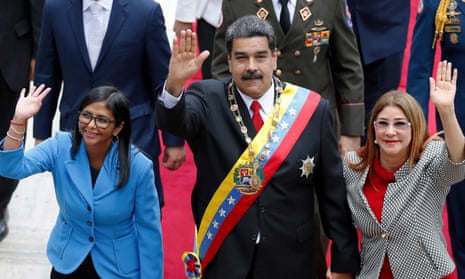
Nicolás Maduro, his vice-president Delcy Rodríguez, left, and his wife, Cilia Flores, in 2018. Photograph: Ariana Cubillos/AP
Venezuela's Delcy Rodríguez appears to be in Caracas
Wire reports are coming in that Delcy Rodríguez is in Venezuela.
There have been hours of rumors that Nicolás Maduro’s vice-president may not have been in the country, and even that she may be in Russia. She had been speaking by telephone on state television but her whereabouts were not made public.
Then Donald Trump said he understood she’d been sworn in as president of the country to replace Maduro, but without giving details.
Now news agencies are reporting that she’s in the Venezuelan capital, Caracas. Reuters just reported that she has just been seen on TV alongside other leading politicians, and her brother.
Camille Rodríguez Montilla
At a gathering of Venezuelan exiles in Valencia, Spain, the only
subject of conversation was the events in Caracas overnight.
Since the beginning of the day, WhatsApp groups and cellphones have been going off constantly. As usual in Venezuelan family meetings, all of the conversations crossed, people interrupted each other, and theories were thrown into the air constantly.
The celebratory mood paused for a moment when Donald Trump brushed off the suggestion that Nobel peace prize-winning opposition leader María Corina Machado could play a role as, at least, a potential interim leader.
“I think it would be very tough for her to be the leader. She doesn’t have the support within or the respect within the country,” Trump told reporters at the presidential press conference earlier. “She’s a very nice woman, but she doesn’t have the respect.”
There was a moment of disappointed silence before one of those
gathered rationalised the comments away, saying: “He probably said that regarding the military forces inside the country, not the people.”
Then the celebrations continued.
Here’s an excellent, short video explainer from our Latin America correspondent, Tom Phillips, who has called the US intervention in Venezuela overnight “one of the most dramatic moments in Latin American history”.
Tom said that he’s never seen anything like this in 25 years reporting on the continent and it is the most dramatic US military action since the invasion of Panama in 1989, and a surprise.
And the US president was also asked at the press conference about how he could justify capturing Venezuela’s Nicolás Maduro when he stunningly pardoned the former president of Honduras in December.
Juan Orlando Hernández was freed from a US prison after having been sentenced to 45 years behind bars for allegedly creating “a cocaine superhighway to the United States”, shocking many.
And this as the Trump administration was bombing boats in the Caribbean Sea that it was claiming, but not proving, were all “narco terrorism” shipments of illegal drugs bound for the US from Venezuela. The pardon received bipartisan criticism.
At the press conference today, Trump said the Honduran had been “unfairly persecuted” by the Biden administration and, turning to his habit of referring to himself in the third person, said: “The man that I pardoned was treated like the Biden administration treated a man named Trump.”











Comments