
 German (DE)
  English (US)
  Spanish (ES)
  French (FR)
  Hindi (IN)
  Italian (IT)
  Russian (RU)
  1 hour ago
Donald Trump’s justice department has aggressively inserted itself into the midterm elections in the contest’s final weeks, shattering the department’s longstanding practice of political neutrality and leaving little doubt about the department’s willingness to help should the president attempt to subvert elections where his party is forecasted to lose seats and ultimately control of Congress.
In the last few weeks, federal agents have raided the home of a Democratic congresswoman up for re-election. It has touted criminal charges and arrests of non-citizens charged with voter fraud. The attorney general has hit the campaign trail to stump for Republican candidates. And the department gave California election officials 48 hours to investigate the citizenship of 20,000 people, and then sued the state when it refused to comply. The FBI also recently published a video criticizing Michigan senate candidate Abdul El-Sayed and other Democrats, drawing an immediate rebuke from one watchdog, who said the video “has no place in a democratic society”.
On Monday, federal agents raided her DC home of Minnesota representative Ilhan Omar, who is running for re-election this fall. The raid was part of a reported immigration fraud investigation into Omar, an outspoken critic of the president, and an apparent push to try to denaturalize her. Omar is up for re-election, and Minnesota Democrats broadly are facing more headwinds than fellow party members in most other states.
“For decades, the justice department sought to avoid investigative steps that might influence an election, recognizing that election integrity is threatened when DoJ is perceived as putting its thumb on the scale,” said Stacey Young, a former justice department attorney who now leads Justice Connection, a group that supports justice department alumni.
“This was always a case-by-case analysis, led by experts in the public integrity section. But this administration pushed those experts out of the department, and employees seeking guidance are now directed to political appointees loyal to the president,” she added.
A justice department official said there is no rule or policy that bars the DoJ from taking action close to an election. The department is not required to stop ongoing work during election season, the official said.
A provision of the justice department manual says prosecutors and law enforcement agents should not take “any action, including investigative steps, criminal charges, or statements, for the purpose of affecting any election, or for the purpose of giving an advantage or disadvantage to any candidate or political party”. A separate provision of the manual says that “the Department should not engage in overt criminal investigative measures in matters involving alleged ballot fraud until the election in question has been concluded, its results certified, and all recounts and election contests concluded”.
An unwritten department practice has established a blackout window of at least 60 days before an election in which prosecutors should refrain from any activities that could influence the election. In September 2024, Todd Blanche, then serving as the president’s personal attorney, pointed to the rule to argue that special counsel Jack Smith should not be allowed to file a long brief with damaging information in the criminal election interference case against Trump. “Departures from these practices should never be countenanced because they risk allowing prosecutors to impact national elections,” Blanche wrote at the time. Experts disagreed with that argument at the time, pointing out that Smith was responding to a court-ordered deadline.
“For decades, the justice department has avoided even the appearance of political interference in the run-up to an election, and that’s exactly what the 60-day rule exists to protect,” said Skye Perryman, president and CEO of Democracy Forward, a watchdog group. “This DoJ is doing the opposite.”
Now, Blanche leads the justice department, and the 60-day rule seems to have gone out the window. The DoJ official said the 60-day rule was an informal practice.
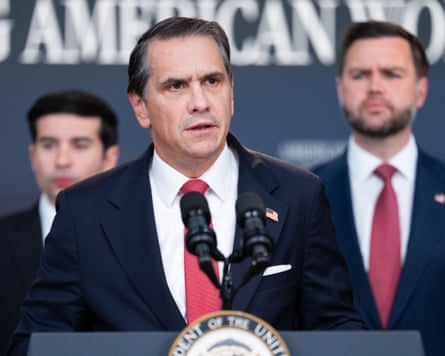
Over the last few weeks, the department has sent out press releases announcing voter fraud charges against noncitizens with photos of their arrests. Noncitizen voting is extremely rare, and when it does occur, it is often because someone is confused about their eligibility. Court documents filed in many of the cases the justice department have charged contain little detail about whether the people charged knew they were ineligible.
“The DoJ’s actions ahead of the election, which violate longstanding norms, are extremely concerning. They are emblematic of how the Trump administration has repeatedly and illegally weaponized the federal law enforcement apparatus to interfere in our elections,” said Donald Sherman, president and CEO of Citizens for Responsibility and Ethics in Washington (Crew), a watchdog group.
The department has also made a last-minute push to try to force states to purge voters from the rolls.
In an extraordinary move last week, the justice department sent election officials in Los Angeles a USB-drive with a handwritten password. The drive contained the names of potential noncitizens on the county’s rolls, the justice department said. The department gave county officials 48 hours to investigate the citizenship statuses and segregate ballots from anyone whose status they could not confirm and said the department would seek “emergency relief” if they did not.
Dean Logan, the top election official in Los Angeles, told the justice department his office would not be accessing the drive because it didn’t consider it secure. The department also didn’t say how many people were on the list and hadn’t described its methodology for identifying the voters. The department later said in a court filing it had provided the names of 20,000 people to the state.
After California rebuffed the DoJ’s efforts, the department sued the state on Thursday, requesting a court order blocking the state from counting the ballots from anyone among the 20,000 whose citizenship had not been confirmed.
The DoJ could have easily provided California with the names of people it suspected were on its voter rolls and its methodology for identifying them months ago, said David Becker, the executive director of the Center for Election Innovation and Research, a group that works on election administration issues. Instead, the department waited until after California had sent out mail-in ballots. Federal law also prohibits election officials from systematically purging voters within 90 days of a federal election.
“If they were seeking to work in good faith to clean up the voter list that they believed had issues, they would have done this months ago in a much different fashion,” Becker said. “However, it does raise questions as to whether or not the sole purpose of this is to set the stage for false claims about election theft after an election that the president might be worried his party was going to do poorly.”
In what may be the department’s most overtly political act, Blanche has also spoken at campaign rallies for Republican candidates and at the Republican convention in Dallas earlier this year. The department recently revised ethics guidance for officials appointed by the president and confirmed by the Senate to allow them to participate in more partisan political activities, according to a memo obtained by the PBS News Hour.
Blanche’s appearance raised concerns among ethics officials, despite the department’s claims that he was acting in his personal capacity.
“Attorney general Blanche’s appearances at political events are made in his personal capacity. His appearances are reviewed and cleared by the department’s ethics officials. Travel expenses are reimbursed by the attorney general in accordance with federal law, regulations and policies,” a DOJ spokesperson said.
Federal ethics regulations prohibit officials from taking actions that “create even the appearance of violating the law or ethical standards”, Joseph Tirrell, who was fired as the top ethics official at the justice department last year, wrote in a blogpost earlier this year.
“The question is not merely whether Blanche crossed a technical line. It is whether his appearance made federal law enforcement look like an arm of a partisan campaign,” Tirrell wrote.
“Senior Trump administration law enforcement officials at DoJ, FBI and DHS have yet to be held accountable for their weaponization of prosecutions and legal attacks on candidates or their apparent violations of the Hatch Act, which bans them from using their official positions for political purposes,” Sherman said. “From Blanche’s participation in political rallies to Trump’s attacks on voting to the recent raid on a congresswoman’s home, these relentless attempts to influence the upcoming election are incredibly disturbing and pose a serious threat to our democracy.”
The DoJ’s insertion into electoral politics comes as far-right figures have urged Trump to take the drastic step of seizing voting machines before the election – something he does not have the power to do. The Trump administration has also refused to rule out sending ICE agents to the polls.
A compliant justice department would get rid of a significant guardrail to implementing some of those ideas. As Trump sought to overturn the results of the 2020 election, senior officials in the justice department refused to go along with the idea and threatened to resign en masse. William Barr, the attorney general in 2020, told Trump the claims about election fraud were “bullshit”.











Comments