
 German (DE)
  English (US)
  Spanish (ES)
  French (FR)
  Hindi (IN)
  Italian (IT)
  Russian (RU)
  3 weeks ago
Catherine BurnsHealth correspondent

 BBC
BBC
BBC News sent a questionnaire to more than 5,000 GPs - more than 750 replied
Hundreds of GPs have told the BBC they have never refused to sign a sick note for a patient complaining of mental health issues.
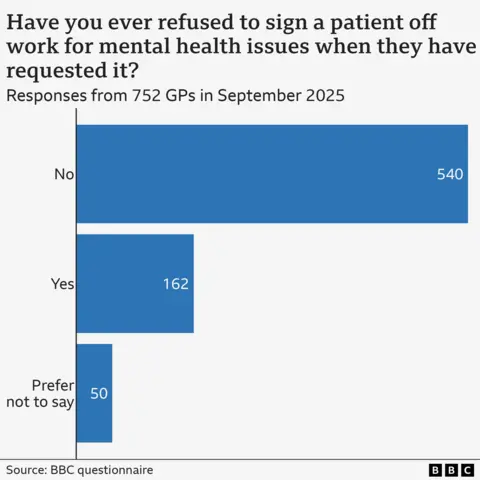
BBC News sent a questionnaire to more than 5,000 GPs in England asking if they had ever denied a sick note - known as a fit note - to someone who had requested one because of their mental health.
Of the 752 GPs who replied, 540 said they had never refused such a request, while 162 told us they had turned at least one down. A smaller number - 50 - said they would prefer not to say.
Some revealed how frustrated they were with the current system, saying the provision of fit notes should not be part of GPs' jobs.
They also highlighted instances of patients becoming aggressive if they were not signed off work. One GP revealed how a patient had refused to leave the practice without a fit note.
We cannot know whether the GPs who responded to the BBC questionnaire are representative of all family doctors.
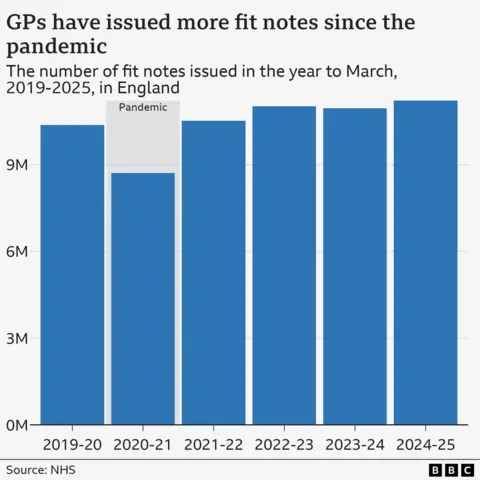
It comes as the number of fit notes being issued has been steadily rising in recent years, with more than 11.2 million approved by GP practices in England last year.
BBC analysis shows that number has increased by almost 850,000 in the past six years.
Fit notes are approved when someone is unwell or cannot work for more than seven days. They do not have to specify why a person is being signed off, and 72% of fit notes do not give a reason.
However, more than 956,000 notes last year cited mental health and behavioural disorders as the underlying reason, far exceeding any other condition.
GPs sign the vast majority of fit notes, although nurses, pharmacists, physiotherapists and occupational therapists are also able to issue them.
Fit notes advise on how the patients' health problems impact on their ability to work - and can help to access certain benefits and sick pay.
A patient can be declared "not fit for work" or "maybe fit for work" with some adjustments, but most fit notes sign people off work entirely.
The GPs who responded to the BBC questionnaire also sent us hundreds of comments.
The most common theme was that signing patients off work was an unfair task for GPs. One said: "It is hard to be patient's advocate and a judge."
They talked about the current system threatening the doctor/patient relationship. One told us: "Patients come for support - not to be dismissed." Another said: "GPs should not be gatekeepers of fitness to work."
Others called signing people off work "a dirty task" and argued it was not their job to "police the sick note system".
Most of the doctors were keen to point out that they do not necessarily sign patients off for as long as they request, and instead issue fit notes for a shorter period.
Some said they explain to patients that going to work can benefit their mental health.
There was a notable divide in the doctors' attitudes towards patients. Some were unequivocally positive, saying they trusted that patients were honest with them.
But many pointed out that it was especially hard to refuse time off for mental health complaints. One asked: "Who am I to say I don't believe that someone is struggling with their mental health? It's not like a chest infection where there is definite proof of illness."
There were also plenty who were more cynical about patients' motives, saying they were "not genuine" or accused patients of "milking the system".
Fit note data is not broken down by age, but several GPs felt that younger adults were more likely to ask for time off work. One said: "We sign off legions of young patients with anxiety and depression who are quite clearly not ill."
Some GPs said they would only sign a fit note if they felt it was "medically appropriate" but others admitted it was "not worth the grief" or "the hassle" to argue with patients.
Several pointed out that it was easier and quicker to sign off a sick note than to deal with a complaint for refusing.
Some also described how patients even had become aggressive, with one doctor saying: "They argue and fight, we end up having to give in for our own safety." Another added: "It would be insane to challenge the patient."
Last year, a government-commissioned report looking into the role of employers in health and disability said that fit notes were "often problematic". The Keep Britain Working review noted GPs often did not have the time, or the occupational health training, to fully assess if someone was able to work or not.
The report said the longer a patient was off sick, the less likely they were to return to work. If someone was absent for 4-6 weeks, there was a 96% chance of them going back. But that dropped to 50% after a year, the report added.
The Royal College of GPs (RCGP) said family doctors may not always be "the most appropriate professionals" to provide long-term support to enable patients to return to work.
They should continue to approve fit notes for up to three weeks, its chair Professor Victoria Tzortziou Brown said. But she said the RCGP was open to exploring whether responsibility for longer-term fit notes should sit elsewhere.
The government said it was clear the current fit note system needed reforming and that it was testing new approaches.
A spokesperson said: "We know that we need to do more to build a system that works for everyone."
 Getty Images
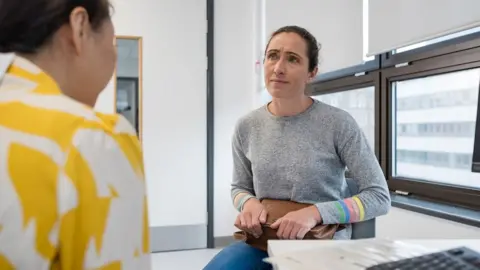
Some GPs said it was easier and quicker to sign off a sick note than deal with a complaint for refusing
The BBC understands government officials are exploring other options, including so-called "stay in/return to work" plans developed with businesses and occupational health professionals. It is not clear if this would reform fit notes, or replace them entirely.
Jaguar Land Rover (JLR) is one of 60 companies working with officials to see how this could look.
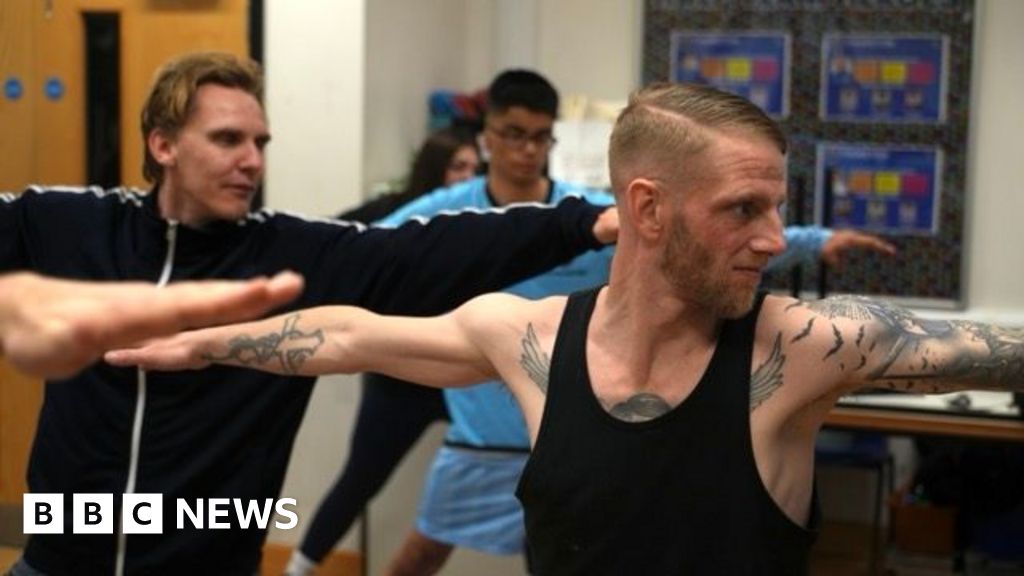
JLR has set up six "centres of wellbeing" for employees in the UK. Some of the focus is preventative, including exercise classes and NHS health checks. But the initiative also helps staff who need support with physiotherapy, counselling and occupational health.
Dr Richard Peters, JLR's chief medical officer, said firms had "a part to play" in supporting people with health conditions in work, adding: "It's the right thing to do because if we have a healthier staff, then we have a more productive workforce."
But there are wider concerns about how this kind of help could be scaled up. Small businesses are already concerned about incoming changes to statutory sick pay, which will mean they need to pay from the first day of absence.
Tina McKenzie, from the Federation of Small Businesses, said: "Proposals to make small businesses pay for a service to provide occupational health advice, as well as fit notes, would add to these costs as well as piling on extra bureaucracy."
Tom Pollard, head of policy and campaigns at the mental health charity Mind, said any move towards an alternative system needed to be "approached with caution" and "built around trusting and compassionate relationships".
He added: "It is essential that people do not feel they are being forced to work when they don't feel able to."
Additional reporting by Vicki Loader and Amy Jackson.
Correction 12 March: A previous version of this article stated that occupational health therapists are able to issue fit notes. This has been changed to say occupational therapist.










Comments