
 German (DE)
 English (US)
 Spanish (ES)
 French (FR)
 Hindi (IN)
 Italian (IT)
 Russian (RU)
 43 minutes ago
Slumped on the ground, the young woman pressed her forehead against the warm pavement of a twilit parking lot in Columbia, Tennessee.
Two other women dressed in white T-shirts identifying them as members of the ministry attended to her, praying over her prone body, speaking to her in low, urgent tones. Her whimpers escalated into moans and then crescendoed into guttural cries: “No! No! No!”
One of the women moved down to her feet, pouring water on them just as Christ washed his disciples’ feet during the Last Supper. No one paid them much mind.
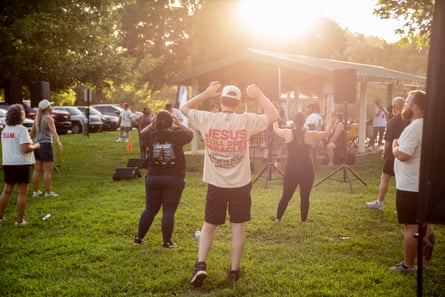
Nearby, 35 or so people who had come to worship – or satisfy their curiosity – stood in clusters, chatting and laughing. Children chased each other in circles. A band played soft, contemplative music under a white tent as a fervent orange sunset cast strange light over the late summer gathering.
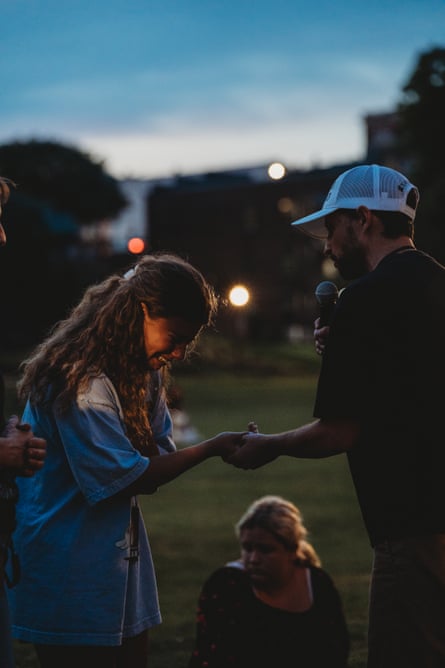
Further away, 13 people lined up, shoulder-to-shoulder, before a man with bright blue eyes and a tidy beard. “I’m gonna gently touch your fingers,” he said to the group, his voice amplified by a microphone. “I’m gonna ask the Holy Spirit to come and clothe you in power and to fill you. He might free you from whatever’s been hassling you.”
Then evangelist James Thayer began to make his way down the line.
Thayer, 36, leads Freedom Collective Ministries, a roving ministry that he describes as “uniting 70 believers from 14 different churches in evangelism, healing and deliverance”. Over the course of five months, the group made its way through 16 cities in Tennessee on a “gospel crusade”, setting up in parks and parking lots to “deliver” attenders from physical ailment, from mental anguish, from false doctrine.
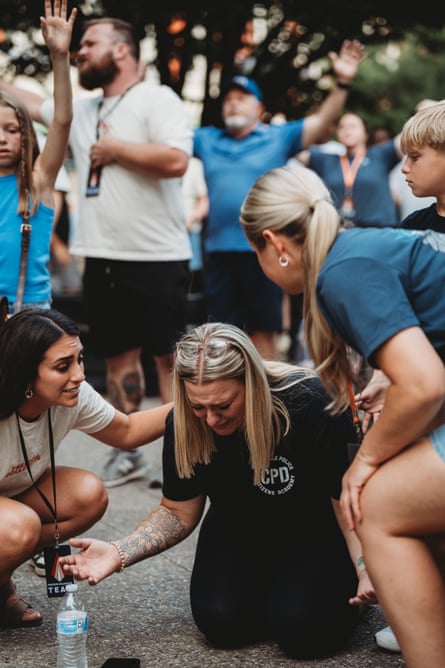
Theirs was a battle against demons, waged to win souls for Christ.
I was unaware of such deliverance ministries until fairly recently, when a friend from my time in college with a campus evangelical group began posting on Instagram about Freedom Collective. She wrote of miraculous healings, to her own body and to others. She also warned of spiritual warfare and ominous forces.
I was intrigued by these violent allusions, which were being bandied about not just on social media but in Christian churches, at political rallies, and in the Trump White House. They seemed to signal a new chapter in white American evangelicalism: an unprecedented marriage between the beliefs I grew up with and the charismatic practices that were always forbidden.
Deliverance ministries such as Freedom Collective and the New Apostolic Reformation movement are growing in popularity, introducing more Christians to the charismatic manner of emphatic worship, miraculous healing, and belief in a demon-plagued world. (Charismatics are so named after the Latinized form of the Greek kharisma meaning “divine gifts”.)
The religious framework may be rewiring American conservatism too. Paula White-Cain, the president’s spiritual adviser who the Southern Baptist minister and theologian Russell Moore once called a heretic, has spoken frequently about “demonic networks” that threaten Trump. Under the leadership of Pete Hegseth, the Department of Defense has repeatedly quoted scripture to position the US military as a divinely sanctioned force for good in a cosmic battle against evil.
Ahead of the midterms, House speaker Mike Johnson told Christian voters they faced a “spiritual battle” against socialists (three out of four Republicans or people who lean Republican identify as Christian). In Kansas, the Republican candidate for governor accused his rival of witchcraft and said the election was part of “a spiritual battle that I’ve never seen before” (he lost, but only just).
Such bellicose declarations aren’t new within the religious right, but they have increased in volume and fervor. Where once the intersection of American Christianity and conservatism was defined by more reserved faith leaders such as Billy Graham and Jerry Falwell, the Overton window is shifting to favor the guys they regarded as charlatans for their theatrics, the ones whose television shows featured people speaking in tongues and convulsing on the floor.
But on the ground, in places like rural Tennessee, the practices are less political and more personal.
Thayer took the hand of the first woman in line and began to prophesy. He sees art. Perhaps, he mused, she’s a painter. He sees her dancing for the Lord, and the Lord is pleased.
After three more women – and those in line were mostly women – Thayer paused to instruct those bearing witness to shine phone flashlights down at their hands to see sparkles of gold dust, a manifestation of God’s glory. Most complied; some saw something, others were puzzled.
Then, Thayer encountered a demon.
The demon had made itself at home in another woman in a dress, the hem of which brushed the pavement, who had become progressively more emotional throughout the service. Thayer gripped her wrist and looked into her eyes. “Up, out!” he cried. “All of it, go out of her belly!”
He told the woman that the demon had been affecting her health, her organs, but it would plague her no longer. “Let it out,” he commanded again. She coughed. “If you’ve got to throw up, that’s fine, we have a bag for you,” he encouraged, glancing back at the ministry volunteers trailing him.
To the demon, he chanted: “Break, break, break, break, she belongs to Jesus, she belongs to Jesus, she belongs to Jesus.”
The woman shuddered and coughed more.
“People have controlled you and manipulated you,” he said to her. “It’s witchcraft. But no longer.”
She began to cry.
“I break every spell on your life, every attack of the enemy, every bit of witchcraft,” he said.
He commanded the demon: “Go!”
He stomped his foot.
“You loose her and you go now!”
His voice cracked, and he laughed a little self-consciously. “Release the daughter of God!”
The woman slumped forward, weeping, as Thayer let go of her wrists. A volunteer offered her a tissue and began to talk to her quietly.
Demon vanquished, Thayer stepped over to the next person waiting.
About a year ago, I began seeing more and more of the supernatural in my feed, though not from my witchy feminist friends or the Fox Mulders in my circle. Rather, the posts came from the evangelicals who loom large in my life. Once, I was one of them.
I grew up Methodist, but not the progressive kind of Methodist that is a stone’s throw from the Episcopalians. Mine was a tiny country church in western Tennessee. We were essentially Baptists, just with less talk about hell and shorter services. More recently, that church split from the United Methodists in the schism over LGBTQ+ affirmation and inclusion; now it simply calls itself a “community church”.
In college in the late aughts, I drifted easily into glitzy megachurch culture and joined Cru, formerly known as Campus Crusade for Christ, an interdenominational campus ministry. I was mostly at home in that evangelical milieu, wearing cheap skinny jeans and Toms shoes to services where lights flashed and a band played music that was easy to pick up. One of the (many) quiet rules in these spaces was to limit charismatic displays of worship: to cry out, to convulse, to “act out” was to draw attention away from God and toward yourself. Talk of demons and witchcraft was discouraged as fantastical at best, or a path toward evil at worst. Even raising my hands to the heavens while I swayed felt like a small rebellion, one I reveled in.
Such distinctions as “evangelical” and “charismatic” tend to evade simple definition. Both are expressions of Christianity and are not necessarily mutually exclusive; most charismatics would say they are evangelical, but, at least up to this point, most evangelicals would not identify as charismatic.
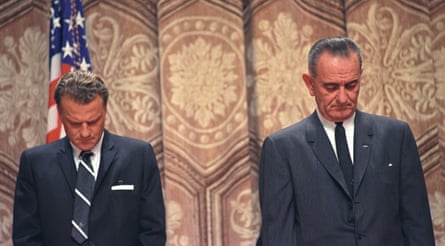
Dr Leah Payne, a professor of American religious history at Portland Seminary, cheekily recommends considering the Southern Baptist minister Billy Graham, a buttoned-up televangelist who wielded significant political power across the Eisenhower, Johnson and Nixon administrations, as the epitome of mainstream evangelicalism. Graham spoke passionately – zealously, even, sometimes pointing an index finger skyward – about his faith and his desire to see nonbelievers enter into a personal relationship with Christ. But he never sobbed, never screamed, and was unlikely to so much as lift his hands in rapturous praise.
“If you look at him, Mr Evangelical, the guy who helped popularize that as a category in the 20th century, you will not see charismatic practices at all,” Payne said. “Like you won’t see people making big emotive displays.”
Sundays at the church of my childhood were quiet. There was prayer, polite greetings, simple hymns, the passing of a brass offering plate. To attend church was a deliberate act of devotion that meant loving the Lord enough to stay awake during the sermon and prioritize worship over something more interesting. The rousing megachurches of my college years, with their pop star pastors in designer jeans and worn V-neck tees, were an upgrade. Compared with miraculous healings and expelling demons, though, even that seems lackluster.
The reach of deliverance ministries is hard to measure, partly because they lack a governing body such as the Southern Baptist Convention or the Catholic church (one map created by adherents shows nearly 600 deliverance ministries in the US, whereas another shows 174). However, a 2023 study from the Public Religion Research Institute, co-authored by Payne, found that 56% of Christian respondents attended religious services that included charismatic practices, indicating “rapid growth” in charismatic evangelicalism. (Just 23% of American Christians were charismatics or Pentecostals in 2006, according to Pew Research data.) Payne noted that although more and more of these ministries are multiracial, as Freedom Collective is, they typically maintain the markers of white evangelical groups, such as white male pastors and surface-level depoliticization.
A growing number of American charismatics are millennial and gen Z churchgoers, who are also more likely to be drawn in through their screens. It makes sense: the romantic, high-stakes drama of spiritual warfare and miraculous intervention is perfect for short-form video. “If you look up TikTok exorcisms, they’re just everywhere,” Payne said.
A post pinned to Thayer’s Instagram, for example, instructs his followers to “watch Jesus heal or deliver 9 different people in 3 minutes”, a supercut from when he set up a booth at a paranormal expo and promised healings to people who, according to him, were likely under the influence of witchcraft.
Charismatic practice seems all but ready-made for this lonely, disorienting moment – more so than the more measured Christianity of Graham. Demons do indeed appear to surround us. Headlines warn of imminent human extinction at the hands of rogue AI agents, though the climate crisis will probably take us out in the end. The rich continue to get richer while the rest of us are squeezed to our breaking points. We grow sicker and sicker as healthcare becomes less accessible. We crave escape; we grow desperate for relief from our cortisol-saturated brains. I, for one, want there to be a good reason for this overwhelming feeling that the world is going to hell in a handbasket, but I keep coming up empty. Demons strike me as at least more interesting than greedy billionaires, and somehow, a battle with a demon seems like a fairer fight.
It’s not unusual for religious practices and ideologies to morph in times of political and cultural upheaval. Perhaps it is the most predictable outcome of a decade that has been marked by a global pandemic, economic inequality and war. A similar phenomenon took place after the September 11 terrorist attacks, when warnings about the end times reached a fever pitch. “I think those supernatural readings of the world are always what people turn to in times of uncertainty,” Payne said. “Americans like apocalypticism culturally, and they like interpreting the world spiritually.”
Conservative politicians often throw fuel on that fire.
Paul Djupe, a political scientist at Denison University who is affiliated with the Public Religion Research Institute, said that in some deliverance ministries, a belief in the supernatural meets a siege mentality that is primed for political weaponization.
“[American evangelicals] have this very militant – like we’re under attack, we’re going to be discriminated against, and we need to upend the order and go to war – idea,” Djupe said. “I think that’s really tightly connected with these beliefs that territories are controlled by demons, and sides and parties are controlled by demons.”
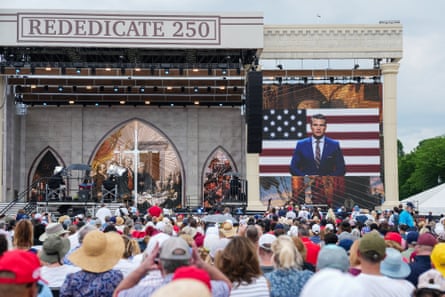
That mindset was on full display at Rededicate 250, a May faith rally on the National Mall in Washington DC, in partnership with the White House. The speakers included Lorenzo Sewell, senior pastor of 180 church in Detroit, a non-denominational charismatic congregation, who said “we do not believe that every Democrat is a demon, but we do believe that the Democratic platform is demonic.” Mike Johnson prayed for God “to save us from these afflictions, to deliver us from the forces of evil, oppression, injustice and tyranny – both within our borders and beyond our shores”.
Christians, for their part, have long believed that they are under global siege for their faith. As Paul warned in the oft-cited 2 Timothy 3:12, at a time when Christians were being tortured and executed for their faith, “all who desire to live a godly life in Christ Jesus will be persecuted”. And now, perhaps more so than ever, apparent confirmations of that persecution appear, unbidden, with a few taps on a pocket-sized piece of glass. Memes that spread fear and hate proliferate on evangelicals’ feeds: that prayer in school is being banned, that Muslims are intent on murdering Christians, that Democrats are demons in disguise, lying in wait to prey on children, be it physically or through ideology.
Plenty of evangelical groups are using this concept of spiritual warfare for political ends, including a Christian nationalist church called Patriot church that partnered with Freedom Collective for its two-day stop in Knoxville. Its pastor, Ken Peters, regularly preaches against abortion, drag performances and Muslim people. Demons are heavily cited in such perceived threats to a Christian way of life. (A woman affiliated with Freedom Collective told me some of its ads were banned by Facebook. “We know that’s the enemy intervening,” she said, shaking her head.)
Before he was delivered, Thayer “was such an idolater of politics”. At one time, he told me, his conservatism led him to so deep a hatred of California that for years, he refused to travel there. When he finally visited the state after the death of a friend, he said 30 people were saved after he preached at the funeral. Now, he said he doesn’t preach about politics. Freedom Collective is more focused on Christians’ everyday battle with Satan and his demons, who work in opposition to their mission of winning souls for the kingdom of heaven.
In Columbia, I spoke to my friend from college about her own deliverance. She told me that she had been plagued with demons that had overwhelmed her with anxiety until she contemplated suicide, and she spoke of immense relief once the Holy Spirit was called down to chase them out of her. She punctuated her story with a refrain: “I know I sound crazy,” over and over again.
Given everything, I do not doubt the sanity of anyone who believes they are locked into lifelong spiritual warfare. Once, a former professor of mine explained her religious agnosticism by saying that she simply couldn’t summon the arrogance to assume she knew perhaps the greatest mystery of the universe. Neither can I.
In the parking lot, night was deepening.
A young man with wavy shoulder-length brown hair who introduced himself as Ethan, a leader at a nondenominational church called Citipointe in nearby Franklin, took the mic. “When I walk through the city, there is a very heavy air of witchcraft,” he said, his tone earnest and pleading. “You may not notice it when you live here. But there is a darkness that inhabits this atmosphere.” The only relief, he warned, was the light of Jesus. The crowd murmured to each other, to themselves, to God.

Thayer then called for anyone suffering from physical pain to line up. Four people came forward, including a bespectacled, goateed man in a plaid shirt and cargo shorts who looked to be in his 60s. Thayer spoke quietly to the man, a hand gently resting on his tensed shoulder, then his abdomen, then his head.
Voice rising, Thayer shouted: “Go! Go now!”
He began to snap his fingers beside the man’s ear.
“Out! Out! Out!”
Thayer’s hand fell to his side, and then moved sharply up through the air.
The man began to cough.
“Good, c’mon,” Thayer urged. He stomped his foot.
This went on for nearly 10 minutes. When it seemed to be over, when the last command in the name of Jesus Christ to leave the man’s body had been uttered, the man smiled. He gripped Thayer’s biceps briefly, nodded and walked away.
Taking the microphone, Thayer told the small crowd: “I believe the Lord just freed a man of cancer.”
Across the lot, the young woman remained prostrate on the ground, the two others at her side. She was still battling her demons.
















Comments