
 German (DE)
  English (US)
  Spanish (ES)
  French (FR)
  Hindi (IN)
  Italian (IT)
  Russian (RU)
  3 weeks ago
In south Minneapolis, a special education student logged on for their online class from the basement. They were hiding because immigration agents were banging at the door.
A second grader started having a panic attack in the middle of art class because agents had arrested his dad. His teacher had to ask a colleague to watch the other students, bring him outside, and hold him for half an hour to help calm him.
Immigration and Customs Enforcement (ICE) detained preschooler Liam Ramos and his father when they returned home from school and then flew them to a detention center in Texas. Ramos was one of four students in his school district who have been detained in recent weeks. A photo of him, in his blue bobbled winter hat, being detained has become a symbol for the indiscriminate nature of the Trump administration’s deportation operation.
The Trump administration has mobilized 3,000 federal agents who have pervaded the region, arresting people at school bus stops, on morning commutes, at grocery stores and outside churches.
The operation has upended the education system, parents and teachers said. Students are struggling to carry on with their lessons, while also carrying grief and fear that they, or their friends, families and caregivers could be taken away.
“This is causing so much harm that is going to carry on for decades,” said Kate*, an early childhood educator in Minneapolis who works with mostly Spanish-speaking children and their families. “This is a generational trauma.”
‘How do I explain any of this to her?’
On a recent Thursday morning, at around 7.30am, Jennifer Arnold and her seven-year-old son ducked out of their home in south Minneapolis and knocked on a neighbor’s door to pick up their kid. Arnold shuffled alongside the two children, who crunched and skidded down the ice-coated sidewalk toward their bus stop.
Normally, about 20 kids and their parents gather at that stop each morning. “There’s a lot of families with kids in this neighborhood,” Arnold said – that’s a big reason why she and her family had chosen to live there.
Many of her neighbors are immigrants – and lately, most of them are staying inside, avoiding even the two-block walk to the bus stop.
Arnold’s kid, meanwhile, has started carrying around a bright orange whistle – just like his mother and all the other volunteers keeping watch for ICE agents in the neighborhood. “He said he’s ready to use it,” Arnold said.
Lately, he said, his school has felt really “small”. Only seven kids had showed up to his second-grade class the day before.
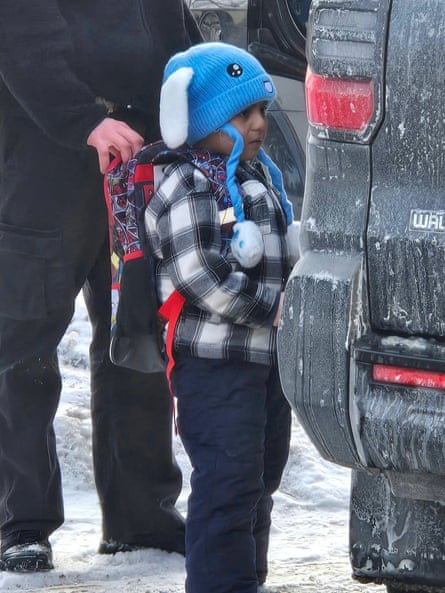
On the same day that an ICE officer shot and killed Renee Nicole Good, immigration agents unleashed chemical irritants outside a Minneapolis high school during dismissal time and detained a staff member. Immediately afterwards, the district cancelled classes – and then a few days later reopened schools with an option for virtual learning for those who are too fearful to come in person.
As parents debated difficult questions about whether it would be safer for their children at home or at school, administrators and teachers scrambled to figure out systems to teach both online and in-person. Schools had offered remote learning during the Covid-19 pandemic – but back then, they had the time to acquire laptops and internet hotspots for students who didn’t have access to those things at home.
And during the pandemic, children were at least able to go outside and take in fresh air, said Kristen, who teaches elementary school environmental education. “Now, many families don’t feel like they can even do that.”
She and others who teach specialized classes – art, physical education, music – currently aren’t able to offer a remote-learning option. And the situation has also enforced a sort of segregation, the teachers said. “Most of the brown kids are at home, and the other kids are at the school,” said Silvia, an art teacher.
Those who are still attending class, she said, are displaying symptoms of traumatic stress.
Children have been falling asleep in the middle of class or bursting into tears. When Silvia’s school was under a “code yellow” – meaning ICE agents had been sighted nearby, the school was under a lockdown and outdoor recess was cancelled – some elementary school-aged children peed themselves. “Nobody said ‘ICE’ or anything like that but the kids know,” she said. “They are having a trauma response.”
The stress is affecting all students – some who are worried about themselves and their immigrant families, and others who are worried about their friends, Sylvia said.
Amanda Otero said her seven-year-old daughter had recently been counting off all the friends she had stopped seeing in class. “Is Michael going to school? No. Is Kelsey going to school? No.”
“I could see her picking through her head, the white versus the brown kids,” Otero said. She didn’t know how to explain to her daughter that though they were light-skinned, they were Latino, too; that they were from an immigrant family, too. “How do I explain any of this to her?”
Teachers have had to grapple with similar questions: how much can or should they try to maintain a sense of normalcy? How much do they need to talk about ICE in class?
Normally, Phil, who teaches post-secondary special education students, does a unit on civil rights and labor rights in the lead up to Martin Luther King Jr Day. They discuss Memphis Sanitation Workers’ strike and King’s I’ve Been to the Mountaintop speech. “It’s totally relevant today,” Phil said. “It’s all fundamentally about the denial of the humanity of some people so that other people can be put at the top.”
But last week, he had to put that lesson on hold.
On 14 January, two blocks from campus, ICE agents took a father and his two children. It happened just as Phil’s students were arriving by bus. Bystanders and volunteer legal observers were blowing their whistles and honking car horns to alert the neighborhood that federal agents were present.
“So literally I had to spend my lesson telling students about what to do if an immigration agent comes to their door and knocks on them and what rights they have in that situation,” he said.
Many of his students have physical disabilities, and are especially vulnerable in confrontations with federal agents. And some of his autistic students, he said, find the commotion of the whistles and car horns designed to alert for ICE presence distressing.
“It can just instantly create anxiety, and they could react in a way that can draw attention from ICE agents and make them even more vulnerable,” he said. “They are in danger because their responses could literally end their lives.”
So they practiced various scenarios. If they hear the horns, Phil coached them: “Let’s take three to five deep breaths. We’re gonna survey the situation. We’re going to look around and try to find the safest route without panicking or running and try to leave.”
The lesson felt especially urgent that day. Video had been circulating of immigration agents forcibly and violently dragging Aliya Rahman – a 42-year-old US citizen and Minneapolis resident – from her car, even as she screamed: “I’m an autistic disabled person.”
Later, Phil said, he felt sick that he had to spend class time training his students for that sort of worst-case scenario. “My lessons were to protect my students,” he said. “But it angers me. I am livid.”
Still, he was glad they reviewed safety. Later that day, one of his students knew to move to the basement and hide when they heard federal agents knocking at their door. They continued with their online class from there.
‘Every day, ICE is more destructive’
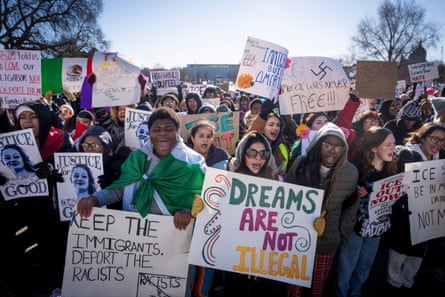
On Friday, about 60 educators held a “teach in” at the Minneapolis city hall – reading out loud a bilingual children’s book about migration – to rebuke the presence of ICE in the state. That day, teachers also joined health workers, faith leaders and other residents in protests across Minnesota against the federal deportation operation.
“Educators have been at the front lines fighting back against ICE’s presence in our communities,” said Drake Myers, a member of the Minneapolis Federation of Educators Local 59 union.
“Basically we’re doing social services,” said Kate – the early education teacher. Many of her young students come from immigrant families that have been too afraid to leave their homes – so she spends her evenings arranging food and supply drop offs.
“Every day, ICE is more destructive in our communities, and there’s more students isolated and in need,” she said. She has growing lists of families she needs to check in with, homes that need drop-offs. Some of her teacher friends, who are immigrants, and have been using up their sick days so they can stay home. “So I need to check on them, too.”
Then there were the students whose mothers were pregnant, and avoiding prenatal appointments because ICE was at the hospitals and health centers. Some families needed help connecting to legal aid, others needed mental health support for themselves and their children.
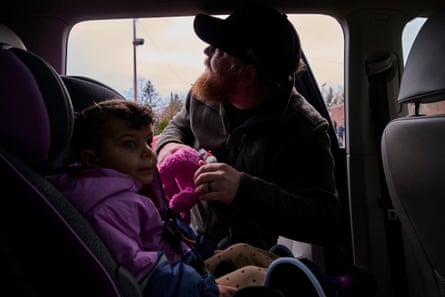
“I got a call at 2am on Saturday, because someone’s kid needed to go to the emergency room. And people are afraid to drive,” she said.
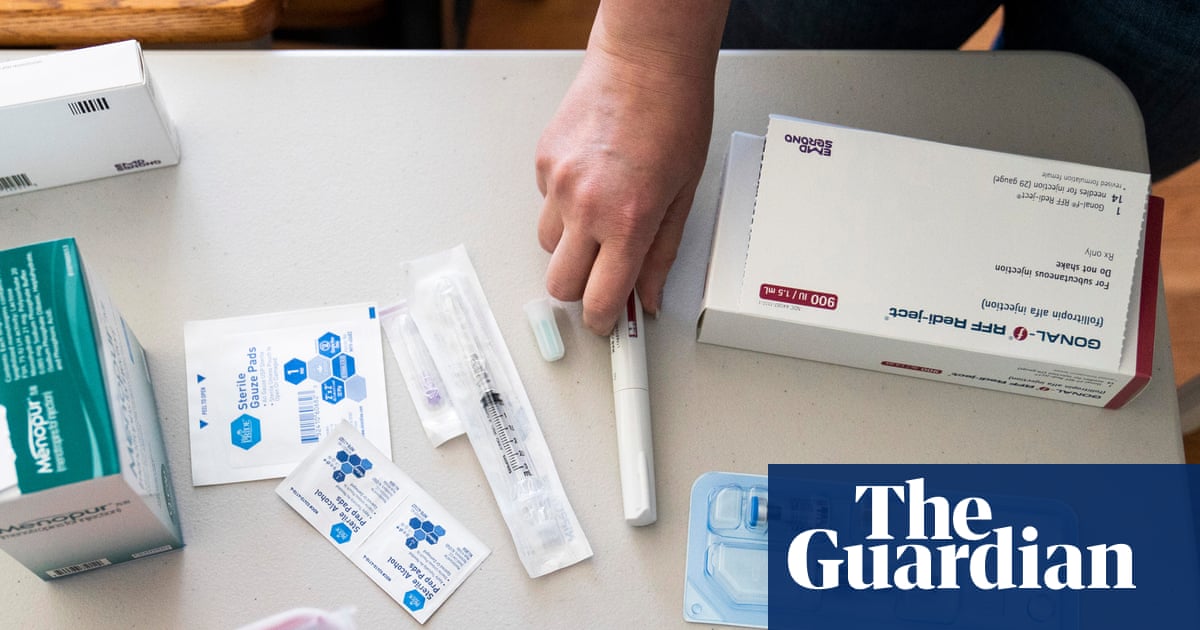
Phil, meanwhile, was helping fundraise for a student who – on top of everything else – lost health insurance after Congress allowed healthcare subsidies to expire. They had to come up with $1,700 for a live-saving epilepsy medication.
It has been painful and exhausting, said Silvia, to teach through so much fear.
The other week, one of her second-grade students had a panic attack in the middle of class – in front of all the other kids. His dad had been detained by ICE. What broke her, she said, was that he blamed himself. “He said: ‘I asked him not to go to work and I prayed to God for my dad but they took him.’” She tried to console him, but he wouldn’t accept it. “He was like: ‘No my dad’s not going to be OK. Trump has guns. They can kill him.’”
Silvia’s own children are a bit older, but they worry about her, too. She’s a US citizen, but she’s originally from Chile. Her younger daughter, who is 13, had begged her in the days after Good was killed to stay home, to not go outside, to avoid the vigils. “We had to have hard conversations about how we need to be there for our community and that I also had other people who were looking out for me.”
Still she, like many other US citizens of color, has started to carry around her passport, even though, she said, “I shouldn’t have to.” Phil, who was born in Korea, has been doing the same. “It feels icky – and frankly disgusting,” he said.
Teachers have started carpooling, or taking slightly different routes to work each day – just to avoid any chance that ICE agents will follow them to school. “I try to put on a good face, but as soon as the kids are on the bus back home, I’m crying” Silvia said.
She recently introduced her students to watercolors, Silvia said, because its a healing medium. “And normally I’m walking around the class, talking with the kids as they work,” she said. But that week that Good was killed, she sat down and started painting as well. “Because I was feeling so dysregulated too.”
They experimented with how different colors layer and flow into each other. It was calming.
“Everybody needs watercolor in their life right now,” she said.
*The Guardian is referring to several educators in this story by their first names for their safety and the safety of their students.







Comments