
 German (DE)
  English (US)
  Spanish (ES)
  French (FR)
  Hindi (IN)
  Italian (IT)
  Russian (RU)
  2 weeks ago
In January 2026, during Operation Country Roads, Immigration and Customs Enforcement and state and local law enforcement detained roughly 600 immigrants across West Virginia.
Many of those arrested were held in the state’s already overpopulated jail system, which until this spring was part of a national network of immigrant detention centers.
Within this market, ICE ships detainees around the country, paying hundreds of facilities a per-day rate for housing them. Many of these facilities are in rural communities where federal funding cuts have hollowed out social services, from healthcare to food stamps, leaving them desperate for economic relief.
Federal immigration detention in local facilities hearkens back to earlier eras of expanding American incarceration. As a sociologist of law and punishment, I’ve explored how rural places have long built and expanded prisons to tap into federal funds during times of economic precarity.
The 1876-1908 blueprint
Rural incarceration isn’t new. More than a century before ICE was established, West Virginia was holding out-of-state federal prisoners to collect revenue – a history I reconstructed using the West Virginia Penitentiary’s administrative records.
As modern prisons proliferated across the nation, major cities exported prisoners to state prisons in less populated areas. West Virginia was one of a few states – alongside Maryland and Texas – to receive these excess urban prisoners.
Beginning in 1876 and lasting until around 1908, federal and District of Columbia prisoners sent to West Virginia drove an expansion of the state’s prison system. During this time, the state’s prison population grew more than sevenfold, booming from about 160 in 1876 to more than 1,200 in 1908. Controlling for population growth, the incarceration rate tripled.
West Virginia was paid for housing each federal prisoner, and the state’s prison administration was desperate for this revenue. Reports that I reviewed from the penitentiary’s wardens and supervisory board show that by 1908 revenue from the federal government was US$77,000 over a two-year period, or the equivalent of $2.8 million in today’s dollars.
Beginning in 1908, after federal prisons opened in Atlanta, Georgia, and Leavenworth, Kansas, most federal prisoners were sent to these new federal prisons, and cells began to empty at the West Virginia state penitentiary.
Filling empty beds
The national incarceration rate – which includes both jails, for short-term detention, and prisons, for sentences of more than a year – has more or less crept downward since 2010. But that decline is not even across place or institution; it has been concentrated in cities and liberal-leaning states that have implemented expansive criminal justice reforms and diversion courts.
Meanwhile, jail stays are booming, especially in rural and suburban places. Lengthy pretrial periods and resource shortages account for much of that growth. So does the rental of jail beds to outside entities, including state departments of correction and federal immigration authorities.
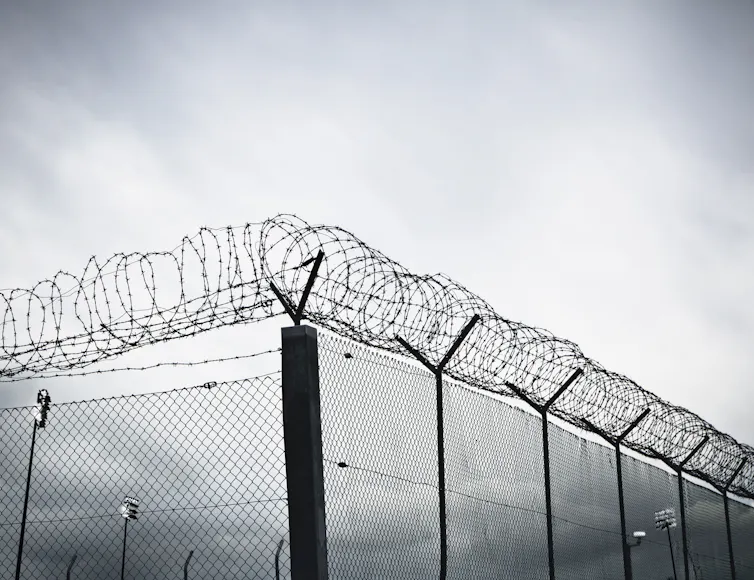
Rural communities have often vied for prisons, just as they lobbied for federal prisoners in the 1800s. These rural areas seek new prisons for the infusion of money and jobs into the local economy. According to sociologist John Eason, these facilities often function as a “state-sponsored public works program for disadvantaged rural communities,” creating “perverse economic incentives for prison proliferation.”
Today, as criminal justice reforms drive down prison admissions in some areas, immigration detention is filling prison and jail cells that would otherwise be empty. The number of people detained by ICE increased by 58% – or more than 25,000 people – between 2025 and 2026, according to the Prison Policy Initiative, which advocates to end mass incarceration. Expanded immigration detention, the group’s March 2026 report says, “accounts for virtually all of the growth in mass incarceration” since its last report.
Indiana offers an example of this shift: Its Miami Correctional Facility in rural Bunker Hill had 1,000 beds it could not properly staff with a limited budget. The state now rents those beds to ICE for $291 per detainee per day.
In the rural town of Baldwin, Michigan, in one of the state’s poorest counties, a closed prison has reopened as an ICE facility. A state legislator told The Washington Post in August 2025 that the facility was on track to become the area’s biggest employer and taxpayer.
Similarly, in August 2026 officials announced that a long-closed private prison in rural Minnesota will soon reopen as an ICE detention center. As sentencing decreased across the state, the prison in Swift County, which was once one of the area’s largest employers, closed in 2010 for lack of demand. But its reopening presents an economic opportunity: Minnesota state Sen. Torrey Westrom pointed to some 450 new jobs that the facility will bring to the area.
History repeats itself
Following the decline of prisoner importation in the early 20th century, West Virginia ceased to receive direct federal payments for housing prisoners. But a similar practice, one fueled by immigrant detention, has returned to the Mountain State.
As immigration enforcement ramped up under the second Trump administration, West Virginia, like many states – including Ohio and Florida – opened its facilities to ICE, which paid the state $90 per day per detainee.
Beginning in early 2026, federal judges ordered the release of immigrants held in the state’s jails, finding due process violations. In late March, the regional jail system temporarily suspended accepting new immigrant detainees.
Nonetheless, West Virginia has continued to collaborate with federal immigration enforcement for financial gain. The state hosts a recently expanded Customs and Border Protection training center and will continue participating in the federal 287(g) program, through which local law enforcement agencies are paid to collaborate with the federal government on immigration enforcement.
In the past, rural states and counties have built out their carceral systems with profit from imported prisoners. Immigration detention is reviving that model. So long as states see immigration detention as a potential revenue stream, it appears that tradition will continue.



















Comments