
 German (DE)
  English (US)
  Spanish (ES)
  French (FR)
  Hindi (IN)
  Italian (IT)
  Russian (RU)
  3 weeks ago
On 19 February, the second day of Ramadan, Mohamad Faisal Nurul Amin and his family gathered to pray before sunrise in their apartment on the outskirts of Buffalo, New York. After nearly a year of waiting, they believed their family would be together again. Amin’s father, Nurul Shah Alam, 56, was coming home.
“For the first time since we arrived in America, I felt happy,” said Fatima Abdul Roshid, Shah Alam’s wife, speaking through an interpreter. “I thought my husband would be with our two sons and me for Ramadan.”
In December 2024, Roshid and two of their sons moved from Malaysia to Buffalo, part of a resettlement effort for ethnic Rohingya people. The Muslim minority has long faced violence in Myanmar (formerly Burma). Three of Roshid and Shah Alam’s other sons remained in Malaysia, waiting for admission to the United States. Shah Alam, who had lost much of his sight during a childhood accident, was weak after spending months in the Erie county detention center because he’d mistakenly wandered into an area resident’s backyard and was arrested by authorities.
A day before his scheduled release, on 18 February, the family visited Shah Alam at the center and began preparing for his return. Roshid gathered ingredients for his favorite recipes from local Burmese and Bangladeshi stores, and laid out new clothes for the holy month.
But Shah Alam never returned home. Five days later, on 24 February, his body was found four miles from where Border Patrol had dropped him, without notifying his family or attorneys. He had no warm jacket or shoes, only the orange detention booties issued to him in custody. Temperatures in Buffalo were below freezing.
“It broke our home,” Amin said, his voice trembling.
On Tuesday, the Erie county medical examiner’s office ruled Shah Alam’s death a homicide.
A cause of death, renewed pain
More than a month after his death, the medical examiner’s office said Shah Alam died from “complications of a perforated duodenal ulcer precipitated by hypothermia and dehydration”. It added that, for death certification purposes, “homicide” includes deaths resulting from the actions of another person, including negligent acts or omissions.
“The Erie county medical examiner’s report confirms our understanding that Shah Alam was placed in a hostile environment from which he could not reasonably be expected to extricate himself,” said Terrence Connors, an attorney representing Shah Alam’s family. “Border Patrol had the ability to place him in a non-hostile environment. That is why the manner of death was ruled a homicide.”
“When I got the call from the medical examiner, my body went into shock,” said Mohamad Faisal Nurul Amin, Shah Alam’s son. “I felt like I was going to throw up. I couldn’t move. My mother was devastated. I am still depressed.”
The Department of Homeland Security said in a statement to the Guardian that Shah Alam’s death “had nothing to do with Border Patrol” and described the findings as “another hoax being peddled by the media and sanctuary politicians to demonize our law enforcement”.
The homicide ruling has intensified calls for accountability.
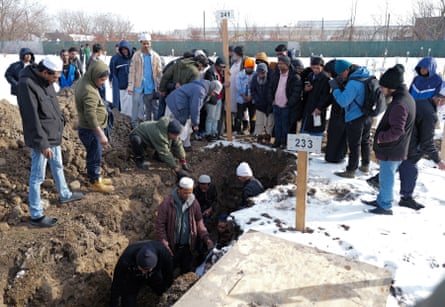
“A homicide finding means this wasn’t just a tragedy. It points to neglect or wrongful action,” said Michelle Brané, executive director of Together and Free and a former immigration detention ombudsman at the Department of Homeland Security.
Shah Alam’s death has raised urgent questions about how federal authorities under the Trump administration handle the detention and release of immigrants. Advocates say the case reflects broader concerns about whether detainees are released without coordination, safeguards, or basic communication with their families.
“These practices seem almost intentionally cruel,” Brané said. “There were established procedures for releasing someone safely that didn’t require extra cost or effort. When those safeguards are ignored, it raises serious questions about whether people are being placed in danger unnecessarily.”
Fear and flight
The death of Shah Alam has also shaken Buffalo’s small Rohingya community, about 2,000 members. Many fled ethnic genocide in Myanmar before rebuilding their lives in the United States.
“After coming to the United States, people think it’s over,” said Imran Fazal, founder of the Rohingya Empowerment Community in Buffalo and a spokesperson for Shah Alam’s family. “You think, now I have an ID, I have paperwork. I can show people who I am and where I’m from. But now the fear is coming back.”
Fear and displacement had already defined much of the family’s life. The Rohingya have been called the most persecuted minority in the world by the United Nations and human rights groups. “They are stateless, denied citizenship in their own country despite living there for centuries,” said Daniel Sullivan of Refugees International, who has spent years tracking the crisis.
In 1977, Myanmar’s military launched what it called Operation Dragon King, a nationwide campaign often described as a form of ethnic cleansing. By May 1978, more than 200,000 Rohingya had fled to neighboring Bangladesh. Four years later, Myanmar passed a citizenship law that excluded the Rohingya from the country’s officially recognized ethnic groups.
Roshid and Shah Alam were wed in an arranged marriage in 1990. “I met my husband at our wedding,” she said. “I didn’t know what he looked like, but I was thankful. He was very kind and loving.”
Renewed violence set off a cycle of migration and eventually separated the family. In 1996, the family fled to Bangladesh, where the government restricted their movement, and life in the camps was difficult. Two years later, the family returned to Myanmar, where the Rohingya were often subjected to forced labor, detention, and abuse. In 2002, Shah Alam left for Malaysia, joining thousands of Rohingya men who migrated in search of jobs and safety. “He worked day and night and sent us money,” Roshid said.
Amid the 2012 clashes between Buddhist and Muslim communities in Roshid’s native Rakhine state, she fled with her children again. They reached Malaysia the next year, where they reunited with Shah Alam and the family’s three older sons.
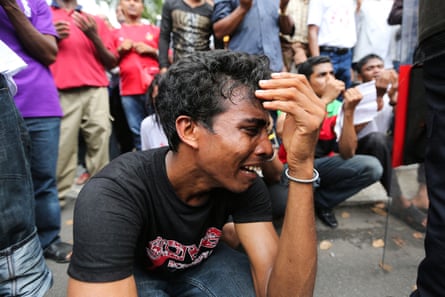
“I hadn’t seen my father since I was very young,” Amin said. “It felt like a dream to finally be together.”
After years of vetting and interviews, the family was granted refugee status, making them eligible for third-country resettlement. Even then, the process was uncertain.
“We were told we could go to America in 2017, then again in 2019,” Amin said. “But my father refused because no one could guarantee we would all go together.”
In 2022, the United Nations refugee agency told the family they could be resettled in the same country, though not at the same time. With that assurance, Shah Alam agreed.
After another two years of background checks and medical screenings, Roshid and two of their younger sons were resettled in Buffalo, New York, in December 2024.
“It was very cold and dark,” Faisal recalled.
Three weeks later, on 20 January, nearly 380 miles away in Washington, Donald Trump was sworn in as the 47th president. On his first day in office, he signed an executive order suspending refugee admissions to the United States indefinitely. That meant that the cases of Shah Alam and Roshid’s other sons were halted with no clear timeline for when, or if, they would be allowed to be reunited.
The incident
A little less than a month after Trump’s inauguration, on 15 February, Nurul Shah Alam was arrested.
According to his family, Shah Alam had gone to a nearby Burmese grocery store and bought a few items, including a curtain rod he later used as a walking stick. Nearly blind and unable to speak English, he became confused on his way home and wandered into a residential neighborhood in Black Rock, a neighborhood in north-west Buffalo.
He entered the backyard of Tracy Chicon, just as she was letting her dog out.
According to reporting by Investigative Post, a local news outlet, Chicon – who is white – called the police and described Shah Alam as “an unidentified Black man” in her driveway. In her account, Shah Alam had opened a gate, let the dog out, and damaged a shed door with the curtain rod.
Ben Macaluso, Shah Alam’s attorney, said in media interviews that Chicon’s account lacked critical context. Shah Alam, he said, “came from a place where people do not keep dogs and was likely frightened when the animal began barking”. The Guardian was unable to reach Macaluso for comment. He had been placed on leave by the Legal Aid Bureau shortly after the incident. The bureau also did not respond to a request for comment.
Body-camera footage reviewed by the Guardian shows Buffalo police officers ordering Shah Alam to drop the curtain rod within seconds of arriving. He did not comply, sometimes pointing the rods toward them and waving them around, appearing confused and unable to understand commands. Officers then used a Taser on Shah Alam, tackled him to the ground, and struck him as he lay restrained. In the video, Shah Alam can be heard speaking in his native language.
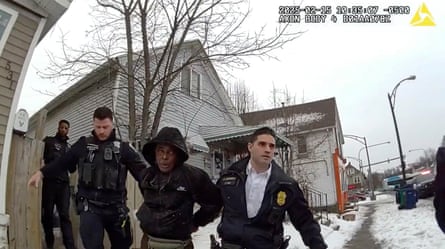
He was arrested at the scene and later charged with felony assault, burglary, and criminal mischief. At a hearing in late May 2025, bail was set at $5,000.
Shah Alam’s family chose not to post bail. They feared that if he were released, he would be transferred into immigration custody, moved out of state, or deported to another country. At the time, immigration authorities had increasingly begun sending detainees to third countries where they had no ties, a practice advocates say lacks oversight and can put lives at risk.
According to J Dale Shoemaker, a local investigate journalist whose colleague later visited Chicon’s home and informed her that Shah Alam had died after their accidental encounter, she expressed no remorse. “He should not have even been let out of jail,” she said. “I don’t feel bad at all.”
On 9 February, the Erie county district attorney’s office agreed to a plea deal negotiated by Shah Alam’s attorney. District attorney Michael Keane said in the statement to the Guardian that the decision followed “a comprehensive evaluation” of Shah Alam’s conduct, criminal history, medical condition, and time served, and took into account the “significant collateral consequences” of a felony conviction, including deportation.
Shah Alam pleaded guilty to reduced charges, including criminal trespass and misdemeanor possession of a weapon, referring to the curtain rod he had been using as a walking aid.
Keane’s office told the Guardian that “it had no communication with federal immigration authorities and believed Shah Alam would remain in custody pending sentencing”. It was not aware of his release until after it occurred, and said a federal immigration detainer remained in place when his bond was posted.
Shah Alam’s immigration attorney, Siana McLean, said she had separately communicated with federal immigration authorities and was assured he would not be taken into immigration custody. The plea, she said, “did not make him removable from the United States”. The Guardian did not receive a response to requests for comment from her office.
It’s unclear how Shah Alam was released, and what coordination, if any, occurred between local and federal authorities. But on 19 February 2026, one thing was clear: Shah Alam was released from the Erie county holding center.
That day, his son, Amin, had posted bond and was waiting outside to take him home. “I was nervous but happy,” he said.
They waited for hours. “We thought he would be out at 11 am,” Faisal said. “By 5 pm, his name had disappeared from the online system. We didn’t know what to do.”
In a statement to the Guardian, the Erie county sheriff’s Office said notifying the detaining agency of a pending release was “standard practice”, and that Border Patrol agents arrived at the holding center before Shah Alam’s release was finalized. The sheriff’s office did not address why Shah Alam’s family, who had been waiting outside since that morning, or his attorneys were not informed that he was being transferred to federal custody.
At that point, Immigration and Customs Enforcement declined to take custody of Shah Alam. US Customs and Border Protection (CBP) agents then assumed custody. According to a preliminary assessment by the state attorney general’s office, Shah Alam was in federal custody starting at approximately 4.30pm on 19 February.
Almost four hours later, CBP decided not to deport him. In a post on X on 26 February, the Department of Homeland Security said agents had offered Shah a “courtesy ride” to a coffee shop described as “a warm, safe location near his last known address,” adding that he showed “no signs of distress”.
That evening, agents dropped Shah off alone at a closed Tim Hortons at 8.18pm. Neither his family nor his attorneys were told where he had been left.
Shah was partially blind, did not speak English, and had spent nearly a year in detention.
“At no point does it appear that anyone considered his needs as a human being,” said Beth Haroules, a senior staff attorney at the New York Civil Liberties Union and director of its disability justice litigation project. “Forget the law. From a moral perspective, every part of the government that interacted with him had a responsibility to understand his needs and ensure he was not harmed.”
Haroules said Shah Alam’s vulnerabilities were visible and should have shaped how officials handled his release. “All of these characteristics – that he was disabled, visually impaired, brown, and unable to communicate or defend himself – worked against him,” she said. “Border Patrol treated him as disposable.”
The following day, DHS issued a second statement on X, calling the case “another hoax being peddled by the media and sanctuary politicians” and stating that Shah Alam’s death “had NOTHING to do with Border Patrol”. The Guardian contacted CBP multiple times, asking whether an interpreter had been used and what assessment had been made before leaving Shah Alam at a closed location in the winter. Federal officials only referred to a public DHS statement.
In a letter to Congressman Tim Kennedy, New York attorney general Letitia James said there was “no reason to credit” CBP’s account. “Our information indicates that Mr Shah did not speak English,” she wrote. “The federal authorities’ unreliable account only raises further questions.”
But Brané said such practices appear to contradict protocols that DHS previously followed when releasing detainees, and that the recent surge in detainees being released in unfamiliar or unsafe locations has raised serious concerns among advocates and former officials.
“We’re seeing cases where people are simply left on their own,” said Brané. “They’re not allowed to arrange a pickup. Officials don’t coordinate with family members, and in some cases, people aren’t even given the chance to make a phone call so a relative or friend can come get them.”
The day after his release, Shah Alam’s attorney began searching for him. His family spent the weekend retracing familiar streets in Buffalo, checking places he once knew, including his old apartment. On 22 February, the family’s attorney filed a missing person report. The sheriff’s office briefly closed the case, then reopened it several hours later. According to Investigative Post reporter Shoemaker, “the sheriff’s office at one point told me that they did not notify any family members or lawyers when they handed him over to Border Patrol”. On 24 February, Shoemaker published a breaking story about the Border Patrol dropping off Shah Alam at the store.
That same evening, at around 8.30pm, a Buffalo police officer responded to a call reporting an unidentified man who “was no longer moving”. He was wearing a dark parka and khaki pants.
The next day, Shoemaker reported that the man was Shah Alam.
The story spread quickly, picked up by national and international outlets, and became a flashpoint in the Trump administration’s immigration crackdown. Democratic lawmakers called for an investigation. The mayor of Buffalo pledged to establish a full timeline. On 5 March, former DHS secretary Kristi Noem was questioned about Shah Alam’s death. A day later, New York attorney general Letitia James opened a formal investigation.
The determination that his death was a homicide on 1 April has intensified scrutiny and drawn sharper reactions from lawmakers and advocates. Congressman Kennedy said: “Mr Shah Alam would be alive today with his family if he had access to medical care. Instead, he was callously abandoned on a cold winter night by the Department of Homeland Security.
“In light of this determination, DHS must fully cooperate with the attorney general’s investigation and ensure a transparent review of what happened.”
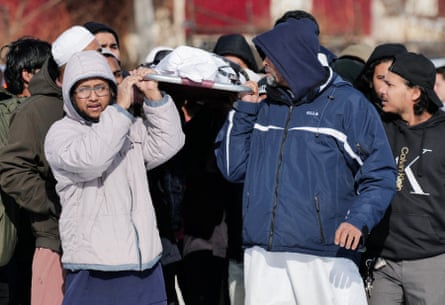
For Shah Alam’s family, the loss was intimate and devastating.
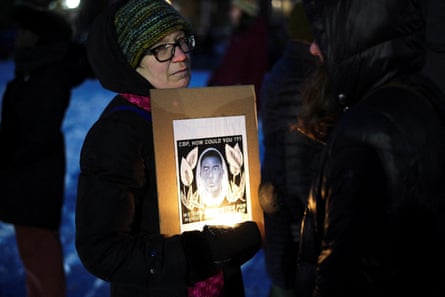
Since learning the cause of their father’s death, they have been forced to relive the pain, reopening years of trauma they believed they had escaped. “We don’t speak good English, but when I learned how my father died, it made my mother, my brothers, all of us very devastated,” said Mohamad Faisal Nurul Amin. “It is cruel. It is inhuman. I never thought it would happen in this country.”
His death shattered what little sense of safety and certainty they believed they had found in the United States. To them, Shah Alam was a devoted father who wanted nothing more than to keep his family together. The family now hopes that their three brothers and their families can be reunited with them, if only to mourn together.
“His lifelong wish was always unity,” Roshid said. “To stay together as a family.” She paused. “Even in his final moments, he didn’t have his children by his side. Not even at his funeral.”
What remains, she said, is hope.
“My husband died with that hope. I’m still here, hoping we can all be reunited one day.”












Comments