
 German (DE)
  English (US)
  Spanish (ES)
  French (FR)
  Hindi (IN)
  Italian (IT)
  Russian (RU)
  3 weeks ago
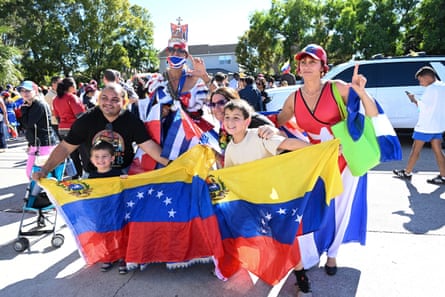
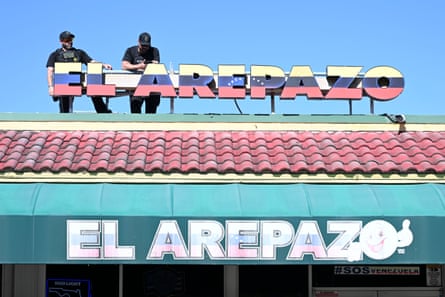
The first chants of “libertad” cut through the air well before dawn in Doral, the suburban Miami city where up to 40% of the population is Venezuelan. Hundreds of people, dancing, singing and waving Venezuela’s yellow, blue and red flag filled the street outside the El Arepazo restaurant, the traditional community meeting place, as they celebrated the downfall of the despised president Nicolás Maduro.
The euphoria lasted well into the day on Saturday as residents learned how the strongman and his wife, first lady Cilia Flores, were snatched from their beds by US military members and bundled away towards an eventual court date in New York City.
Then came Donald Trump’s head-scratching press conference, and a realization for many that the US president’s vision for the next steps towards freedom in their homeland bore little relation to their own.
Instead of popular opposition leaders Edmundo González and María Corina Machado, the Nobel peace prize winner, returning to guide Venezuela through the immediate post-Maduro period, Trump declared the US would temporarily seize control of the country, and American businesses would be taking over its rich oil infrastructure.
“We are ready to stage a second and much larger [military] attack if we need to do so,” the president warned in a thinly disguised threat to those who would stand in his way.
Trump’s sidelining of Machado in particular sits uncomfortably with south Florida’s diaspora of Venezuelans, the largest in the US, which was already reeling from his action, upheld by the supreme court in October, to strip immigration protections from hundreds of thousands of them.
If anything, some experts said, the capture of Maduro and imposition of a US-run government in Venezuela might even speed up deportations.
“They’re celebrating the ouster of Maduro, and I’m in agreement with that. But he also said we’re doing this for the Venezuelans who have been in the US because of Maduro, and now they will be able to go back to a free Venezuela, right?” said Eduardo Gamarra, professor of politics and international relations at Florida International University and a former director of its Latin American and Caribbean center.
“He didn’t say anything of all the refugees, the people who lost their temporary protected status and people who have asylum. So on what basis are you going to say somebody in Venezuela is going to persecute me when it’s the US government that’s running Venezuela? What you might see is an accelerated path of deportations, but you might call them repatriations now.
“I’m not sure that Venezuelans in Doral, or anywhere in the US, really grasp this. They’re all happy, but I really wonder how many of them are going to go back to Venezuela.”
Republican politicians in Florida, unsurprisingly, were quick to praise Trump’s action. The representative Carlos Gimenez, a former mayor of Miami, likened Maduro’s ouster to the “fall of the Berlin wall” in a post on X, and said the community was “overwhelmed with emotion and hope”.
“President Trump has changed the course of history in our hemisphere. Our country & the world are safer for it,” he wrote.
But the Democratic representative Maxwell Frost, who is Cuban-American, said the president’s action was “illegal, dangerous, and outside the bounds of his constitutional authority”.
In a statement, Frost echoed Gamarra’s fears of escalating deportations of Florida’s Venezuelans: “President Trump thinks that Maduro is a big enough problem to take illegal actions in Venezuela, but not a big enough problem to provide Venezuelans with temporary protected status.”
“He’s willing to risk American and Venezuelan lives for political gain, but refuses to extend a critical legal lifeline to families fleeing the very crisis he claims to oppose.
“Nicolás Maduro was a brutal dictator and an authoritarian. He has repressed, jailed, disappeared, and murdered his people for over a decade. I stand against authoritarianism, no matter the nation. I shed no tears for Maduro’s loss of power.
“But I do shed tears for the destruction of our own democracy. Authoritarians like Donald Trump will always seek justification to break the law in order to start foreign wars for unclear reasons. Congress cannot give him an inch, or there will be much more reckless behavior that endangers lives and allows him to consolidate more power.”
Some Doral Venezuelans said they were hopeful for the “opportunity” they believed Maduro’s removal might bring.
“Many of our entrepreneurs fled the Maduro regime, including myself,” said Leonardo Trechi, president of the Miami-based Venezuelan American Chamber of Commerce. “I have an independent media company and my employees, journalists and cameramen were arrested and persecuted, even our equipment was confiscated.
“There was a car dealership in Venezuela threatened by Farc dissidents and closed its business there, but opened here in Florida and they are now one of the most successful businesses of its kind. That’s why we believe the Venezuelan diaspora in the US plays an active and fundamental economic role in the growth of both countries.
“The detention of Maduro is not just a relief, it’s an opportunity. We’re willing to contribute the experience we have gained within the US and the capital of Venezuelan entrepreneurs in the US to the reconstruction of Venezuela, and we are also willing to work hand in hand with the Trump administration.”
Celestino De Caires, who was born in Caracas and has lived in California since 1980, said he was hopeful that conditions would begin to improve in his homeland.
“If you go to Venezuela, you will realize that it’s the grandparents who are raising the kids, their grandchildren, because the parents had to migrate to all parts of Latin America and the US due to corruption. There was no jobs, there was nothing to eat,” he said.
“People in Venezuela are hungry and their wellbeing depends on this transition.”











Comments