
 German (DE)
  English (US)
  Spanish (ES)
  French (FR)
  Hindi (IN)
  Italian (IT)
  Russian (RU)
  2 weeks ago
Local officials across Michigan are highly confident in their ability to administer an accurate election this November, according to a report on election integrity my team published on Aug. 12, 2026. They also voiced concerns about rising disinformation and costs.
“We work very hard at our elections and resent all the negative comments about insecure or fraudulent elections,” one local official said in the report, which details findings from a survey of local officials and clerks who administer elections in Michigan. The officials responding to our survey were granted confidentiality.
Michigan voters will elect a new governor, a U.S. senator, several representatives in Congress and lawmakers in the state Legislature in November 2026.
Public confidence in elections and secure and accessible voting are the bedrock of a healthy democracy. Because U.S. elections are run by local governments, collecting data on local officials’ on-the-ground experiences and perspectives is one of the most valuable ways researchers can gauge local governments’ preparedness to run the upcoming election with integrity.
Local confidence in election integrity is high
At the University of Michigan Center for Local, State, and Urban Policy, where I am the director, we have been tracking how local officials feel about local election administration, democratic functioning, fiscal health and a wide range of other local issues since 2009.
Our Michigan Public Policy Survey consistently gets responses from local officials in over 70% of Michigan’s 1,856 cities, villages, townships and counties. This makes us confident that our results reflect the full range of communities, from small rural townships to large cities.
In spring 2026, we asked local officials how they are feeling about administering the 2026 November general election. We revisited questions we previously asked them in 2017, 2020 and 2022.
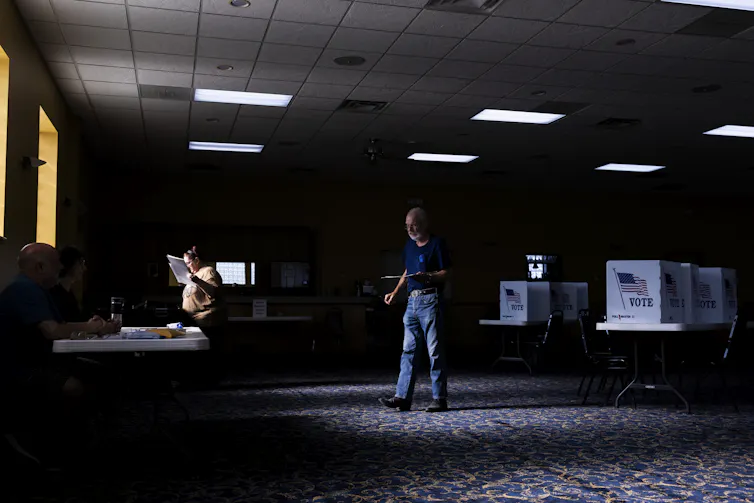
Local clerks and municipal employees are responsible for the day-to-day work of administering elections. They register voters, maintain voter lists, distribute and collect absentee ballots, run polling locations on Election Day, distribute “I voted” stickers, and tabulate and report election results.
We found that this year 95% of city and township clerks are “very confident” in their ability to administer an accurate election this November. This is a slight increase compared to surveys in 2020 and 2022. The high level of confidence holds across communities large and small, urban and rural, and deep red and deep blue.
Local officials want the public to know just how seriously they take their responsibility for election security.
“(We) are very protective of our election process. Our clerk is constantly updated on elections and changes that occur,” one official told us. “We have a secure room for our election equipment and are very proud of how our elections are handled.”
What keeps election clerks up at night
Despite their high confidence overall, some clerks shared key concerns.
Almost half – 49% of surveyed officials – worried about the cost of running elections. This was the largest concern by far. Running elections requires hiring staff, buying equipment, investing in security upgrades, and, in Michigan and many other states, opening polling locations and staffing offices for between three and 46 days of early voting.
Michigan voters approved election reforms in 2022, including adding nine days of early voting. Many clerks say this has added significant cost, especially in smaller communities.
Elections are run by local governments. That means the costs of election equipment upgrades and wages for poll workers must compete for budget dollars with police officers, potholes and trash pickup, among many other local services.
As one Michigan township official explained, “Spending so much money on elections is taking away from other programs and causes that the money went to before.”
Besides costs, some officials worried about technical problems. Eight percent of officials reported concerns about equipment failures, 5% about long wait times and about inaccurate voter registration lists. These problems may cause delays while election workers troubleshoot or switch to more manual methods of counting votes, but they are unlikely to result in fraud.
Looming threats of disinformation
About 1 in 5 local officials expect problems with their voters being targeted with disinformation about elections or voting procedures, and about 8% expect disturbances at polling locations, our survey found.
Zooming in on the largest communities, these numbers increase. In communities with over 30,000 residents, over 40% of local leaders expect problems with disinformation, and 26% expect problems with disturbances.
“The aggressiveness by which some try to force their way into working elections for the purposes of disruption is increasing,” a local official explained.
Another official said their community is having difficulty finding polling locations because local schools and churches are increasingly worried about security.
“The rise of election misinformation and the resulting distrust in democratic systems have fundamentally shifted the landscape for municipal clerks and election officials,” one survey respondent explained. “What was once a largely administrative, behind-the-scenes role has become a high-stakes, public-facing position that requires navigating a ‘hyper-partisan’ environment.”
Partisan mistrust
Despite high confidence in their own communities, some local officials voiced concerns about their peers.
When asked how confident they are in other communities’ ability to administer accurate elections, 37% say they are “very” confident and another 37% say they are “somewhat” confident, with the remaining 26% expressing more doubt or saying they don’t know.
These levels of doubt about elections vary widely by political party. Among Democrat respondents, 94% report being “very” or “somewhat” confident in other communities’ ability to administer elections. Among Republican respondents, however, the percentage falls to 68%, and 25% of Republican respondents say they are “not very” or “not at all” confident. This is compared to just 1% of Democrat respondents.
Strength of local election control
Compared to other countries, elections in the U.S. are highly decentralized. There are over 10,000 local jurisdictions that administer elections and more than 1,600 in Michigan alone.
This decentralization means Americans often have to wait longer for local election workers to tabulate votes, compile results and declare winners. But keeping election administration local is also a strength. It means that the local officials and clerks who count our votes are members of our communities, not appointees chosen by partisans in state capitals or Washington, D.C.
Right now, election officials and clerks are telling us to worry less about whether they can do their jobs and more about those who may be spreading lies and disinformation ahead of the November election.

















Comments