
 German (DE)
 English (US)
 Spanish (ES)
 French (FR)
 Hindi (IN)
 Italian (IT)
 Russian (RU)
 2 hours ago
Research on political polarization points to how people’s preferred news outlets and social media use create information silos, environments in which people primarily encounter views consistent with their own, further cementing those views.
But this research often omits an important source of political information: popular culture, from influencers and podcasts to comedy, television and movies.
Politics are intertwined with popular entertainment media. The current president is a former reality television star who was reelected in 2024 with the help of comedy podcasters like Joe Rogan. Blockbuster films such as “The Odyssey” spark controversy and turn into political footballs, while late-night talk show hosts must skirt the Trump administration’s regulatory ire with their politically oriented humor.
While we know a lot about the news-consumption habits of Republicans and Democrats, there is less data about the other places that people encounter political ideas. This is particularly true for younger people, who are increasingly likely to get political content from social media influencers and popular culture sources.
Political consultant Sarah Longwell of The Bulwark recently told The New York Times’ Ezra Klein that many people in her focus groups get political information from an “algorithm-driven information environment” populated by influencers, comedians and sports personalities. She noted that the “overlap between politics and culture” creates a “vibe” that shapes many people’s political decision-making.
As co-founders and research affiliates of Colorado State University’s Center for Democracy, Art, and Popular Culture, we conducted a survey that documents the pop culture preferences of Americans ages 18-49.
We wanted to know whether the siloing that has been observed in Americans’ news environments is replicated when younger Americans are consuming entertainment media that often contains political content.
It isn’t.
That matters, because popular influencers and entertainers who cross partisan boundaries have an increased ability to shape the political “vibe” discussed by Longwell. And an important finding from our survey is that many of the favorite creators and outlets ranked in the survey feature men and promote masculinity.
Favorite influencers and podcasts
Pop culture is the diverse collection of cultural productions consumed by members of a society: films, television series, video games, art, music, comedy and the like.
We asked 741 Americans to name their top influencers, podcasts, comedians, musicians, video games, films and television series. We examined results by age and political party.
Respondents first identified which pop culture outlets they engaged with and then shared their favorites in each content category. The answers were diffuse, but trends are evident in the top three listed by people across political affiliations.
Both the Democratic and Republican parties have turned to influencers to reach voters – particularly young voters – who “don’t consume traditional political news.”
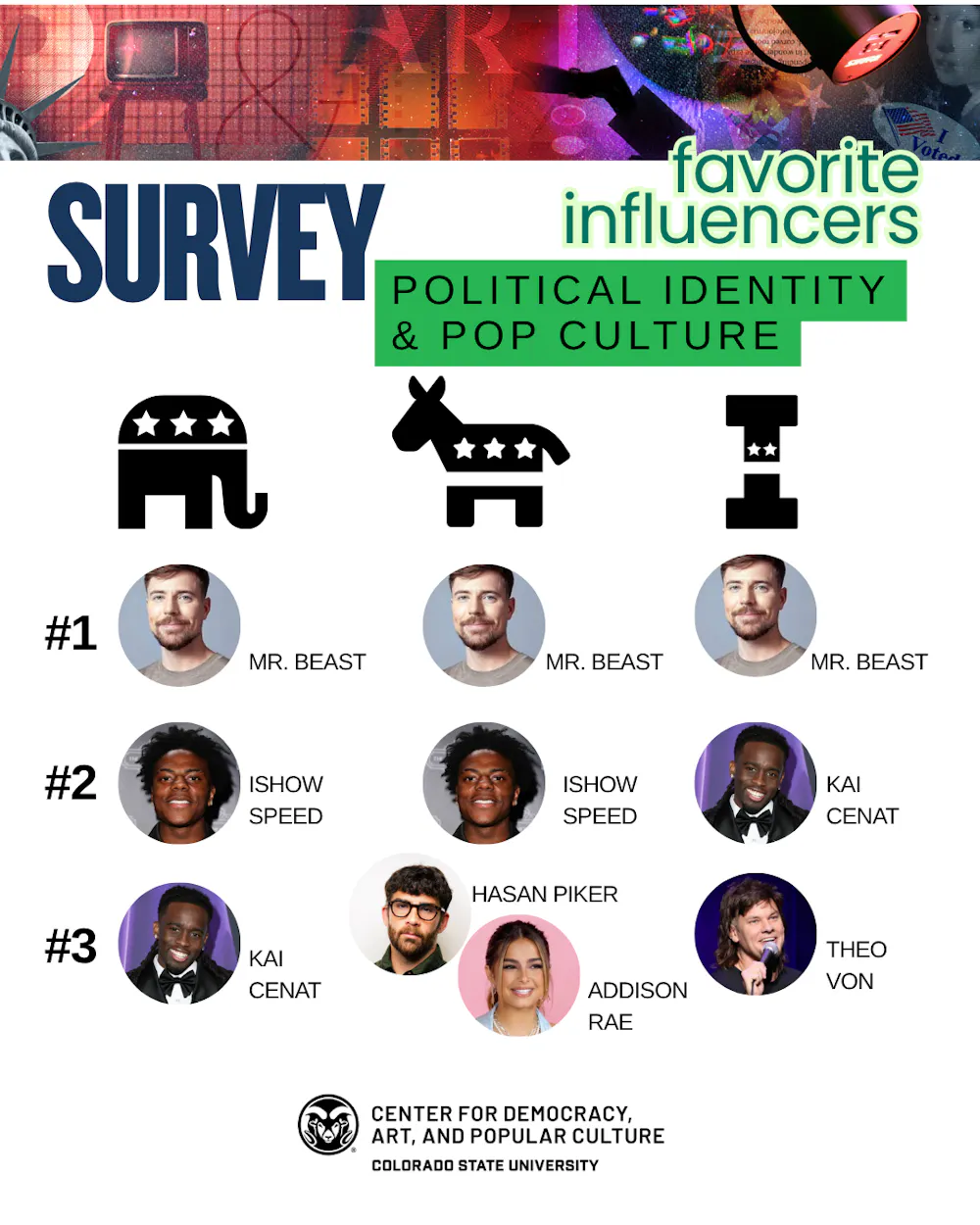
In our survey’s lists of favorite influencers, three creators who rose to fame staging viral stunts, interviewing celebrities and playing video games on YouTube and the live streaming platform Twitch dominated the list: MrBeast was No. 1 for Democrats, Republicans and independents. Republicans and independents ranked Kai Cenat in their top three, while IShowSpeed was No. 2 for Democrats and Republicans.
A similar pattern of the same names populating each list is evident in people’s favorite podcasts. “The Joe Rogan Experience” and “Call Her Daddy” were in all groups’ top three, while Republicans and independents also ranked the “Tucker Carlson Show” and “This Past Weekend with Theo Von.”
Joe Rogan and Theo Von are comedians turned podcasters, whereas Tucker Carlson rose to fame as a right-wing pundit. “Call Her Daddy” is an outlier on our list insofar as it is hosted by a woman, Alex Cooper, and is known for frank discussions of sex and relationships.

The website Campaigns & Elections reported that in 2024 half of all registered voters surveyed who listened to at least one podcast per month said that podcasts had some influence on their vote. The site reported that in the 2024 presidential election, those podcast listeners favored conservatives.
Our survey helps to explain why. Rogan, popular with all three groups, has long voiced libertarian ideas and platformed right-wing politicians. Von occupies a similar space, and Carlson is conservative. Both are favorites not just of Republicans but also independents.
Favorite comedians and video games
Political scientists and media scholars have demonstrated how comedy can influence politics. Our survey found considerable overlap among political partisans’ favorite comedians.
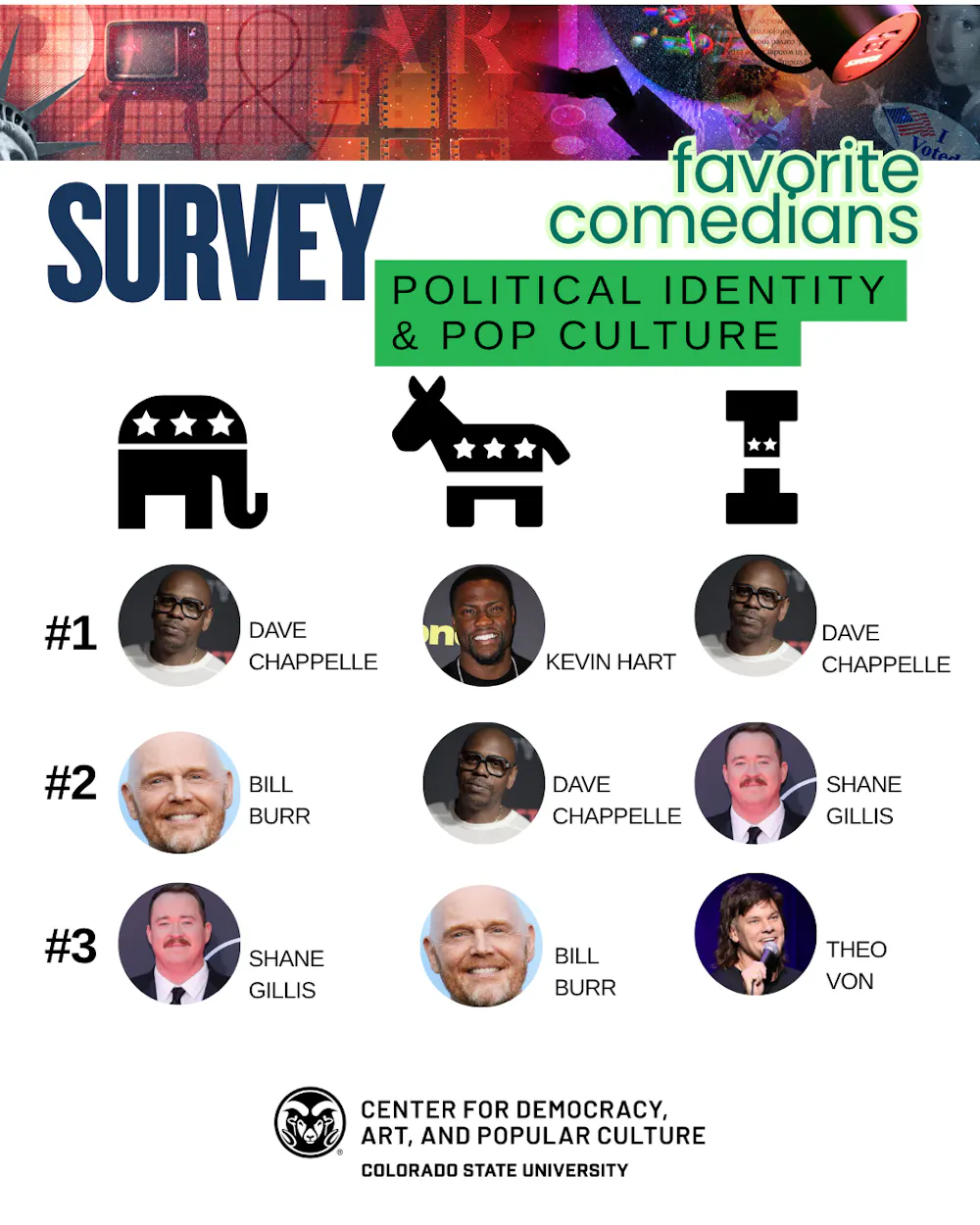
Dave Chappelle, creator of the boundary-breaking Comedy Central series “Chappelle’s Show,” topped the list for Democrats and Republicans and was the second favorite of independents. Bill Burr, known for comedy that is both cocky and aggrieved, was in the top three for Republicans and Democrats, while Shane Gillis, whose comedy The New York Times says “fits into the evolving meaning of conservatism,” was second and third for independents and Republicans.
Video games are another shared pop culture venue where Americans of different political affiliations are encountering one another as they play, via discussions with other players on Twitch and by participating in the comments sections of gameplay livestreams.
Researchers have demonstrated that young people, in particular, are exposed to diverse political views when engaging with one another in “online participatory activities that are non-political in nature.”
For example, one study examined how a viral trend of “building Trump’s wall” while playing Fortnite spurred political discussions both inside the game and in comments on gameplay videos and social media posts.
U.S. Rep. Alexandria Ocasio-Cortez demonstrated the political power of the medium in 2020 when she livestreamed herself playing the game Among Us, an online, multiplayer deduction game similar to the popular party games Mafia and Werewolf. Ocasio-Cortez playing the game with U.S. Rep. Ilhan Omar and prominent gamers was billed as a get-out-the-vote effort and earned 4.5 million views.
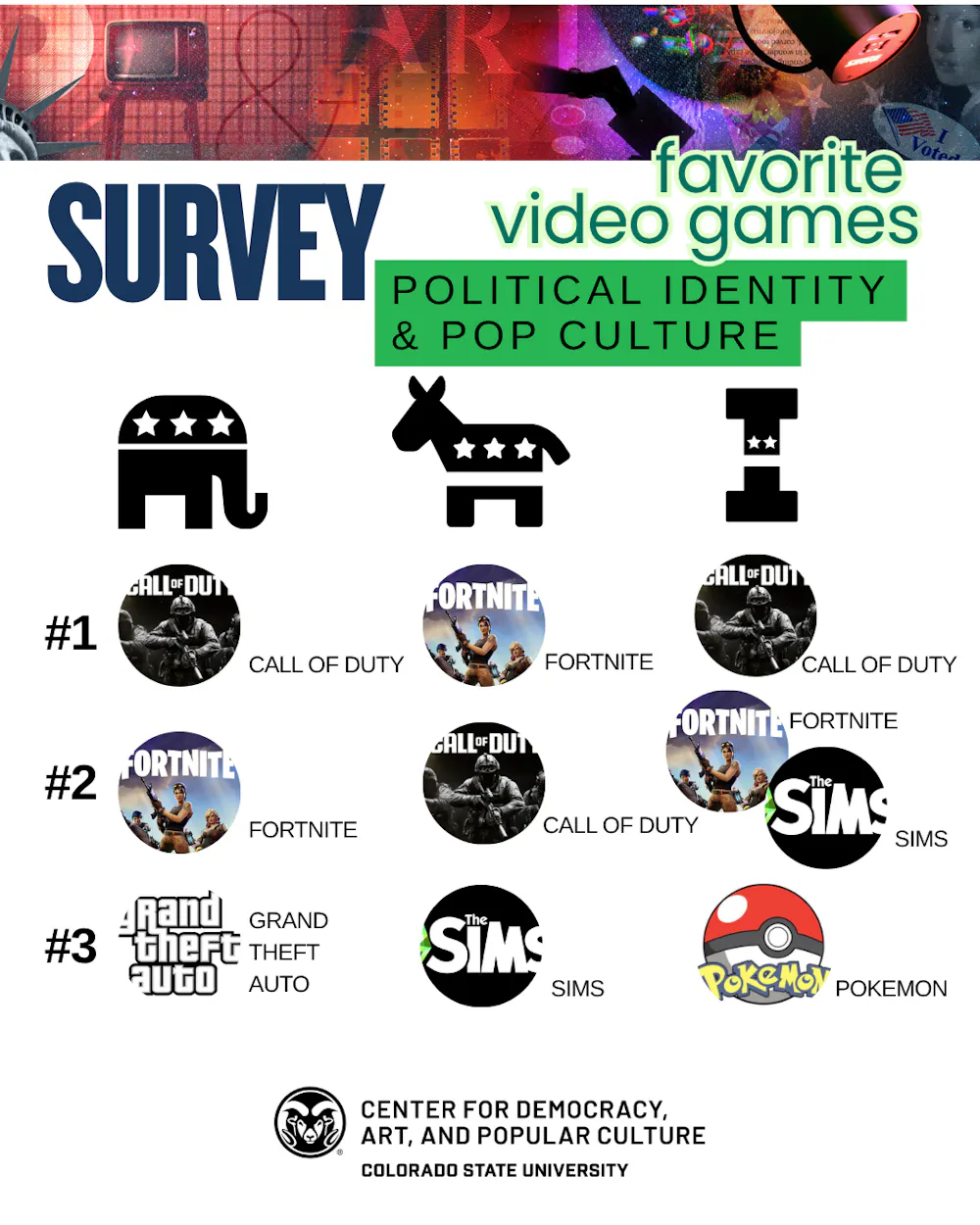
In our survey of video games favored by people of different political affiliations, Call of Duty, Fortnite and Sims appeared on all three lists.
Our data suggests that these pop culture spaces are thus not partisan silos. But that doesn’t mean they are free of particular ideologies.
Manosphere vibes
Some of the most popular creators – Rogan, Von, Carlson and Gillis – appeal to, or helped construct, the manosphere, a loose collection of online communities that promote masculinity and often reflect misogynistic attitudes.
Burr’s comedy is not politically conservative. But The New York Times said that it “gives voice to the aggrieved confusion of the white heterosexual guy adrift.”
Chappelle is known for his satirical critiques of racism. But in his more recent Netflix stand-up specials, he voiced anti-trans sentiments that Mother Jones called “indistinguishable from, and grist for, the material of conservative streamers and right-wing edgelords.”
Our survey did not ask respondents why they preferred these influencers, podcasts, comedians and video games. Academic research has shown that pop culture audiences don’t passively accept every message a creator delivers. Nevertheless, the dominance of male creators and the prevalence of misogyny and transphobia in their humor and commentary is significant.
Whether convened online or in person, the groups that gather via popular culture do not fit into the partisan silos that have formed around news and social media outlets. That makes the gendered nature of these lists even more significant, because the manosphere vibes are not relegated to one side of the political spectrum.
















Comments