
 German (DE)
  English (US)
  Spanish (ES)
  French (FR)
  Hindi (IN)
  Italian (IT)
  Russian (RU)
  3 weeks ago
At a packed town hall meeting last month in Laredo for James Talarico, the 36-year-old Democrat vying for a US Senate seat in Texas, Cristina Rodriguez took the microphone. Rodriguez, a 16-year Marine Corps veteran, said she had never cast a ballot. She didn’t identify as either a Democrat nor a Republican, and to her it didn’t matter. Regardless of what party the president belonged to, she had to obey orders.
Her attitude changed after the re-election of Donald Trump, whom she viewed as spiteful and divisive. In Talarico, a state representative from the Austin suburb of Round Rock, she found the exact opposite – a former middle school teacher and current seminary student who speaks in measured tones and preaches mutual respect.
“Because of you, I decided my voice does matter,” Rodriguez told the candidate and the crowd. “You’re not spewing hate. You’re speaking truths in a compassionate way and that just resonates with me.”
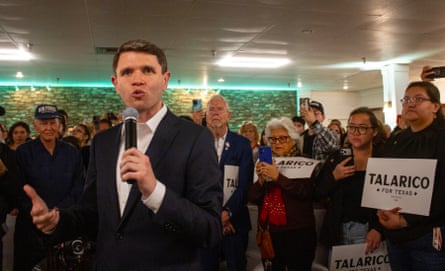
Rodriguez’s conversion offered a trickle of vindication for Talarico’s strategy. In a reliably red state where Democrats haven’t won a US Senate seat since 1988, Talarico believes his “top v bottom” economic pitch can cut across political divides and sway a critical mass of disillusioned Trump voters and independents. His rocketing path into the national spotlight suggests he might be on to something.
Whether the New Testament-quoting Democrat can win in a state that voted by 14 percentage points for a presidential candidate whose campaign hawked God Bless the USA bibles for $59.99 will depend on whether Talarico can first beat Jasmine Crockett, currently the congresswoman for Texas’s 30th district. Beloved by Democrats craving a “fighter”, the 44-year-old former public defender has built a reputation as a sharp, partisan brawler who hurls insults as fiercely as Trump. (She has called the president “Putin’s ho” and an “old white nepo baby”.)
National Democrats are watching closely to see which style and message resonates – anti-Maga rage or a populist crusade against a “corrupt” political system. The outcome could have implications for contested Democratic primary races across the country this year, and for the nascent 2028 presidential contest.
Republicans have for decades maintained a death-grip on Texas politics. The GOP has controlled both chambers of the state legislature and the governorship for more than two decades. A Democrat has yet to win a statewide election this century. But this cycle, the party sees an opening: a powerful backlash against Trump – and the potential for Republicans to nominate a scandal-plagued Maga warrior that has national Republicans fretting they could lose a safe red seat.
Talarico and Crockett are presenting themselves as progressive antidotes to Trumpism. Polling has consistently shown that Democrats like both their options. One voter broke down in tears, telling CNN she loved Crockett but chose Talarico because she believed he had a stronger chance of defeating a Republican in November. Kamala Harris on Friday swooped in with late-breaking support for Crockett. Beto O’Rourke, a Democrat who narrowly lost to Texas senator Ted Cruz in 2018, has not endorsed either candidate, calling them “generational talents”.

Data from early voting that shows Democrats have cast more ballots than Republicans so far, a sign of the party’s unusual excitement about their prospects this year, said Katherine Fischer, executive director of the Texas Majority Pac.
“No matter the outcome, we’re going to have someone in the general who’s just a real powerhouse,” said Fischer, who worked for O’Rourke’s 2018 Senate bid.
The same anti-Trump backlash that bolstered O’Rourke in 2018 are even more apparent today, according to Luke Warford, founder of the Agave Democratic Infrastructure Fund, a Pac working to help Texas Democrats win statewide. Trump is less popular today than he was then. Voters today are more frustrated with the economy. National Republicans are spending millions to prevent the party’s rank-and-file from electing Ken Paxton – a rightwing extremist plagued by corruption allegations and extra-marital affair scandals.
“I’m not a person who gets excited every year and says ‘this is the year we’re going to flip Texas,’ but this year you can definitely see a path to victory for Democrats if you squint,” Warford said in an interview. “One of the reasons the supporters of each candidate are arguing so vociferously is not just because they think theirs is the right candidate – it’s because they think they might win in November.”
A dead heat
Last summer, when Trump directed the Republican-controlled Texas legislature to gerrymander the state’s congressional maps to give the party an edge in the November midterms, Talarico fled the state with his Democratic colleagues in a bid to stall the effort. He became one of the party’s leading voices in the ensuing redistricting fight, appearing on Joe Rogan’s podcast in July. “You need to run for president,” Rogan, who endorsed Trump in 2024, told Talarico.
Talarico instead ran for Senate. Former Texas congressman Colin Allred was already running for the Democratic nomination when Talarico jumped in last year. Crockett entered the race in December, just before the filing deadline, prompting Allred to bow out and run for a newly redrawn congressional seat.
As a young state rep from the suburbs, Talarico entered the race with a much lower profile than Crockett. But he barnstormed the state for months in his signature Lucchese cowboy boots, rallying Democrats on college campuses, church pews and even a rodeo. Talarico says his campaign has recruited some 13,000 volunteers.
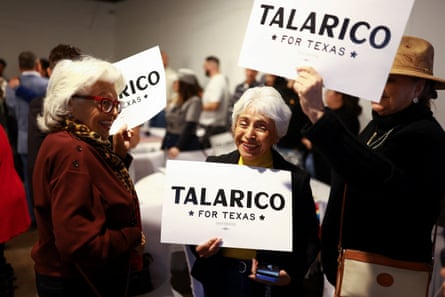
“The Talarico campaign has been working 24/7 in terms of public events, TV advertising, digital advertising, and social media activity,” Rice University political scientist Mark Jones said.
By her own admission, Crockett has run a less “traditional” campaign, largely eschewing broadcast advertising. As a sitting congresswoman, she has split her time between the campaign trail – where she prefers old-school retail politicking – and Washington, where Democrats are in a fiscal standoff with Republicans over reining in ICE.
Talarico holds a significant fundraising advantage and his campaign and the outside groups supporting him have outspent the congresswoman on the airwaves. Crockett, a cable news fixture, entered the race with high name recognition and base of support, especially among Black voters in the state.
But in the final weeks, before the primary, campaigning has ramped up for both candidates.

Crockett is holding back-to-back campaign stops on her “Texas Tough” tour. “I’m ready to kick some ass and become your next US senator,” she said during an evening event at a bar in Houston.
Early polling showed Crockett comfortably ahead, buoyed by her far greater name recognition. But Talarico closed in as the race entered its final month.
Then, on 16 February, CBS refused to air late-night host Stephen Colbert’s interview with Talarico, citing concerns about the Trump administration’s FCC guidance. Widespread charges of censorship, which FCC chair Brendan Carr denies, helped the YouTube version of the interview rack up millions of views.
The Colbert interview was like “manna from heaven” for the Talarico campaign, Jones said, bringing in an influx of new cash just as early voting began in Texas. Even Crockett conceded that the pulled interview, and the controversy surrounding it, likely gave her rival a “boost”.
A fighting chance
Whichever Democrats wins the 3 March primary will have to do two things: boost turnout among the notoriously lackluster Texas Democratic voter base, and peel off independents and conservatives disheartened by Trump’s mayhem. But Crockett and Talarico are presenting two different playbooks for how to win in Texas, driving a spirited debate about which strategy is best – and which candidate is more electable.
Crockett has argued that Democrats’ best chance of winning in November is to “double down” on the party’s base, by working to turn out young people, disillusioned Democrats and voters of color. She has cast herself as the most formidable fighter in the political ring, arguing that her no-holds barred attacks on Trump and Republicans were far more of an asset than a liability.
“I am confident that the Devil is mad every single time I wake up and my feet hit the ground,” she wrote in an Instagram post.
Talarico takes a different tack. At campaign events, he reminds voters that “Donald Trump is a child of God” and preaches a “different kind of politics”. “Not a politics of hate, not a politics of fear, not a politics of division, but a politics of love,” he said at a recent event.
He holds up his experience of flipping his own conservative state house district as evidence that the right mix of hyperactive canvassing and willingness to find common ground can win over conservative-leaning voters who have buyer’s remorse from voting for Trump.
“One is looking at the electorate as it is, and one is looking at the electorate as it should be,” Manny Garcia, the former executive director of the Texas Democratic Party, told the Guardian. “Everything is about persuasion, but one is ‘persuade to vote’ and another is ‘persuade you to vote my way’.”
That difference in strategy has at times evoked racial overtones in a majority-minority state where people of color have made up roughly two-thirds of Democratic voters. According to surveys, Crockett has consistently led with Black voters and voters without a college degree, while Talarico has an advantage among white voters and voters with a college degree.
When asked in an open-ended survey question what made Talarico a stronger general election candidate, many of his supporters said his identity as a white male Christian was an advantage, and worried bias against Crockett as Black woman could hurt her chances.
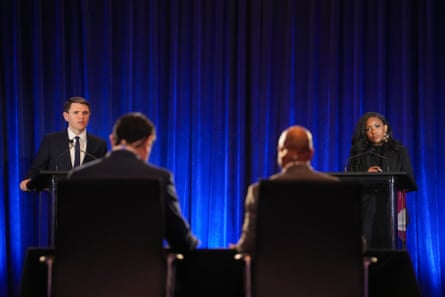
Talarico voters often pointed to his emphasis on mutual respect as a political asset in a conservative state like Texas.
“I like that he’s not antagonistic to anybody,” Laredo resident Alejandro Hernandez, 28, told the Guardian. “He’s very approachable, which is great. I think if he was too aggressive toward the other side it might turn off people.”
Meanwhile, Crockett’s supporters say they are drawn to her “people-first advocacy,” believing her authentic, relatable, “for the people” approach would resonate better in a general election.
“I am tired of people asking whether or not I am electable,” Crockett told reporters recently. “That is nothing but [a] dog-whistle.” She has pointed to the millions of dollars Republicans, including the state’s governor Greg Abbott, are already spending to attack her, suggesting they think she would be the stronger candidate in November.
The math for Texas Democrats will be unforgiving in November, Fischer said. They must narrow their margin of defeat in rural counties, win by more in urban ones, turn out low-propensity liberal voters, and win back historic losses in their former bastion of south Texas – all while persuading at least some disaffected Republicans.
“It can seem like an impossible prospect – you need everything to go right for you in order to eke out a win,” she said. “And that’s true, but that’s also what happens in wave elections.”
















Comments