
 German (DE)
  English (US)
  Spanish (ES)
  French (FR)
  Hindi (IN)
  Italian (IT)
  Russian (RU)
  3 weeks ago
Sharon BarbourNorth East and Cumbria health correspondent

 Sharon Barbour/BBC
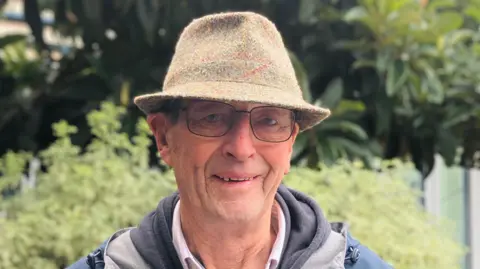
Peter Littlefield is one of the first mesothelioma patients on the proton beam trial
A trial using proton beams to try to treat a cancer caused mainly by exposure to asbestos has been described as offering "realistic hope" to patients.
There is no cure for mesothelioma, but Dr Crispin Hiley of University College London Hospitals (UCLH) said the aim of treatment was "not just to help people live longer but to live better".
The North East of England is one of the worst affected areas with high rates of the cancer due to industries like shipbuilding.
Ray Turnbull from Washington, who has lost four members of his family to the disease including his wife Jean who was exposed to asbestos as a child, said the region was proud of its industrial heritage but the cancer was a "cost".
Some 2,700 people are diagnosed with the aggressive cancer in the UK each year, with the principal cause being the inhalation of asbestos fibres.
"Mesothelioma is one of the most challenging cancers to treat," said Dr Hiley, who is leading the trial for UCLH with University College London.
Standard radiotherapy is unsafe as it can cause harm to vital organs such as the heart, but the proton beam directs high-dose radiation precisely at the affected area.
Dr Hiley said it was hoped the treatment could increase two-year survival rates from about 30% to 50%, adding: "If successful, it could fundamentally change how mesothelioma is treated in the UK."
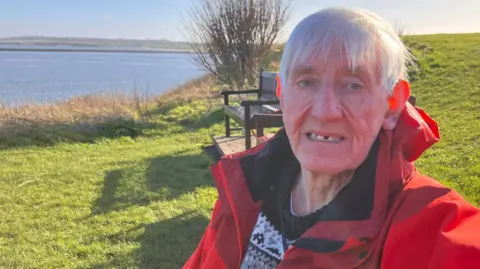
Ray Turnbull has lost four relatives to the cancer, including his wife Jean
Ray knows all about the dangers of asbestos exposure.
His wife Jean died in 2009 at the age of 62, decades after she was exposed to asbestos when walking past heaps of the material resembling "the white cliffs of Dover" as a child.
His mother was 72 when she died in 1979 and his brother and uncle were also killed by the disease.
They all worked at the Turner & Newall factory in Washington, which made products containing asbestos.
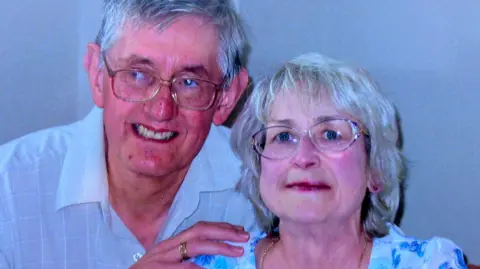 Ray Turnbull
Jean Turnbull died aged 62 in 2009
Ray has worked to support others with the disease and knows 20 other people who have died from it.
The North East has the highest rate of deaths in the UK largely due to shipbuilding, according to Dr Helen Turnbull, a consultant clinical oncologist at the Northern Centre for Cancer Care at Newcastle's Freeman Hospital.
Asbestos had been a wonder product used for fireproofing, insulation and strength, but it was later found the microscopic fibres it was made from were potentially lethal when breathed in, with cancer taking years to develop.
The use of asbestos in building was completely banned in 1999.
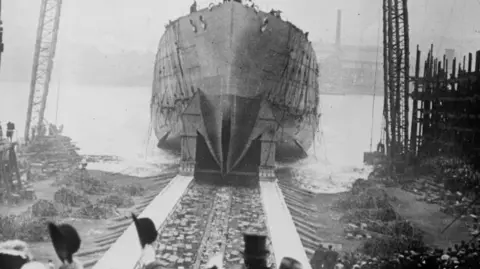
Ray said seeing the newly-built ships sail down the Tyne was a "proud time", before adding: "But there was a cost, and we are finding out the costs."
He said apprentices would have "snowball" fights with asbestos and he knew of two women who died having probably inhaled particles while washing their husband's work clothes.
 Getty Images
Tyneside has a proud history of building ships
More than 70,000 people have died across Britain since the 1980s from mesothelioma, with more than 5,000 deaths recorded across the North East.
Dr Turnbull said being able to allocate eligible patients to the trial was "really exciting".
About 50 patients from across England and Wales have so far been recruited, with the trial aiming to find up to 148 people from 23 NHS centres.
Participants receive daily proton beam therapy, Monday to Friday, for five weeks at either UCLH or The Christie NHS Foundation Trust in Manchester.
The two centres were built for £260m after the national NHS Proton Beam Therapy programme was approved by the Department of Health and Treasury in 2015.
One of the first patients taking part in the trial is 83-year-old Peter Littlefield from Portsmouth, who was diagnosed after getting breathless and developing a cough.
Doctors told him neither chemotherapy nor radiotherapy were suitable, the latter because the cancer was too near his heart.
Getting on to the trial was therefore "really unbelievable", he said, with the chance of living longer and spending more time with family meaning "everything".
Life is the most precious thing, Peter said, adding: "You can't buy it."
 Sharon Barbour/BBC
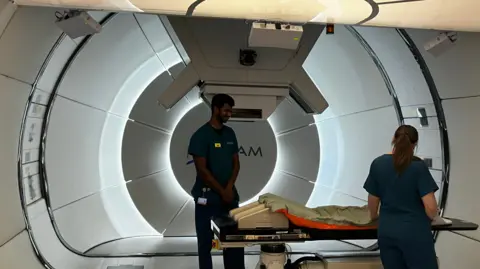
The proton beam centre in London is powered by a giant underground cyclotron
The centre in London is huge, with a vast cyclotron buried five stories underground and powering the proton beam 24 hours a day, Dr Hiley said.
"It's a phenomenal piece of infrastructure," he said.
Various different trials have taken place and are ongoing, but its use for NHS patients is mainly limited to cancers that are close to vital parts of the body - especially for brain tumours and in younger patients.
The NHS said so far the programme had cared for more than 5,000 patients.
Dr Samantha Walker, director of research at Asthma + Lung UK said the research was "vital" for the "devastating condition".
Liz Darlison, chief executive at Mesothelioma UK, said the country "shamefully has the highest incidence of mesothelioma in the world" with research urgently needed.
Few people know that better than Ray, whose family has been ripped apart by the condition.
"It gives hope," he said of the trial. "Realistic hope."












Comments