
 German (DE)
  English (US)
  Spanish (ES)
  French (FR)
  Hindi (IN)
  Italian (IT)
  Russian (RU)
  2 weeks ago
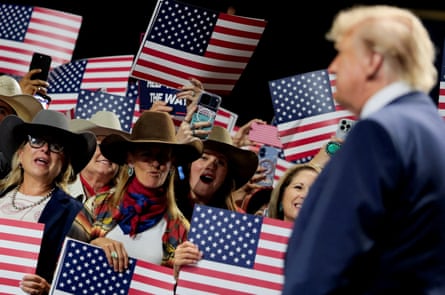
Donald Trump pulled out all the stops at the Republican party’s midterm convention two weeks ago. In speeches aimed at the voters who will soon decide whether to keep Republicans in control of Congress for the final phase of his presidency, the president dangled $5,000 checks, and warned the United States would turn into a “communist country” if Democrats are elected.
The unprecedented political gathering amounted to a hail-mary pass at retaining control of Congress, which history indicated Trump’s Republican allies had always been likely to lose in the 3 November vote. Two weeks later, with election administrators in several states already sending out mail ballots, there is no indication the gambit has worked.
Polls have continued to show Democrats with an edge on the generic ballot, a key indicator of voter sentiment in congressional races, as well as in in some key Senate contests such as North Carolina and Georgia, both states where Trump won two years ago. Forecasters have moved their ratings of other battleground races almost uniformly in Democrats’ favor, despite Republican-led states’ concerted effort to redraw House districts in the party’s favor.
Trump’s approval ratings remain low, with some surveys finding him plumbing new depths. Prices for gasoline and diesel have started climbing again amid the ongoing war with Iran, prompting the Republican Senate stalwart Chuck Grassley of Iowa to publicly encourage the president to do more for farmers, whose businesses have been particularly hard hit by the conflict’s economic shocks.
Top Republicans suddenly appear worried about the fortunes of incumbents standing for re-election in some of the reddest states in the country. Last week, vice-president JD Vance campaigned in Kansas, which has not elected a Democrat to the Senate in nearly a century, but where Adam Hamilton is seen as a strong challenger to the Republican incumbent Roger Marshall.
Back in Washington, the extent of the House GOP’s jitters became clear when Democrats forced a vote on a war powers resolution to end the fighting with Iran, and three Republicans who had not backed the previous five efforts supported this one, ensuring its passage.
“This midterm is going to be a fucking bloodbath,” said Nancy Mace, the outgoing congresswoman who was among the trio of new converts, and predicted that her party would not keep control of the Senate and House of Representatives when ballots are tallied in a month and a half.
In the days that followed, more Republicans in competitive races came out against the Iran war.
“The war with Iran needs to end, and end quickly,” Mike Rogers, the Republican nominee for Michigan’s open Senate seat, said in a campaign ad released on Monday. Ashley Hinson, the congresswoman who is running to represent Iowa in the Senate, wrote on social media “the war needs to be brought to a successful and immediate end”. She had voted against the Democratic war powers resolution, as had John James, the congressman who is the Republican nominee for governor of Michigan, but on Tuesday, the Detroit News reported he told reporters: “We need to end this war quickly. Because war is terrible, and no one likes war.”
Democratic operatives have long maintained that Trump was leading the GOP’s congressional majorities into oblivion, and are now being joined in that prediction by veteran politics watchers, who see the toxic combination of rising prices, poor approval rating and dampening enthusiasm among voters as likely fatal for Republicans hopes of keeping control of the House, if not the Senate.
“We are seeing a dramatic souring and just overall level of anger at the broken promises of Trump and House Republicans, like, issue after issue after issue. Like, people are just unhappy right now,” said a Democratic strategist who did not want their name to be used.
Talk has even re-emerged of a “blue wave” in November that will see Republicans lose in deep-red corners of the country.
“Republicans should brace themselves: the three most plausible outcomes are that it will be bad, really bad, or truly horrible,” wrote the veteran analyst Charlie Cook.
Yet not everything is necessarily going Democrats’ way. In the battle for the Senate, Republicans have grown increasingly optimistic about their Senate candidate winning in New Hampshire, which some major forecasters now view as a toss-up. The party may also have come out ahead in the mid-decade redistricting push, and definitely has more financial resources this year than the Democrats – a reversal from most midterms prior.
“House Republicans are running with a more favorable map, historic fundraising, stronger candidates, and a commonsense agenda, while Democrats are burdened by unelectable far-left nominees and deeply unpopular policies that make their path to the majority far more challenging than the pundits suggest,” said Mike Marinella, a spokesman for the National Republican Congressional Committee.
After much speculation about when he would act, Trump’s Maga Inc Super Pac has started spending its $400m war chest, buying $15m in advertisements to support the Republican Ken Paxton in the Texas Senate race. Fairshake, a Super Pac connected to the cryptocurrency industry, will reportedly spend $30m against Sherrod Brown, the Democratic former senator from Ohio and cryptocurrency adversary seeking to return to the chamber, after the industry spent $40m to see him defeated in 2024.
Republicans and their allies have thus far put $384.5m into Senate races, to Democrats’ and their supporters’ $112.7m, according to data compiled by political analyst Rob Pyers. In the House, Republican supporters have spent nearly $65.7m to the Democrats’ $51.1m, but Politico has reported that much of that money has gone to districts where Trump won two years ago, a sign that the GOP is playing defense.
Winning the Senate will require Democrats to oust at least four Republicans in states that Trump won in 2024. The House seems an easier target for the party, since the GOP controls it by a low single-digit majority.
House Republican leaders including the speaker Mike Johnson nonetheless insist that voters will expand rather than disband their majority in November. They note that 23 Democrats represent districts that voted for Trump in 2024, a number that has increased due to GOP-led states’ redistricting, while only eight Republicans represent districts that backed Kamala Harris. The party also believes that voters are still too disenchanted with Democrats overall to put them back in charge in the Capitol.
“Voters might not like Trump. They might not even like Republicans. But the polling shows that they hate Democrats even more,” a Republican strategist said on condition of anonymity.
In a statement, Julie Merz, the executive director of the House Democrats’s campaign arm, the Democratic Congressional Campaign Committee, acknowledged the party’s fundraising struggles but said they were still on track for a return to power.
“We are confident we’re poised to win the majority, and that’s why Republicans in deep red territory are running scared,” Merz said. “If Democrats want to break the Republican gerrymanders in the south and get the largest majority possible, more resources ensure we can flip those seats too. We need more cash.”
Money isn’t everything, as Democrats know – Harris and her supporters outspent Trump and his allies in 2024, a year of resounding Democratic losses. And many of the factors that will decide the election outcome may already be baked into the result, said John T Woolley, co-director of the American Presidency Project at the University of California, Santa Barbara.
“Inflation, employment rates – they’re just not going to change a whole lot. So the kind of thing that’s left, the seats, those are fixed, [you] can’t change that stuff. So the only thing that’s left is the president’s approval,” Woolley said.
“What that means is the president has to shift swing voters, independent voters, voters who don’t identify as either Republican or Democrats.”
But that group, too, appears to have soured on the GOP: a New York Times and Siena University poll released last week found 57% of independent voters were planning to vote Democratic in the midterms, and just 34% for the Republican candidate.















Comments