
 German (DE)
  English (US)
  Spanish (ES)
  French (FR)
  Hindi (IN)
  Italian (IT)
  Russian (RU)
  3 weeks ago
As soon as the US government voted to cut funding to more than 1,500 public media outlets last July, Luke Dennis, general manager at WYSO, a public radio station in Yellow Springs, Ohio, kicked into action an emergency funding drive.
“The thing that really bothered me was not so much that the federal funding went away, because I felt like that was inevitable under the current administration, but to give us zero runway to prepare for it,” says Dennis.
“That was very panic inducing.”
He feared laying off staffers who had recently been hired.
“These people trusted me; people we hired a year or two years ago,” he says. “I told them that this was a stable environment and that they’d do well here.”
WYSO was already in the midst of several major infrastructural changes. In 2024, it opened a new studio in downtown Dayton, putting it closer to minority communities. Early next year, it will move to a new facility in Yellow Springs that will see classrooms, conference areas and a 110-seat performance space accessible to the public.
The Trump administration’s shuttering of the Corporation for Public Broadcasting (CPB), however, means that WYSO has found itself in a $600,000 hole for this and the upcoming financial year.
But almost immediately, the community responded. WYSO, which broadcasts across 14 urban and rural counties in south-western Ohio, recorded its largest ever single-day donation figure in late July.
“We’ve added more new members this year than we’ve ever added in any previous year,” recalls Dennis. “Most people, it really got them off the fence if they were wondering if their donation was important.”
Across the US, the federal cuts have galvanized many communities in support of their local radio stations. By last July, about 120,000 new donors had given $20m to public radio and television stations, with overall donations totaling $70m more than the previous 12-month period. It has even acquired a name: “rage-giving”. While in past years donor counts had been falling, 2025 has proven a sea change in the right direction for public radio and television stations.
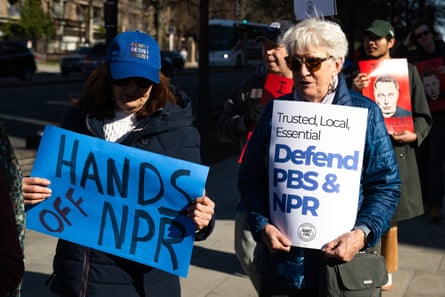
“People want to know what they can do to be helpful right now, at a moment when it feels like the government is not listening to their concerns and is breaking laws and ignoring precedent,” says Dennis.
“Sending 25 bucks to your local radio station, for some, I think, it’s viewed as an act of resistance.”
One study of 50 public media organizations conducted by industry publication Current showed a 61% increase in donor growth between August 2024 and August 2025. Moreover, the number of donors aged 45 or younger almost doubled to 24%.
“Much of the increase in new donors in 2025 is likely attributable to the loss of federal funding. Like other crisis giving in the last decade, online giving saw the sharpest increase. The share of new donors acquired online doubled in 2025,” the report read.
It’s having real impact on the ground. KSUT, a public broadcaster that covers Native American communities and affairs in Colorado, New Mexico and neighboring states, recently recorded its largest ever donations total. Similar stories are playing out in Kentucky, Vermont, Alaska and elsewhere.
Philanthropic organizations have stepped up their support too.
In August, more than half a dozen foundations announced a $36.5m “immediate relief” donation to public radio and television stations that were deemed likely to close without swift help. About $26.5m of that will go to the Public Media Bridge Fund, which was established with a goal of raising $100m over a two-year period to assist the most at-risk public radio and television stations around the country.
However, while these contributions have brought public radio stations and rural communities closer together, they are, so far, not enough to replace the more than $535m cuts initiated last July and the hundreds of millions of dollars more that public broadcasters had been banking on to fund operations in the months and years ahead.
“I’m not surprised at all [at the rise in donations], in part because of our history. Every time that public radio finds itself under attack, donors respond, members respond,” says Scott Finn, an instructor at the Center for Community News at the University of Vermont who previously served as CEO and president of Vermont Public and West Virginia Public Radio.
“It’s good – and it’s not enough because what tends to also happen is that fades over time, that initial burst of generosity actually declines after the immediate threat goes away or people’s memories start to fade.”
Low population regions have been hit particularly hard by the planned dissolution of CPB.
In October, Prairie Public, a broadcaster in Fargo, North Dakota, that maintains transmitters across several northern states and in Canada, announced 12 job losses or nearly one-fifth of its workforce. Last month, KYUK, a public radio and television station broadcasting out of Bethel, a town of 6,000 residents in western Alaska, and which relied on federal funding for 70% of its operating costs, was forced to eliminate six full-time jobs.
While NPR’s leadership in September offered $8m to local stations to help with the cost of licensing NPR content, that’s a fraction of the overall shortfall.
“These stations are going to have to make some really hard choices about how to continue service in those areas,” says Finn.
Meanwhile, some Republican politicians have appeared to acknowledge the importance of public radio to their voters, with one Republican congressman in WYSO’s broadcasting area, Mike Turner, voting against the Trump administration’s Rescissions Act of 2025 to end federal funding for the CPB.
Like hundreds of others, WYSO broadcasts from a small town, a community of just 3,600 residents. And while Yellow Springs is wealthier and more liberal than many other midwestern communities of its size, for radio station general manager Dennis, the worry is omnipresent.
“I’m concerned in two years … when people forget how angry they were that the federal subsidy was pulled. What will happen then?” says Dennis.
“But we’re planning for that too.”












Comments