
 German (DE)
  English (US)
  Spanish (ES)
  French (FR)
  Hindi (IN)
  Italian (IT)
  Russian (RU)
  3 weeks ago
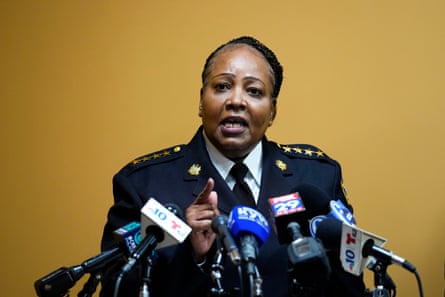
Rochelle Bilal, Philadelphia’s sheriff, warned ICE agents last week: “If any of them want to come in this city and commit a crime, you will not be able to hide.
“Nobody will whisk you off,” she said. “You don’t want this smoke, ’cause we will bring it to you.”
On the surface, it sounds like Philly political braggadocio. Sheriff’s deputies don’t generally spend their time arresting anyone. They serve warrants, guard prisoners and keep court in order. Under other circumstances, Bilal’s comments could be dismissed as a Democratic elected official throwing red meat at a blue audience.
But she’s not alone. Last year, municipal leaders in cities including Chicago, Portland and Charlotte made simple promises for their police not to cooperate with immigration enforcement, and to monitor the activities of ICE for civil remedies. In June, Michelle Wu, Boston’s mayor, signed an executive order requiring regular Freedom of Information Act requests of the DHS to learn when and where immigration arrests are made.
Last week, Jacob Frey, Minneapolis’s mayor, more directly told ICE to “get the fuck out of Minneapolis”.
State or local police arresting federal officers would have been unthinkable last year. But federal agents have never faced widespread accusations of misconduct, as they do now. State law enforcement is increasingly presenting itself as an answer to federal impunity for civil rights violations.
Typically, if a federal officer commits an abusive crime, local leaders might expect a federal investigation to lead to charges and an arrest. But administration leaders have essentially said they will not prosecute agents for abuses, beginning with Donald Trump’s exhortation for cops to “do whatever the hell they want” after sending national guard troops to Washington DC.
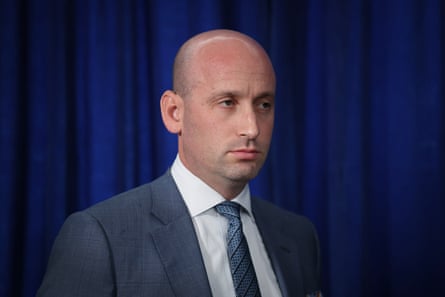
The X account of the DHS reposted comments made by Stephen Miller – the White House senior adviser and architect of Trump’s immigration enforcement policies – repeating claims of immunity to prosecution in the wake of an ICE officer fatally shooting Renee Nicole Good in Minneapolis last week.
“To all ICE officers: you have federal immunity in the conduct of your duties, and anybody who lays a hand on you, or tries to stop you, or tries to obstruct you, is committing a felony,” Miller said Tuesday on Fox News. “You have immunity to perform your duties and no one – no city official, no state official, no illegal alien, no leftist agitator or domestic insurrectionist – can prevent you from fulfilling your legal obligations and duties.”
At least four senior leaders of the civil rights division of the Department of Justice and six other federal prosecutors in Minnesota have resigned over how the administration has handled the Good shooting. The rhetoric of Trump, Miller, JD Vance and others suggests not only that federal agents need not fear a federal prosecution, but that they may be pardoned by the outgoing president forestalling any future prosecution.
That leaves state and local prosecution as the only legal remedy for crimes by federal agents.
States “are legally permitted to prosecute federal officials for state crimes – within limits”, Bryna Godar, a staff attorney at the University of Wisconsin Law School, wrote in an explainer in July. “The limits stem from the federal constitutional principle that states should not be able to undermine federal policy via targeted criminal prosecutions, a doctrine known as supremacy clause immunity. But this principle only applies when federal officials are reasonably acting within the bounds of their lawful federal duties.”
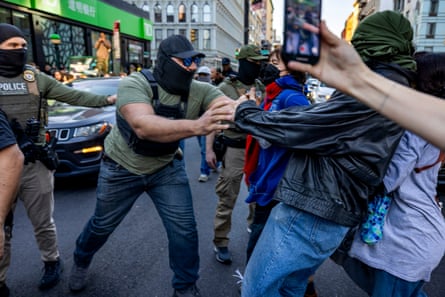
The supremacy clause doesn’t protect agents when they are not acting within the scope of their duties, behave in an egregious or unwarranted manner, or violate federal law, Godar wrote. The increasingly routine activities of federal agents during stepped-up enforcement – from complaints of excessive force when using a military-style helicopter raid in Chicago to the shooting of Good in Minneapolis – put states and cities in uncharted waters.
“It just has not been the custom or the practice before 2025, because we were not seeing the kind of behavior we’re seeing now,” said Cristine Soto DeBerry, executive director of Prosecutors Alliance, which advocates for prosecutorial reform. “What makes it unusual is that nobody is accustomed to thinking that way about other law enforcement or federal agents.”
”
State prosecutors have begun gathering evidence.
As ICE agents descended on Canal Street in October to make arrests in New York City, Letitia James, the New York attorney general, launched an online portal to gather evidence of federal misconduct. The next day, Julia Salazar, a New York Democrat, called for arrests. “If an ICE officer assaults a New Yorker, that officer must be arrested and prosecuted by state and local authorities,” she said in a statement posted to X.
The same day, JB Pritzker, the Illinois governor, formed an accountability commission to document the activities of federal immigration officers amid the provocations of their “Midway Blitz” operation. The stated intent of the commission was to analyze the documented conduct of federal officers during the operation and identify conduct requiring the most urgent corrective action and remediation based on its egregiousness and impact on the community.
In the wake of the Minneapolis shooting, Lori Lightfoot, the former Chicago mayor, is now leading an effort to document abuses for future prosecution.
Lightfoot was president of the Chicago Police Board and chair of the Chicago police accountability taskforce, which carried out misconduct cases in the Chicago police department, before serving a term as mayor from 2019 to 2023. She said she hoped the information the public provided would start a process that leads to grand juries, investigations and criminal charges when warranted.
“Open up a grand jury investigation on the shootings, the killings and the assaults that are very well documented; there’s no prohibition on doing that,” she said. “There are always parallel state and federal criminal investigations. Typically the feds will defer to the state, but if the state is absent and we’ve got a federal government who’s focused on a cover-up – not a search for the truth – then we got a problem.”
“My hope is that by accumulating this body of evidence, it will be inescapable,” she added. “They’ll have to look. They’ll have to do something, because the public will demand it.”
Larry Krasner and Brooke Jenkins – district attorneys of Philadelphia and San Francisco, respectively – have also called for the arrest of ICE agents who break the law in their districts.
On Wednesday, California officials defended two new laws that would permit local police officers to arrest federal agents.
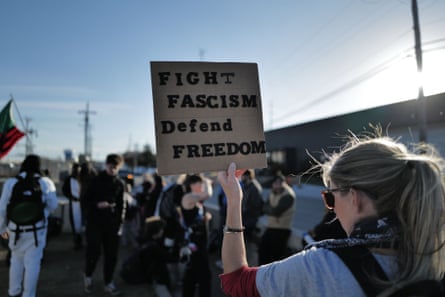
With some exceptions, the No Secret Police Act makes it a misdemeanor crime for police officers – including federal officers – to wear face masks that conceal their identity while performing their duties. The No Vigilantes Act requires law enforcement officers operating in California who are not uniformed to visibly display identification including their agency and either a name or badge number to the public when performing their enforcement duties. It also requires federal officers to show ID to local cops when approached by one who suspects the federal officer of committing a crime.
The laws took effect on 1 January. But a court challenge by federal law enforcement agencies placed it on hold. The Trump administration made their case for a preliminary injunction in front of Judge Christina Snyder in the United States district court of the central district of California on Wednesday.
Sergio Albarran, director of the ICE field office in San Francisco, wrote in an affidavit supporting DHS that ICE agents face the threat of doxing and activists using personal information to harass and intimidate agents. Identification leads to “local organized crime and transnational criminal organizations” targeting officers “in serious and potentially deadly ways”.
The DHS claimed in court that cartels placed bounties on the heads of ICE agents, and that this justifies concealing the identity of agents. The complaint stated that the federal government does not intend to comply with the California law. The DHS relies largely on the supremacy clause in its suit to have California’s new laws blocked.
“Taken to its logical conclusion, plaintiff’s position would mean federal agents could commit crimes and violate Californians’ – or anyone’s – constitutional rights with impunity, accountable to no one,” replied the California attorney general’s legal team.
Snyder said on Wednesday that she would rule on whether to issue a preliminary injunction soon. But even if Snyder clears local police in California to arrest federal officers, one should not expect a showdown with state police facing off against ICE agents in the street any time soon, DeBerry said.
“If I were a police officer, I think that my preference would be to document it if I see a crime happening here and allow the prosecuting agency in my jurisdiction to decide if there’s enough evidence there and in fact a violation of the law that should be prosecuted,” she said. “That seems the most calm, clearheaded way to go about it.”












Comments