
 German (DE)
  English (US)
  Spanish (ES)
  French (FR)
  Hindi (IN)
  Italian (IT)
  Russian (RU)
  3 weeks ago
In his first year back in office, Donald Trump has fundamentally reshaped the Environmental Protection Agency, initiating nearly 70 actions to undo rules protecting ecosystems and the climate.
The agency’s wide-ranging assault on the environment will put people at risk, threatening air and water quality, increasing harmful chemical exposure, and worsening global warming, experts told the Guardian. The changes amount to “a war on all fronts that this administration has launched against our health and the safety of our communities and the quality of our environment,” said Matthew Tejada, the former director of the EPA’s environmental justice program.
“It is an attempt to completely eliminate [the’ EPA and just leave a symbolic husk,” said Tejada, who is now senior vice-president of environmental health at the national green group Natural Resources Defense Council (NRDC).
Since January last year, Trump’s EPA has launched a total of 66 actions to roll back or weaken environmental rules – a stunning rate of more than one per week – an analysis by the Guardian has found. Based on research by NRDC, that total comprises a wide variety of moves, from issuing rule exemptions for polluters, to shuttering the agency’s research and development office, to initiating efforts to repeal the legal finding underpinning virtually all US climate regulations.
The moves have come as federal officials repeatedly pledged to return the agency to its “core mission” of protecting the environment and human health. But in reality, EPA has “abandoned” its mission, said Jeremy Symons, a former EPA policy adviser.
“The Environmental Protection Agency is now the Environmental Pollution Agency, helping polluters at the expense of human health,” he said.
The EPA has rejected criticism of its priorities. An EPA spokesperson said: “Unlike the climate zealots, the Trump EPA knows we can economy-crushing regulations that make Americans poorer while also fulfilling our statutory obligation to protect human health and the environment.”
Here are four key ways the EPA’s deregulatory efforts could affect people across America.
1. The air we breathe
A flare stack at a refinery in Linden, New Jersey. Photograph: Kena Betancur/Bloomberg via Getty Images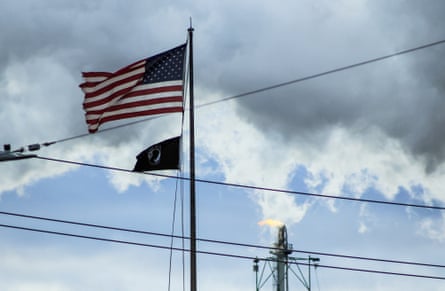
A range of recent EPA actions may expose Americans to dirtier air, experts told the Guardian. In March, officials invited polluting facilities to seek toxic pollutant exemptions under the Clean Air Act by simply sending an email.
Overall, Trump’s EPA offered two-year exemptions to Clean Air Act pollution standards to over a third of all domestic coal plants, chemical manufacturers, coke ovens, commercial sterilizers and highly toxic facilities, advocacy group Union of Concerned Scientists found last month.
An EPA spokesperson said the president has the authority to issue Clean Air Act exemptions “for national security reasons”.
The agency has also overturned strengthened limits on major pollution sources. And in September, it announced plans to shut down the Clean Air Act Advisory Committee and Mobile Sources Technical Review Subcommittee, both critical to developing clean air standards.
In an even more stunning move, this month, the agency stopped estimating the monetary value of lives saved when restricting fine particulate matter and ozone – two of the deadliest air pollutants – calculating only the costs to companies. The change goes far beyond the usual “pendulum swing” of regulations in which Democratic administrations tighten rules and Republican administrations ease them, said Tejada.
“They’re ripping the pendulum out of the clock and telling people what time it is,” he said.
An EPA spokesperson said the agency is updating the consideration of human health in regulatory decision making “because air pollution has already dropped so dramatically that older tools can’t accurately measure today’s smaller risks”. They did not specify how EPA will model these impacts in the future.
The agency is also reviewing clean air standards “to ensure they remain effective,” which is “responsible governance, not rollback,” the spokesperson added.
“The claim that EPA’s actions will worsen air quality is simply wrong. America’s air is the cleanest it’s been in decades, and that progress continues every year,” the spokesperson also said.
2. The water we drink
Photograph: MediaNews Group/Orange County Register/Getty Images
Trump’s EPA will also imperil water quality, experts say. In March, it said it will narrow the definition of waterways protected under the Clean Water Act, which would ease restrictions on runoff from agriculture, mining, and petrochemicals. In June, the EPA administrator Lee Zeldin announced plans to revise Biden-era wastewater standards for coal plants, meant to curb the discharge of toxic heavy metals like arsenic, mercury, and lead.
Under Zeldin, the EPA has moved to rescind or reconsider federal limits on PFAS, a class of persistent “forever chemicals” linked to cancer, immune dysfunction, developmental harm, and more. In May, he proposed repealing four of six national drinking water standards for these contaminants, and in September said the EPA will no longer defend Biden-era protections against unsafe PFAS levels.
Millions of Americans rely on water systems which have seen PFAS levels that previous EPA administrations deemed unsafe, said Tejada.
An EPA spokesperson claimed the agency narrowed the Clean Water Act waterways definition to align with supreme court precedent, while defending the extension of compliance deadlines, saying those moves make sure “utilities can plan investments, keep the lights on, and still meet tough limits on toxic discharges”.
“Any suggestion that this EPA is backing off PFAS is patently false,” the spokesperson said, noting that the administration has kept some standards in place. “Our water policies are about cleaner water, stronger infrastructure, and smarter, more workable rules.”
Gaurab Basu, assistant professor at Harvard Medical School, called such acts “unconscionable.”
“We as health professionals see the toll of their decisions, and we are enraged at the harm they are causing our patients,” he said.
3. The chemicals around us
A pesticide warning sign on the edge of a field in Wisconsin. Photograph: Wolfgang Hoffmann/Design Pics Editorial/Universal/Getty Images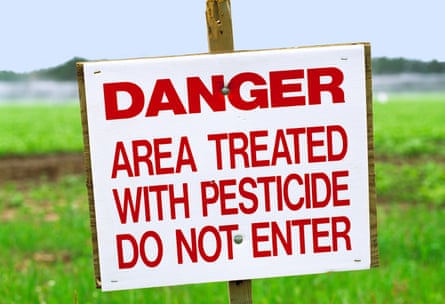
EPA has worked to loosen restrictions on toxic compounds, raising concerns about former chemical industry executives Trump tapped to lead the agency’s chemical safety efforts.
The agency plans to cancel $40m in grants for scientists studying toxic hazards to children in rural America, including pesticides and other potential food contaminants, the New York Times reported in April. It is also moving to revise rules for evaluating chemical risks under the Toxic Substances Control Act, narrowing evaluations to specific uses instead of all potential exposures. Critics warn this could weaken findings and limit regulatory action.
“They are systematically going after evidence-based sound science,” said Adam Finkel, a former member of the EPA Science Advisory Board and professor at the University of Michigan School of Public Health. “It’s an agency gone rogue.”
An EPA spokesperson said the agency was working to change chemical evaluations to boost efficiency.
EPA has also moved to deregulate chemicals like formaldehyde, a carcinogen used in industrial resins, particleboard, and disinfectants. In December, it said it will reverse the long-standing EPA position that no level of formaldehyde exposure is safe.
Officials are also weakening restrictions on methylene chloride, used in adhesives, sealants, and paint removers. In 2024, the Biden administration finalized a ban on most uses – a “much-needed, science-based change”, said Finkel, who has worked on EPA regulatory research on the chemical. But Trump’s EPA delayed the compliance deadline for commercial facilities.
These deregulatory moves come as health secretary Robert F Kennedy Jr works to reduce routine vaccine recommendations and remove fluoride – which has been found to strengthen teeth – from drinking water, Finkel said.
“If it has benefits to normal people, like fluoride and vaccines, the Trump administration are against it, and they believe in extremely low doses of exposure being harmful,” he said. “But with harmful chemicals, they’re shouting that EPA has exaggerated risk.”
The EPA spokesperson said its chemical policies are based on “gold standard science and radical transparency”.
“That is how you Make America Healthy Again, not by clinging to broken systems that fail the very communities critics like Finkel claim to defend,” they said.
4. The climate we live within
Traffic backs up on northbound Interstate 405 in Los Angeles. Photograph: Kevin Carter/Getty Images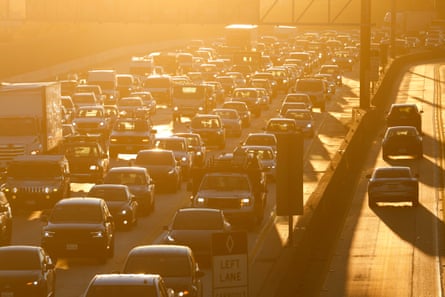
EPA actions during Trump’s second term are poised to sharply increase greenhouse gas emissions, experts warn. In its most audacious move of 2025, the agency proposed repealing the 2009 endangerment finding, the legal foundation for all federal climate regulations. Expected to be finalized soon, the rollback would effectively erase all federal climate rules at once.
EPA’s spokesperson defended the rollback, saying the finding “is the legal prerequisite used by the Obama and Biden administrations to justify trillions of dollars of greenhouse gas regulations”.
“The endangerment finding is the foundation for us to do anything about [the climate crisis], and they are going after that foundation with a sledgehammer,” said Tejada.
On the same day, Zeldin said he would move to repeal limits on carbon dioxide from vehicles. Transit is the largest source of greenhouse gas emissions in the US.
Last month, EPA also began the process of drastically weakening fuel economy requirements for new vehicles. And in the power sector, the agency is moving to gut or repeal rules on coal- and gas-fired power plants, which account for nearly a quarter of domestic greenhouse gas emissions.
The EPA spokesperson said the Energy Information Administration expects CO2 emissions to decrease by 16m tons under the Trump administration, while the economy will grow. Much larger cuts are needed, experts say.
In July, EPA also announced plans to delay the enforcement regulations on methane, a pollutant that is over 80 times more planet-heating than carbon dioxide.
Meanwhile, the Trump administration has also scrubbed climate-focused language from federal websites, including EPA’s, and shuttered offices responsible for climate research, including the Office of Research and Development and Office of Atmospheric Protection.
“The deregulatory action, the staff shrinkage, the reduction in research activities, all of these things add together,” said Olivia Guarna, a climate justice fellow at Columbia University’s Sabin Center for Climate Change Law. “It amounts to rolling back the ability for EPA to carry out its duties.”













Comments