
 German (DE)
  English (US)
  Spanish (ES)
  French (FR)
  Hindi (IN)
  Italian (IT)
  Russian (RU)
Anti-fascists in 2018 march near the site of a makeshift memorial where Heather Heyer was killed at the “Unite the Right” rally in Charlottesville, Virginia, the year before. Win McNamee via Getty Images
At a diner next to Seattle-Tacoma International Airport, five men took turns loudly saying a racial slur to prove they are bona fide members of Patriot Front, a white nationalist organization.
Sometime later, one of them returned, alone, with a $300 tip and a message for their server, a woman of color: “Those guys aren’t my friends.”
Politics: Pete Buttigieg Nails 2 ‘Very Rare’ Signs That Trump Administration Is ‘On The Back Foot’
The man, “Vincent,” was one of several “antifa” spies around the country who had gone undercover in fascist groups. Over several months, he worked out, hiked and camped with a group of committed white nationalists. He joined them as they dropped propaganda banners and vandalized public artwork depicting people of color.
Months later, in the middle of a nationwide Patriot Front video call, Vincent started playing a recording of “Bella Ciao,” the Italian anti-fascist anthem. “You guys really forgot to remove the antifa spy’s access?” he taunted them.
While embedded with Patriot Front, Vincent expropriated reams of previously unknown membership data and logistical information that allowed other anti-fascists, in anonymous collectives around the country, to “dox,” or publicly identify, the group’s members. These collectives vandalized extremists’ vehicles, alerted their neighbors and employers — and, step by step, worked to shrink their influence in American public life. Similar infiltrations have hit several neo-Nazi and white nationalist groups around the country over the years.
For years, the journalist — and former longtime HuffPost reporter — Christopher Mathias chronicled these efforts, cultivating sources from antifa groups across the country, verifying the information they gathered, and publicly outing cops, teachers and members of the military who led secret double lives as neo-Nazis and white power activists. (Mathias and I reported several stories together for HuffPost, including about Donald Trump’s fascism.)
Politics: Veteran Senator Destroys JD Vance After He Compares Her To Forrest Gump
Mathias’ new book, “To Catch a Fascist: The Fight to Expose the Radical Right,” takes readers behind the scenes of the fight to push back against the rising tide of fascism since Trump entered the political sphere over a decade ago.
Some may think the antifa movement is just about punching Nazis in the street, but as Mathias’ book explores, it’s about a lot more than that. It builds on generations of activists fighting for civil rights and pushing back against racial domination in the U.S. “To Catch A Fascist” takes a look back at this long history through today, as Trump’s second term delivers armed, masked federal agents to communities nationwide, stopping people at random because of their skin color and accents.
“Throughout history, when fascists wear masks, they do so in hopes of creating a world in which they won’t need masks at all,” Mathias told me this week. “I think it is an alarming and scary prospect to consider a world in which [Immigration and Customs Enforcement] agents feel comfortable not wearing masks.”
More observers than ever seem to be saying, “Yes, it’s fascism.” But Mathias and plenty of others have been saying that for a while. He spoke to HuffPost about antifa’s “fundamentally hopeful … struggle against impossible odds,” modern fascism, and what connects Minneapolis and Charlottesville, Virginia.
Politics: Melania Trump’s 1-Word Take On Her Husband Donald Trump Stuns Critics Online
This interview has been edited for length and clarity.
How do you think about the interplay between street-level fascist thugs committing violence and what it means for the most powerful government in history to be a fascist government?
Politics: Dems Eye Possible Deal On ICE Conduct, Freezing Temps Come For The South (Again): Live Updates
Reporting and researching this book made me completely rethink what fascism is and the way we talk about it. So much punditry over the last 10 years, during the Trump era, has revolved around this question: “Is it fascism? Could it happen here? Is it happening here?” And there was always this impulse to suggest that, “Once we reach a certain point, it’s fascism.” Once it’s analogous to Mussolini’s Italy or Hitler’s Germany, then we can call it fascism.
What’s really interesting from the militant anti-fascist perspective is that there’s not a certain threshold we cross before things become fascist. Throughout American history, fascism has been a fact of life for many people.
There is a mythology we tell ourselves as Americans that we defeated fascism in World War II. And obviously, yes, the U.S. Army — my grandfather was part of that — defeated the Nazis. But the U.S. Army was also a segregated army. It was a colonial army. And when Black soldiers fighting in segregated units returned to the United States, they returned to Jim Crow and, later, mass incarceration. If you were, for example, a Black man swept up in mass incarceration, unjustly incarcerated for years and years of your life, what is the material difference between that experience and the experience of living in a fascist state the way we talk about it, in Europe? I would argue that it’s kind of negligible — that is a fascist experience.
So this is basically my way of saying, I’m glad people are calling what’s happening now fascist. And I think what is happening now is an intensification of these underlying social arrangements, these underlying dynamics of domination, and making those dynamics more and more explicit.
Politics: FBI Raid In Georgia Highlights Trump's 2020 Election Obsession
One of the foremost scholars of fascism, Robert Paxton, initially decided not to call Trump a fascist when he came to power in 2016. After Jan. 6, 2021, he revised that assessment and declared Trump a fascist. Obviously we’re at a point now where — there are just so many elements that point to calling Trump a fascist. I mean, he’s threatening to invade Greenland, and he has a secret police force raiding people’s homes [without warrants]. So it’s pretty blatant by this point.
A lot of your book is a corrective of the use of the term “antifa” and particularly how it’s become an all-purpose bogeyman for Trump and the right. To them, “antifa” is an “outside agitator,” but also they’re destroying their own communities. They’re “super soldiers,” but they’re also feminine, blue-haired transgender socialists. Talk about that label “antifa” and how it became so useful for propaganda on the right. Is it to create a pretext to confront racial justice activists while armed?
Totally. What’s really important context is that no one in America knew what the **** antifa was before 2017.
And all the sudden, with Trump’s inauguration, you have Richard Spencer get punched in Washington, D.C. And then, as the far right is emboldened and mobilized across the country — in places like Berkeley and Gainesville and Lansing and Charlottesville, where Nazis felt like they could go on the street and make their presence known — all of a sudden there are these leftists, radical leftists, sometimes wearing all black, punching these Nazis. And these videos obviously go viral, and there’s a thousand explainers in the media about who these Nazi punchers are, and they are antifa.
[After the deadly “Unite the Right” rally in Charlottesville,] Merriam-Webster adds “antifa” to its dictionary, Oxford Dictionary short-lists “antifa” for its “word of the year.” That’s how, suddenly, the word became part of our lexicon, through this militancy. So most of the public associates antifa with just Nazi-punching. But in reality, that tactic — physical confrontation — represents a really tiny percentage of the work antifa does.
So in 2017, suddenly everyone knows who antifa is. And something really interesting happens after Charlottesville — when the right and MAGA finds itself on the defensive [because] Trump has called them “very fine people,” and it’s become obvious that this MAGA coalition includes Nazis, that these Nazis are very violent, and that they just killed someone in Charlottesville.
There is a pseudonymous pro-Trump troll called Microchip who starts a viral petition to the White House to designate antifa a domestic terror group. And Microchip gives this fascinating interview to Politico that’s incredibly frank and upfront about why he’s doing this. He knows that the White House can’t designate antifa a terror group because there’s no statute for that. That’s not the point. The point, as he puts it, is to set up antifa as a punching bag, and to distract and deflect from the right’s very real violence, and create this false equivalency where, “Yeah, we have our extremists, but look, the left has their extremists too!” Which is an absurd equivalence, of course. The far right has killed hundreds by this point over the previous couple decades, and antifa, at this point, hasn’t killed anyone.
And what happens throughout 2017, 2018, 2019 is, you have these far-right and MAGA influencers — guys like Jack Posobiec, Mike Cernovich, Andy Ngo and a lot of other people — who create conspiracy theories about antifa.
After nearly every mass shooting in America — even before America knew who the shooter was or what their motives were — they would rush to fill that information vacuum with baseless claims that the shooter was antifa. Even if later it proved that the shooter was actually a white supremacist, by that point, the waters have been muddied and people are confused.
Antifa gets blamed for natural disasters, for wildfires. There’s a rumor that antifa “super soldiers” are going to behead white parents. It’s absurd, and again, this is all to distract and deflect from the right’s escalating violence in America.

Like this article? Keep independent journalism alive. Support HuffPost.
[Eventually,] there’s a bit of a lull in the way the antifa bogeyman is used, but then in 2020 it’s repackaged as a response to the George Floyd uprisings. MAGA, Trump — they blame antifa for fomenting these mass, historic uprisings, which, again, is absurd. Yes, its practitioners did take part in the uprisings, but their numbers are so small that they would never have the power or organizing capacity to foment uprisings like that.
Moreover, those uprisings, as we know, were created and led by the communities that they were in, and they were Black-led uprisings. And that’s why MAGA and Trump blamed antifa for these uprisings in a big way — to distract from the very real grievance at the heart of the protest, which was for cops to stop murdering Black people.
It was also a tactic to sow division on the left — entangling the left in debates about tactics and so forth. The way they wield that label, they eventually start calling anyone they want antifa. And that’s just a way of designating someone as outside the realm of political respectability. When you do that, you are creating a pretext for that person to be targeted, either by state prosecution or by vigilante violence, which we saw a lot of in 2020.
Fast forward to 2025, Trump claims to designate antifa a domestic terror group — which, again, is an effort to label this burgeoning uprising against his agenda as outside the realm of political respectability and worth repressing.
Talk about the difference between “antifa” as a term and anti-fascist as an ideology or description.
When I say “antifa,” there is an important distinction to make. Antifa, yes, is just the shortening of the word “anti-fascist.” A lot of liberals and centrists will point to that fact as a way of saying, “Well, aren’t we all antifa?” It’s kind of a way of saying, “Antifa isn’t a real thing,” or that it doesn’t exist. But that’s not true. Antifa, as a word, refers to a very specific kind of militant radical tradition of combating the far right “by any means necessary.”
And when I talk about antifa, these are activists who practice a political tradition that believes in a few basic tenets: First, that, yes, sometimes fascists need to be confronted in the streets, sometimes violently. Fascists should be given no platform to speak or organize. That means revoking permits for them to speak in cities or parks, or de-platforming them from social media.
Another important tenet is that the state and law enforcement cannot be trusted in this fight. And that essentially means they view the government and law enforcement as inherently white institutions that will collaborate with and support fascists.
Antifa didn’t emerge out of nowhere. It emerged from preexisting networks of anarchists, socialists and communists — largely from a tradition born in the ’80s and ’90s to kick Nazis out of the punk scene, and the formations of groups like Anti-Racist Action and Skinheads Against Racial Prejudice, and they basically developed those tenets we talked about, those points of unity when combating the far right.
You mentioned that there’s a tendency to say, “Well, I’m anti-fascist, and my grandfather was anti-fascist in World War II.” But you get into the history of anti-fascists, of doxing fascists, in the book, and the history traces back well before either of those words existed — before doxing existed, before the word fascist existed. You go back to investigative journalist Ida B. Wells. You go back to Walter White, who investigated lynchings in the early 20th century for the NAACP. You go back to Frank Schwab — the mayor of Buffalo who revealed the identities of 18,500 people who were members of the KKK in the area, posting their names at the city’s police headquarters — and the undercover detectives who infiltrated the Klan. Why was it so important to you to get into that history of very specialized resistance to racial domination?
So Langston Hughes made this point. [“Negroes in America do not have to be told what fascism is in action. We know. Its theories of Nordic supremacy and economic suppression have long been realities to us,” Hughes said in 1937, at the Second International Writers Congress in Paris.]
What I find frustrating about the discourse about fascism in America, again, is this mythology we tell ourselves that we’re the good guys who defeated the fascism. Robert Paxton, the scholar of fascism I mentioned, has described the Klan as the proto-fascist organization, right? Nazi Germany looked to Jim Crow laws in America for inspiration for its own race laws in Germany. America, in many ways, was fascist before the word fascist existed.
What I found so compelling about efforts to unmask the First and Second Klans was, first, just how insanely brave that work was — people really putting their bodies on the line.
Edward Obertean, an undercover police officer who infiltrated the Klan in Buffalo, was murdered afterwards by a Klan member.
The history of white supremacy in America is marked by periods where its most ardent practitioners wore masks, and periods when they didn’t need to.
The First Klan is born to destroy Reconstruction. There’s an amazing effort to unmask them, and it’s successful in a lot of ways in destroying the Klan. But part of the reason that Klan dissolves is also because they were successful. They could trade the anonymity of the hood for the anonymity of the lynch mob.
The Second Klan, same kind of thing — an amazing effort to unmask them that goes a long way in destroying the Second Klan. But again, they were also dissolved, in a way, because they were successful. The 1924 immigration law is passed, the Johnson-Reed Act — and Johnson, the congressman, by the way, was in the Klan — and created these immigration quotas, which, incidentally, are the quotas that restrict immigration to Northern Europe, and is kind of what the modern far-right, including Stephen Miller, wants to go back to.
For me, it was really important to tell those stories, because I actually find them really inspiring. The people doing this work didn’t wait on anyone to save them. They understood that we have to save ourselves, and they didn’t always get to see the fruit of their work. The work they did would contribute to later victories.
You talk a lot about antifa’s work as modern-day journalists. In my opinion, the anonymous collectives that comprise your description of antifa are some of the most skilled journalists working in the country today. That might be a surprise to readers, but to folks who have covered the “extremism” beat, they know. I mean, how many of your own stories that were published in HuffPost stemmed from that sort of work? Reading your book, it was striking to me how much projects like “Panic! In the Discord” or “Ignite The Right” sound like “The Panama Papers” — that is, collectives of journalists working together on a large project. Talk about the skill of these folks as journalists, and whether you think they get their due.
No, I don’t think they get their due. There is still this presiding snobbery in journalism that says you have to write for this outlet or that outlet to be considered a journalist. There’s also what I would consider an antiquated notion of objectivity around journalism that says that people doing the type of research that antifa does couldn’t possibly be journalists. I push back against that in the book and am upfront in the intro about the fact I, myself, subscribe to militant anti-fascism.
I do not think that objectivity exists or that there is a “view from nowhere” to report on masked secret police abducting my neighbors. And that is the perspective that antifa also takes. And if we are to consider journalism, first and foremost, to be in the public interest and for the public good, then I think journalism should be explicitly anti-fascist. The investigations that antifa did over the last 10 years were absolutely remarkable sometimes. I talked to one anti-fascist who read through 60,000 tweets to collect enough little morsels and clues and bread crumbs to unravel a Nazi’s identity.
You compared the leaks of Nazi chat messages to The Panama Papers, which is a really apt description. It goes grossly underappreciated that Unicorn Riot, the independent news outlet, created an absolutely remarkable database for leaked white supremacist chat messages — millions and millions of these messages that were open-source material that anti-fascist researchers across the country could mine and look through to figure out who among their neighbors is a Nazi. And that’s a remarkable story and a remarkable feat of journalism.
Talk about the source relationships that you have with anti-fascists. I take it you’ve been talking to some of these folks, unnamed sources of yours, for a decade, or at least many years. How did those source relationships develop over the years, and how have they changed you as a reporter?
It took a long time to gain the trust of anti-fascist sources. They are, understandably, wary of the press. And also, I take their trust in me very seriously, because there are fascists out there that want to harm them. So it’s important for me to protect their identities. And, of course, the state also wants to target antifa, so it adds an extra level [of concern].
But yes, I’ve been talking to so many people for upwards of a decade now. For the book, I ended up talking to about 60. What is most striking for me is that almost everyone involved in this work started doing it after personal brushes with fascists in their communities.
One anti-fascist I talked to a lot, her friend lost someone in the El Paso Walmart massacre, which inspired her to start doing this work.
One of the things that prompted me to do this book was seeing them do that work — neither for glory or acclaim — and also seeing diminishing returns when they were doing the doxes; for a while there, they were getting Nazis fired from their jobs and there was real accountability. But then, something started to shift, and occasionally there were towns where they didn’t care that they had a Nazi as a neighbor. And so I started to talk to anti-fascists about what that meant for American politics in general.
You spoke about inciting incidents for people to get involved in this work. You were at “Unite The Right” in Charlottesville in 2017. You saw DeAndre Harris being beaten. Can you talk about that as an inciting incident for a lot of journalists of the far right and the effect it had on you?
Anyone who was in Charlottesville on Aug. 12, 2017, had their lives irrevocably changed afterward. For me, it was the beginning of this long kind of reporting journey into this new, insurgent fascist movement — and then, eventually, into the anti-fascist opposition. But more generally — on a visceral, emotional level — when you see, up close, that kind of vile racism and bigotry so comfortable with itself in public, you start to realize how urgent the need is to fight back against it.
Especially in reporting this, I had a front-row seat to seeing how what we considered fringe in our politics actually wasn’t that fringe at all, and that the Republican Party was becoming the party of the Nazis that marched in Charlottesville. So, it’s just a radicalizing process. There’s no way around it.
What would you say to folks in Minneapolis today, who, I think you would argue, are looking at a different form of fascist violence, a traumatic sort of street violence, except this time it’s performed by the federal government?
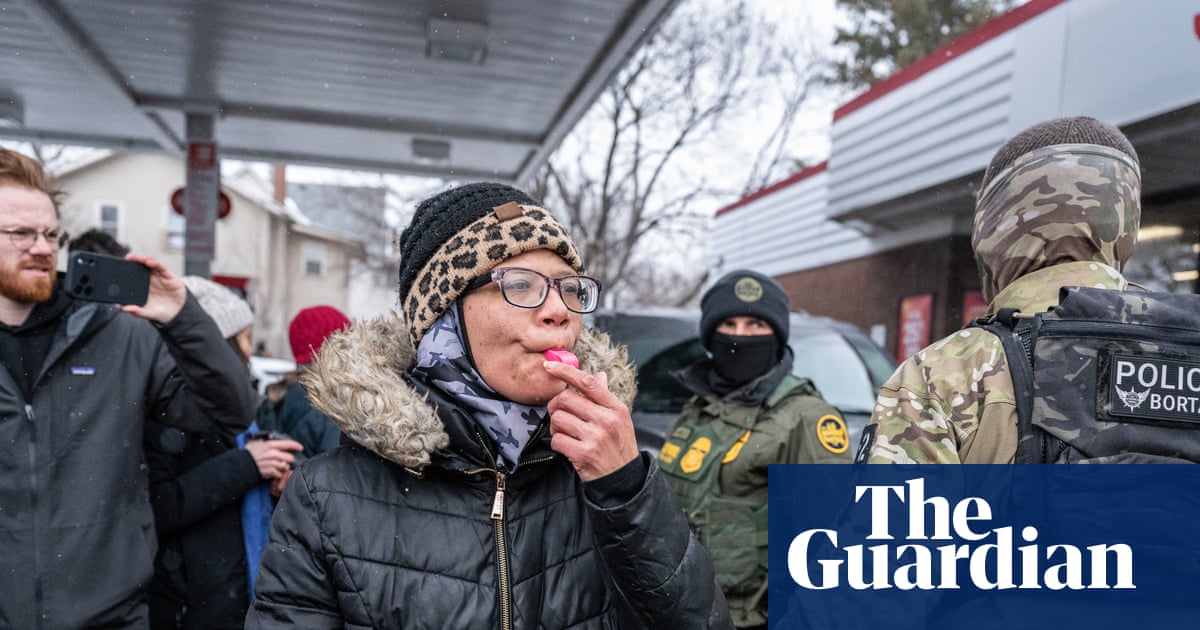
I cannot stop thinking about the similarities between the uprising against ICE in Minneapolis and the uprising against all the fascists that were taking to the streets in 2017 through 2020. They’re embracing the same organic, grassroots tactics that are not dependent on law enforcement or the government, which, in Minneapolis, has kind of abandoned them. They have to do this on their own.
And they’re doing all the stuff that anti-fascists were doing to Nazis a few years ago — which was following them, monitoring them, identifying them, doxing them, pressuring businesses and hotels not to host them. They’re doing noise demonstrations outside of hotels. They are creating a social cost for being in ICE, for being part of the secret police, for being part of la migra, which is really heartening and really remarkable and really brave, and the similarities are really striking.
You talked to an ex-member of Patriot Front in the last chapter of this book, and he essentially laid out the argument for doxing. He explained that when people think of Patriot Front, “the first thing they think is, ‘If I join Patriot Front, I will be doxed.’” On the other hand, he noted, once unmasked, fascists sometimes dive further into those communities as a support network.
There is also the question of, what happens when the social stigma around white supremacy is gone? Given the strength of fascism in America today, given its position inside the U.S. government, if antifa 10 years ago saw what was going to happen, do you think there would have been a change in tactic? How are these tactics changing now?
There’s this debate over whether antifa was successful. Because, obviously, they destroyed all these fascist groups. But of course, now, we have a much broader mass fascist movement, MAGA. It’s an interesting question, and I don’t have a clear answer.
But what antifa does at the local level is an insurgent form of community self-defense, and it was an urgent, pressing political tactic — or style of politics — that prevented Nazis from being comfortable in specific places, the streets. And in that way, it was really successful.
But you also have to remember, antifa is an incredibly small subculture — a small phenomenon or movement. It would never have had the members to stop what is happening now. That said, like I was saying with Minneapolis, we are seeing an adaptation of militant anti-fascist tactics on a bigger scale.
I personally think that those kinds of tactics, if replicated on a big enough basis, could be really effective. And I’ll say that there’s a reason MAGA — Kristi Noem, Trump — are so scared of efforts to dox ICE agents. And that’s in part because MAGA saw what doxing did to the alt-right. And doxing, again, is dependent on leveraging a societal taboo against explicit white supremacy. And I think doxing, identifying ICE agents, for example, is an important part of creating and maintaining a taboo against being in ICE.
I think it will be important now to let people in ICE know that they are the Nazis in this movie, and that in a generation, they will be depicted as villains in the movies their kids watch. We are already seeing public opinion turning against ICE. [A YouGov poll taken the day immigration agents fatally shot Alex Pretti in Minneapolis showed 19% of Republicans and 46% of American adults overall indicating support for abolishing ICE.] That is remarkable.
I quote an anti-fascist in the book saying that anti-fascism is fundamentally hopeful, that it’s a struggle against impossible odds. And I find that example of anti-fascists over the last few years, actually, very inspiring for this fascist moment that we’re in right now.











Comments