
 German (DE)
  English (US)
  Spanish (ES)
  French (FR)
  Hindi (IN)
  Italian (IT)
  Russian (RU)
  2 weeks ago
Nick TriggleHealth correspondent

 Getty Images
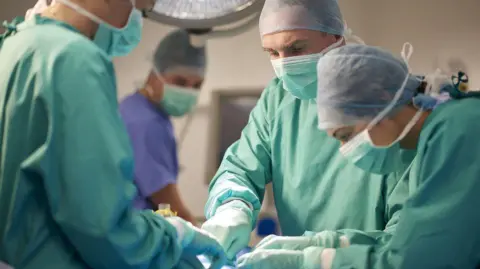
The hospital waiting list in England has dropped to its lowest level in nearly three years.
At the end of December 2025 there were 7.29 million patients waiting for treatments such as knee and hip operations. That is the lowest number since February 2023.
But NHS England's monthly update shows continued long waits in A&E, including a record number of 12-hour trolley waits.
More than 71,500 patients spent longer than 12 hours in January 2026 waiting for a bed on the ward once they had been assessed by A&E staff – the highest figure since it started being tracked in 2010.
It means nearly one in five patients who were admitted after attending A&E waited that long.
Health Secretary Wes Streeting said while there had been good progress, there were some big challenges to overcome.
"There is much more to do. We've got to pick up the pace...but the NHS is on the road to recovery."
Dr Vicky Price, of the Society for Acute Medicine, said it was clear hospitals were operating beyond safe levels when it comes to emergency care.
"These are people unwell enough to need admission, often older and frail with complex needs, who are at the greatest risk of harm when care is being delivered in corridors and hospitals are operating beyond safe limits."
Duncan Burton, Chief Nursing Officer for England, praised the progress being made on reducing waits, pointing out this had happened during a period when the NHS had to cope with strikes by resident doctors, the new name for junior doctors.
He said it was a "triumph" for the hard work of staff.
But while the waiting list did drop, performance against the 18-week target declined slightly. Some 61.5% of patients were waiting less than 18 weeks - compared to 61.8% in November. The target is 92%, which the government has promised to meet again by 2029.
Rory Deighton, of the NHS Confederation, which represents hospitals, said the progress was welcome, but added it masked "a wide degree of regional variation".
Deighton said: "The NHS is not one homogenous body, but is made up of hundreds of separate organisations each with their own distinct financial and operational challenges.
"This means that tackling care backlogs will be more difficult in some parts of the country than others."













Comments